


As researchers and organizers, often we have to take time off from research to do very important organizing. Though it is good to know for knowledge sake, research is only as valuable as its application ultimately.
In anticipation of a national and thorough report on how academics have supplied the genocide of Palestine, we have come to realize it is valuable to write on case studies of research-mercenaries who have professorship titles. The national report is to be featured soon in a prominent investigative outlet so stay tuned.
In the meantime we will begin chunking up our work by treating one academic at a time.
Our first case is that of magnetometers. Magnetometers are magnetic-field sensors. Electronic devices are constantly putting out electro-magnetic signals and those signals can be somewhat unique, somewhat like a signature. Magnetometers do precisely that, they sense magnetic signals.
The next question is how would such a mundane application be so lucrative for military use?
It turns out quite.
Modern warfare has accelerated with the advent of electronics particularly just before and after WW2. Explosives and bullets may take the most prominent foreground in our minds but the future of warfare relies on the refinement of accuracy; not for the sake of ethics but for snuffing out of key figures like Anas Al-Sharif. The following schematic shows you just how important electronics are to warfare.
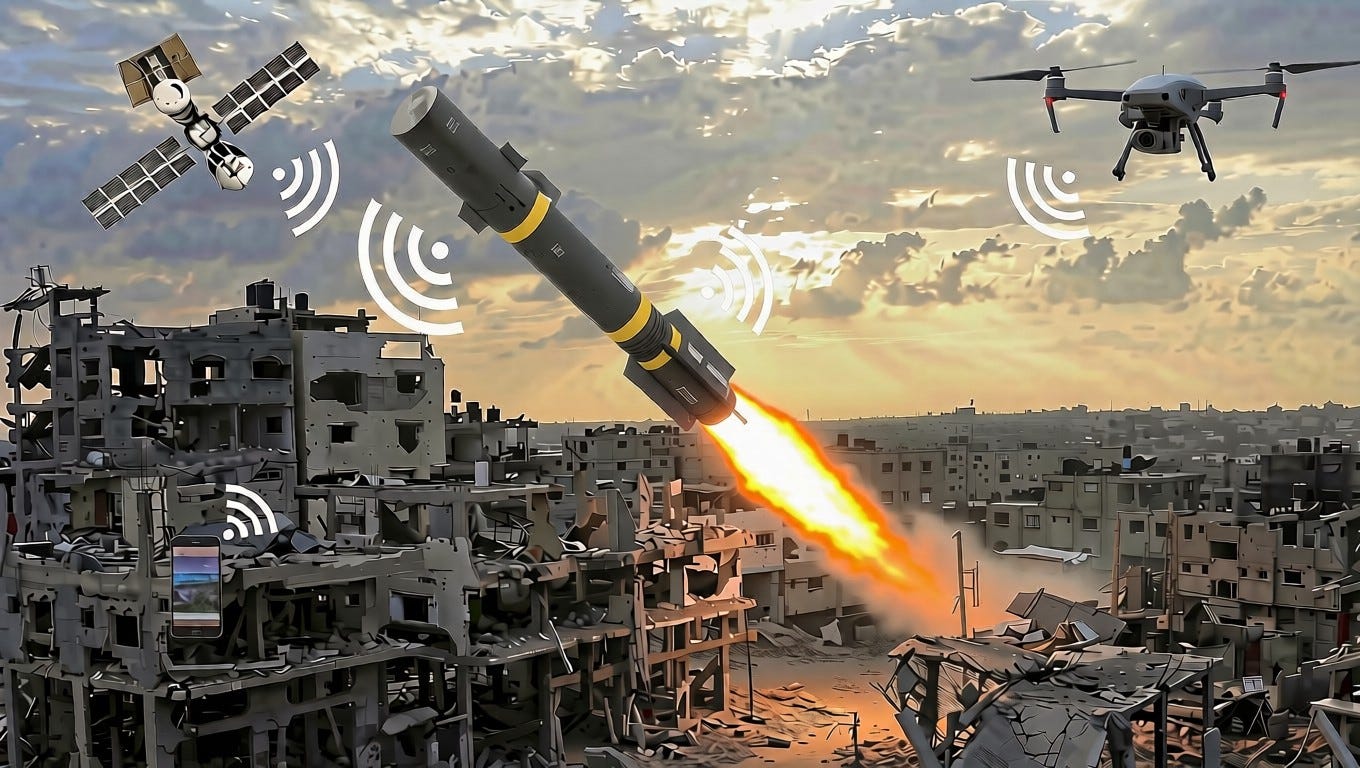
The image shows a hellfire missile, a satellite, a drone and a cell-phone. All of them put out signals to communicate with each other and/or to sense each other. Sometimes electronic stealth, such as that of MQ-9 reaper drones, is desired but that is a nuance at this stage.
As a result of the presence of all these signals, warfare can be quite complicated. How does a device find the other devices it needs to communicate with? How does it check it is friend or foe? Can it communicated in an encrypted manner? Is there a way for an enemy to jam the spectrum of frequencies to prevent such communications? That kind of jamming is very valuable as it can allow an adversary to prevent a drone, which was receiving guidance signals from a satellite, from receiving further instructions and therefore incapacitate it.
That kind of jamming is partly what we see the modern military discussing mitigations of. In other words “how do we make sure our weapons are more efficient, autonomous, resilient and effective?”. This is what has been on the D.o.D.’s mind for the last 10 years and is in large part the reason for the enormous drive behind the A.I. race, partly jump-started by Bob Work and Eric Schmidt’s N.S.C.A.I. report.
So what does that have to do with academics? Naturally, where the forefront of technology is, so are academics and their research. Enter Michael Romalis in the department of physics at Princeton.
In 2003, him and a graduate student of his Thomas Kornack wrote a paper titled “A subfemtotesla multichannel atomic magnetometer“, in which they were able to develop a highly sensitive magnetometer. It was able to sense changes in the ambient magnetic field to a precision of .5 femtotesla (5*10^-16 tesla). For reference the Earth’s very very weak magnetic field is anywhere from 25-65 microtesla (2.5-6.5*10^-5 tesla). What’s important to understand is that these are orders of magnitude apart.
What implications would that have? For one, we can tell based off of what the federal government has contracted Twinleaf for. Twinleaf is the company that Kornack then went on to found after graduating from Princeton. A full S.B.I.R. contract list can be found here.
A few of the key applications are GPS-free navigation. GPS requires that a device interacts with a satellite for guidance. In military operations where jamming is a form of electronic warfare, to make electronic devices still able to navigate the environment, such a magnetometer would be extremely useful for drone navigation so that even when GPS is jammed, a drone can still guide itself using the magnetic field of the Earth as a compass.
That’s not the only application. Remember that magnetometers can sense all sorts of magnetic fields.
Those same magnetometers could be incorporated to seek out and target submarine for example by detecting the signals that they may put out. We can see that the Navy contracted them for this kind of work.
Drone warfare requires that drones be highly expendable. And the cheaper its components the better. That’s exposed pretty thoroughly by the irregular warfare in which Iran’s cheap Shahed drones are out-competing the onerously expensive Patriot missiles. Twinleaf’s magnetometers are relatively cheap and quite effective.
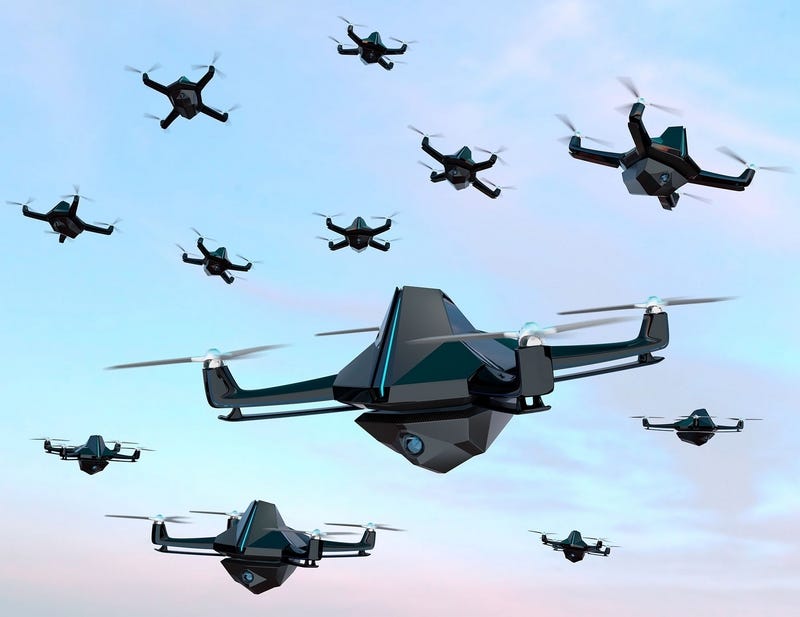
To comment on a last application of Romalis’ magnetometers, we can also see how it could be used for modulating drone swarms. Think of a swarm of drones, like a flock of birds, they have to prevent themselves from colliding and becoming a tangled mess. In order to do that, magnetometers can help drones sense each other. When the magnetic field becomes too strong then that tells the drones to put a little more distance between themselves.
Romalis with Kornack and Twinleaf own the patent for these magnetometers and variants of them. We can see very evidently the military interest. That is further exposed by our findings from last year. We had found that the research group received about $500k from the Israeli Ministry of Defense between the years of 2015 and 2019 from A-133 audits or O.M.B. Guidance reports. Typically whenever one sees a financing of about $500k that indicates that a Ph.D. was financed as that is about the amount that it requires. What Romalis was financed for is unclear, in part it may have been to further conduct research, but it is also possible that he may have also been a consultant in part.
Twinleaf and Princeton University over the last few years have exchanged millions of dollars in federal grants in the meantime.
Further evidence shows that one of his patents was foundational to the technology developed by the Israeli weapons manufacturer RAFAEL in 2008. Their own patent helps to refine the technology developed by Romalis which could be used for all the aforementioned technologies and more.
It is quite possible that the technology of Romalis was relevant in Gaza since 2021. Indeed an article publication by weapons manufacturer Booz Allen Hamilton states that: “Israel’s victory over Hamas in 2021 was the first war to be won via the asymmetric advantage provided by AI, and the conflict in Gaza that started in 2023 continues to be characterized by AI as well as information warfare in the cognitive domain... Israel became the first country to use true drone swarms, deploying them in its 2021 conflict with Gaza, and is arguably the global leader in this technology because of their implementation of Elbit Systems’ Legion-X, a modular, heterogeneous, multi-domain C2 swarm system.” [-]. In other words the use of drone swarms in Gaza has been prevalent.
Romalis as a case study shows how American research-mercenaries, financed by the Israeli Ministry of Defense are surrounded by strong circumstantial evidence of having contributed, directly or in-directly, to genocide by the literal flow of hard-ware from the labs in which these components are invented to the companies that are founded as a result and the continuing research of these labs.
Academics surrounded by such strong evidence should be open to further investigation and potentially to their resigning entirely. We will soon pull bill of lading data to further investigate if Twinleaf LLC has directly supplied the Israeli Ministry of Defense.
Greetings. Thank you for the important analysis. I am David Cortright, longtime peace activist and currently a visiting scholar at Cornell University. Do you specific information about any military technical contracts at Cornell related to the Israeli military sector? Thanks.