


Summary: Despite its appearance as a university dedicated to the humanities, Princeton University, both as an institution and as a group of individuals, maintains streams of funding and productions of research that in part rely on contracts and subcontracts that either directly involve private defense contractors and foreign governments or are explicit in their applications to war. Explicitly, research groups at the university have accepted funding from the Israel Ministry of Defense, taken funding from and collaborated with Lockheed Martin, Raytheon, Peraton, Exxon and more, or have developed military applications all on their own. These associations demonstrate the university’s standing as a warring institution linked to documented human rights violations in regions like Sudan and Palestine [via the U.S. government and Lockheed/Exxon/Raytheon/etc.’s sales to Israel and the U.A.E.]. This article explores the plethora of types of contracts, funding, collaborations and start-ups associated with the university. Worrisome and unethical applications range from development of missiles to cyber-security and invasive AI algorithms [without even considering the serious impacts of each of these companies on climate change]. In addition, the embedding and normalization of funding sources from institutions that carry out extremist American policies [i.e. carry a big stick, de-escalation via escalation/proliferation] within the academic research environment signifies the complicity of Princeton University in the international affairs and foreign policies of nations. Therefore, it’s implicated in the global arms trade and the broader proliferative tech industry which raises serious and critical ethical concerns on the relation of human rights on campuses to human rights off campuses.
Click to see all data in this report
With an endowment in excess of $34 billion [-], Princeton, possessing the highest endowment per capita of any university, is the richest in the world, but most of the university’s investments are not available freely to the public. In spite of the university’s lack of transparency of its endowment investments, an investigation by Rahma at Ethics.vc in support of Princeton Israeli Apartheid Divest group revealed that the university had several investments in defense contractors. These include, as of 2022, direct holdings in TransDigm Group and indirect holdings in Firestorm [via 645 Ventures] as well as Howmet Aerospace [via Farallon Capital] [-]. Recent data provided to the author by Rahma have revealed additionally that Princeton has investments, as of 2022, in Vannevar Labs Inc., another defense contractor specializing in digital intelligence. Yet investments are only one way in which universities can participate in the reinforcement of the defense industry. The financial mass it has accumulated allows the university to function like a corporation and lobby Congress and state/local governments as well as donate to political campaigns.
In Washington D.C., Princeton University has its own Office of Government Affairs [O.G.A.] [-]. It houses employees who carry out its lobbying efforts. Amongst its current employees are Julie Groeninger, Aaron McClendon and David Bagby. Julie Groeninger, current Assistant Vice President of O.G.A., prior to their employment at Princeton was a legislative and staff assistant to Senators Carl Levin and Frank R. Lautenberg. Groeninger has now taken up the mantle of their predecessor, Joyce Rechtschaffen, who occupied the same position since 2006. David Bagby, Director of O.G.A., and Aaron McClendon, Assistant Director of O.G.A., also had prior experiences within the halls of Congress. The O.G.A. reports to the vice president of communications at Princeton University, Gadi Dechter. Dechter served in the Obama administration’s White House National Economic Council and National Security Council.
At the behest of Princeton University leadership, O.G.A. lobbies both in the House of Representatives and the Senate. These lobbying efforts either influence policy for its own sake or can yield federal grants and awards. As of the latest data up to this past October, the university has lobbied $330k in the year 2024 alone. Prior to that, it lobbied $490k in 2023 [-]. In 2022, 2021, 2020 and 2019, the respective lobbying sums were $430k, $400k, $360k and $520k. Universities collectively lobby millions each year including $76m in 2024 [-]. For context, a for-profit institution such as UnitedHealth group with a 2024 revenue of $400b, lobbies in Congress with an approximate yearly $7m [-].
Amongst the bills that it lobbies is the yearly Department of Defense [D.o.D.] budget titled ‘The Department of Defense Appropriations Act’. Every year, the House of Representatives in Congress drafts and votes to grant $800-900b of tax-payer money to the military, tech companies as well as universities. Half of these $8-900b are spent on “contracts for products and services” [-]. This includes the production of vaccines, communication systems, transportation methods, weapons and basic research. In FY 2023, $182b of defense contracts was given to the following top ten companies: Lockheed Martin [$61.4b], RTX/Raytheon [$24.1b], General Dynamics [$22.9b], Boeing [$20.1b], Northrop Grumman [$16.3b], Huntington Ingalls [$7.8b], Humana [$7.5b, health insurer], L3Harris [$7b], B.A.E. Systems [$7b] and Cencora [$4.4b, health insurer]. Arms sales from Lockheed Martin to the U.A.E. or from Raytheon to the Saudi government have been linked to the genocide and violation of human rights in Yemen and Sudan [-] [-]. In addition, sales to Israel by the Biden administration have been inextricably linked to the ongoing genocide of Palestinians [-] [-]. Among the $400-430b, the D.o.D. contracts out around $8.03b to universities. Out of these $8.03b, Princeton’s lobbying yields it a share of direct contracts with the Department of Defense as well as federal funding in the form of grants, federal awards, fellowships etc.
To give concrete evidence, in 2024, Groeninger, McClendon and Bagby lobbied for the 2025 D.o.D. Appropriations Act [H.R.8774] to ensure research funding and federal awards from the Department of Defense to Princeton, including from sub-agencies like Minerva and Defense Advanced Research Projects Agency [D.A.R.P.A.] [-] [-]. D.A.R.P.A. was created by the Eisenhower administration during the Cold War as a response to the Soviet’s Sputnik 1 with the goal of developing technologies to maintain U.S. military power. While D.A.R.P.A.’s main interests lie in research projects related to military applications, its scope is wide and not every project funded by D.A.R.P.A. has direct military relevance.
Direct contracts of Princeton’s have involved producing assays for ebola detection [$3.7m HDTRA116C0025 -] as well as studies of modeling insurgency and counter-insurgency [$85.6k N6227112M1017 -] and the production of geolocation algorithms [$500k W15P7T08CP603 -] and modernizing computer hardware/software systems [$300k FA865008C7851 -].
In 2003, Jeremy Kasdin of the Mechanical and Aerospace Engineering department published work with Pini Gurfil, at Israel Institute of Technology, on the U.S. Missile Defense Agency contract MST-02-C-0001 [-]. The work focused on improving target-estimation for guiding missiles.
In 2019, D.A.R.P.A. funded the project “Physics of Artificial Intelligence” to the tune of $1m [-]. The goal of the project is to “apply “Third Wave” AI technologies to sparse data and adversarial spoofing, and that incorporate domain-relevant knowledge through generative contextual and explanatory models.”. The D.o.D. has expressed their intent to integrate this research in their informatic systems. On the grant, Robert Kosut, Vice President of Systems and Control for defense contractor S.C. Solutions and former visiting researcher at Princeton is mentioned as a frequent contributor [-] [-] [-]. While at Princeton, Kosut collaborated with other Princeton researchers and others at Sandia National Laboratories, a government facility that is managed by private corporations. Until 2016, it was managed by Lockheed Martin but it is now under the direction of Honeywell [-]. The work was done on optimization and control algorithms for the purposes of quantum computing.
In another more recent example, with Office of Naval Research funding, Princeton and MIT collaborated on the creation of a surveillance tool that allows monitoring of underwater signals from airborne sensors [-].
Research grants, in which the government is more hands-on, often fall into the category of Cooperative Agreements and are typically closer to applications. These can include cyber-security applications [$1,511,740 FA87501220295 -], mass data analysis [$1.8m FA87501420009 -], novel computer chip architectures [$643,652 FA87501220296 - -] and machine learning for combustion [$450,000 W911NF1920127 - -].
One notable cooperative agreement [N6227112M1017 -] on foreign diplomacy is held by U.S. Navy veteran Professor Jacob N. Shapiro, via the “Empirical Studies of Conflict Project” (E.S.O.C.) and has received funding directly from the D.o.D. under a project titled “Influence, Manipulation, and Information Threats as Adversarial Techniques: Events, Evolution, and Effects” [-]. E.S.O.C. is also in part led by I.D.F. veteran Eli Berman at UC Berkeley. Shapiro is also Special Adviser to the Office of the Director of National Intelligence, which was established in 2004 as a result of the “Intelligence Reform and Terrorism Prevent Act” [-]. They have jointly published a book “Small Wars, Big Data” on modernizing warfare and “building an information-centric understanding of insurgencies”[-]. Their research appears to include the study of response patterns of “radical and religious violent groups” which they categorize Hamas as. Berman, for example, has studied best policy practices for Israel to implement in order to lead to the least violent equilibrium. No where in the articles is there any mention of apartheid or occupation. His 2024 article concludes: “Major operations by Israel are shown to achieve deterrence by denial, reducing the violence of the resulting equilibrium by shifting the Gazan response curve to less violence.”. [-] [-]. It appears, therefore, to be a purely reductionist “scientific” analysis of a political problem without consideration of context or history. Shapiro has also studied militant groups from the lens of terrorism.
At times however, the federal government allows for sub-contracting in which an institution or company that earns a federal award may elect to employ another institution or company on the same contract. Within this context, sub-contracting or sub-awarding are known as federal pass-through programs. Via these pass-through programs, American universities including Princeton do a large part of business and collaboration with private defense contractors. On average, Princeton receives a yearly $30m from the D.o.D. in research funding of which about $4-6m come in via pass-through programs [-]. The amounts are made publicly available on usaspending.gov as well as O.M.B. Uniform Guidance reports [formerly known as A-133 audits], and are collected by other organizations such as techinquiry.org. Often, there is significant discrepancy between funding reported by Princeton through O.M.B. Uniform Guidance reports and usaspending.gov, with the University’s totals often being significantly lower than the U.S.A. Spending’s data, suggesting significant under-reporting by Princeton or overreporting to the government of funds either way. Regardless of the sums, the reporting of pass-through programs show relationships between universities and other institutions, be they other universities or private industry [-] [-] [-] [-] [-] [-] [-] [-] [-] [-] [-] [-] [-].
The following data is mostly taken from Princeton’s own A-133 audit reports written by PWC over the last 12 years, unless a sub-award was found via USA Spending [which syncs with fpds.gov on a nightly basis] and did not appear in the A-133 audit reports. Furthermore, the majority of the funds are via D.o.D. pass-through programs with some exceptions of a few D.o.E. and N.A.S.A. contracts. For example, Lockheed Martin, whose current C.E.O. is Princeton alum James Taiclet [along with its former C.E.O. Norman R. Augustine], sub-contracted Princeton University for at least $655,000-800,636 of work done in the form of service items and research over the last 12 years [-] [-]. S.R.I. International likewise sub-contracted $3,561,679 over the same time period. RTX/Raytheon passed on $1,329,100, I.B.M.: $2,477,451, Bascom Hunter: $174,559, Honeywell: $113,752, B.A.E. Systems: $659,500, D.E. Technologies: $100k, Battelle: over $1m, MetroLaser: $596k, H.R.L. Laboratories: $4,576,182, Universal Technology Corp: $445k, Twinleaf LLC [a company borne out of Princeton University]: $558,333, Siemens: $985k, Northrop Grumman: $566,463, AIMdyn Inc.: $279,312, L.G.S. Innovations and C.A.C.I.: $900k, Teledyne: $20k, and Peraton/TT Govt Solutions/Vencore/Perspecta/A.P. Science Comms: over $8.2m. Solutions Through Innovative Tech, via fellowships and other items, has contracted Princeton about $1.7m [-] and S.C. Solutions on a D.o.E. contract [DE-SC0020618 -] sub-contracted Princeton about $626k. This list is by no means exhaustive but all these pass-through payments have either originated from the D.o.D. or defense contractors who are often contracted by the D.o.D.. The range of projects is vast from applications within physics to those in biology and funding both theoretical and experimental programs. Given this wide range, only a select few will be mentioned.
This relationship via sub-contracts fosters collaborations between Princeton and researchers at defense contractors. At times large collaborations with significant government funding on in-flight spectroscopy even bring together competitors like Raytheon/RTX, Lockheed Martin and Northrop Grumman [-]. Similarly, a great deal of interest in quantum algorithms and computers regularly brings about collaborations with I.B.M., in this instance with the Tureci group including with a Princeton alum who went to Raytheon [-]. In other studies, Princeton researchers from the Smits and Arnold groups collaborated with Lockheed Martin on nano-scale sensors [-]. Machine learning applications have also brought about a collaboration between the Poor group and Northrop Grumman [-].
In addition, a D.o.D. sub-agency named Defense Security Cooperation Agency [D.S.C.A.] can help to facilitate grants from foreign nations including their respective D.o.D.’s [-]. Amongst such programs is D.S.C.A. 1000366232, which helped to facilitate an Israeli Ministry of Defense [I.M.o.D.] grant to researchers at Princeton. Though a grant number is not listed, it is highly likely that this funding went towards the Romalis group [-]. The sum-total was about $520,004, enough to fund an entire Ph.D.. Given nearly identical author lists it is highly likely that a few other papers were published that took funding from this grant [-]. The Romalis group at Princeton, with authors on similar articles researching magnetometry [meaning the detection of magnetic fields for imaging/navigation purposes], has also worked with Twinleaf LLC [-]. Twinleaf LLC, a “Princeton startup”, was in part founded by Thomas Kornack, a former graduate student of the Romalis group [-]. Twinleaf LLC has been sub-contracted by B.A.E. Systems and S.R.I. International in addition to being contracted by the Navy for $1.3m to produce magnetometers for the navigation of U.A.V.s/drones [N0001414C0214 Mod. P00001 -] [-].
At times as well, Princeton may subcontract the defense industry as well via pass-through programs. Over the course of the last 10 years and on several projects, Princeton transferred to Lockheed Martin $438,366 of tax-payer money via D.o.D. pass through-programs [N6600112C4203 & N652361211006 - -]. Likewise, in 2013, I.B.M. received $1,839,729 [N660011114110 -]. These sums contribute to the ~$400b given directly from the Pentagon to the defense contracting industry. Princeton also gave $2,836,524 of tax-payer money to its own start-up Twinleaf LLC [-] [FA86501317326 & W911NF1310034 & FA86501617673 - - -]. Though separate from the D.o.D., Princeton also notably passed along $5,203,170 to defense-tech giant Northrop Grumman via a N.A.S.A. pass-through program [NNG17FC93C -] and $331,584 to L3Harris [NNG17FC93C -].
However, Princeton, as a private institution may choose to directly correspond with private industries and individuals. Exxon Mobil over the last 5 years, has sponsored Princeton to the tune of $7,322,088 whereas B.P. Intl. has given $9,263,500 and Shell Oil has given $394,801 [-] [-] [-] [-] [-] [-]. All three fossil fuel companies are contributing to Israeli occupation’s genocide by providing key and necessary fuel supplies for jets [-] [-]. At least one laboratory can be identified in receiving Exxon funds including the Ju lab in Mechanical and Aerospace Engineering in 2023 [-]. The work was also funded by the D.o.D. [W911NF1920127 -] and D.o.E. [DE-SC0021135 -]. The Ju lab focuses on researching combustion phenomena. Chevron has also sponsored $156,498 in research at Princeton.
In addition, Lockheed Martin has sponsored $35,602 and General Dynamics sponsored $124,950 over the last 5 years. Their correspondence with defense contractors goes much further back and includes a 2011 collaboration on photonics with Princeton’s Paul Prucnal [-] [-] and a 2006 study of Prucnal’s in support of Lockheed Martin’s operations [-]: “We designed and built a highly scalable incoherent optical CDMA testbed for Lockheed Martin as a novel platform for testing different avionics applications.”. Prucnal’s correspondence with Lockheed Martin on photonics was still active as of 2022 [-]. In addition to Lockheed, Prucnal also has an on-going industry collaboration with L3 Harris [-]. There are also current collaborations with RTX/Raytheon on new semiconductors [HR00112490463 -] led by the Element Six of DeBeers jewelry corporation [-]. The aim is to utilize polycrystalline diamond wafers to produce silicon chips and semiconductors. Raytheon and Princeton’s collaborations also go further back via collaborations on other computer architectures [-] [-]. These lists are by no means exhaustive of these defense contracting collaborations [-] [-].
Within the software sector, Microsoft has sponsored $40k, Google sponsored $221,485 and Amazon founder Jeff Bezos has sponsored $73,132 [-] [-] [-]. It is possible that some amount of the funds from Microsoft may have been put to use with Jacob N. Shapiro’s Empirical Studies Of Conflict project to develop tools for detecting misinformation online [-].
Defense tech company and Raytheon collaborator C3.AI has sponsored $657,045 [-]. C3.AI was founded by former Princeton Board of Trustee member and benefactor Thomas Siebel. Funds went to Mengdi Wang, Matthew Desmond, Stefana Parascho, Corina Tarnita, H. Vincent Poor [-] and Simon Levin [-]. Their funded projects were formally concerned with the development of artificial intelligence for responses to pandemics. Some of the research can easily be weaponized. For example, in one case the goal was to create a “crowd management” tool: “a computational tool that utilizes machine learning to predict people’s movement and provides suggestions for adapting existing spaces through local physical interventions”. C3.AI has since utilized A.I. algorithms for purposes of surveillance and defense. With respect to surveillance, it has created an intelligence suite which is being marketed to the Department of Homeland Security and federal law enforcement agencies. It has also produced a software program to help interpret Palantir’s software output. A competitor, Palantir, with a similar intelligence software program has serviced the Immigration and Customs Enforcement [I.C.E.] agency [-] [-]. During this past summer, I.C.E. raided local Princeton communities, without self-identifying as law enforcement, which is illegal [-]. The un-identified enforcers focused on the Hispanic community. Local organizing by immigrant labor organization, La Resistencia remains vigilant. Tangentially, Palantir has an unofficial pipeline of students from Princeton [-] [-] [-] [-] [-]. With respect to defense, C3.AI has been contracted by Raytheon/RTX to implement A.I. into the US Army’s Tactical Intelligence Targeting Access Node [T.I.T.A.N. - -]. Palantir and Anduril have also been competitively contracted on T.I.T.A.N. [-]. C3.AI has additionally been contracted to apply A.I. to aircraft such as the F-35 [-]. It has recently acquired a new contract to work with Booz Allen Hamilton as well [47QFCA21F0018 P139524-5] [-].
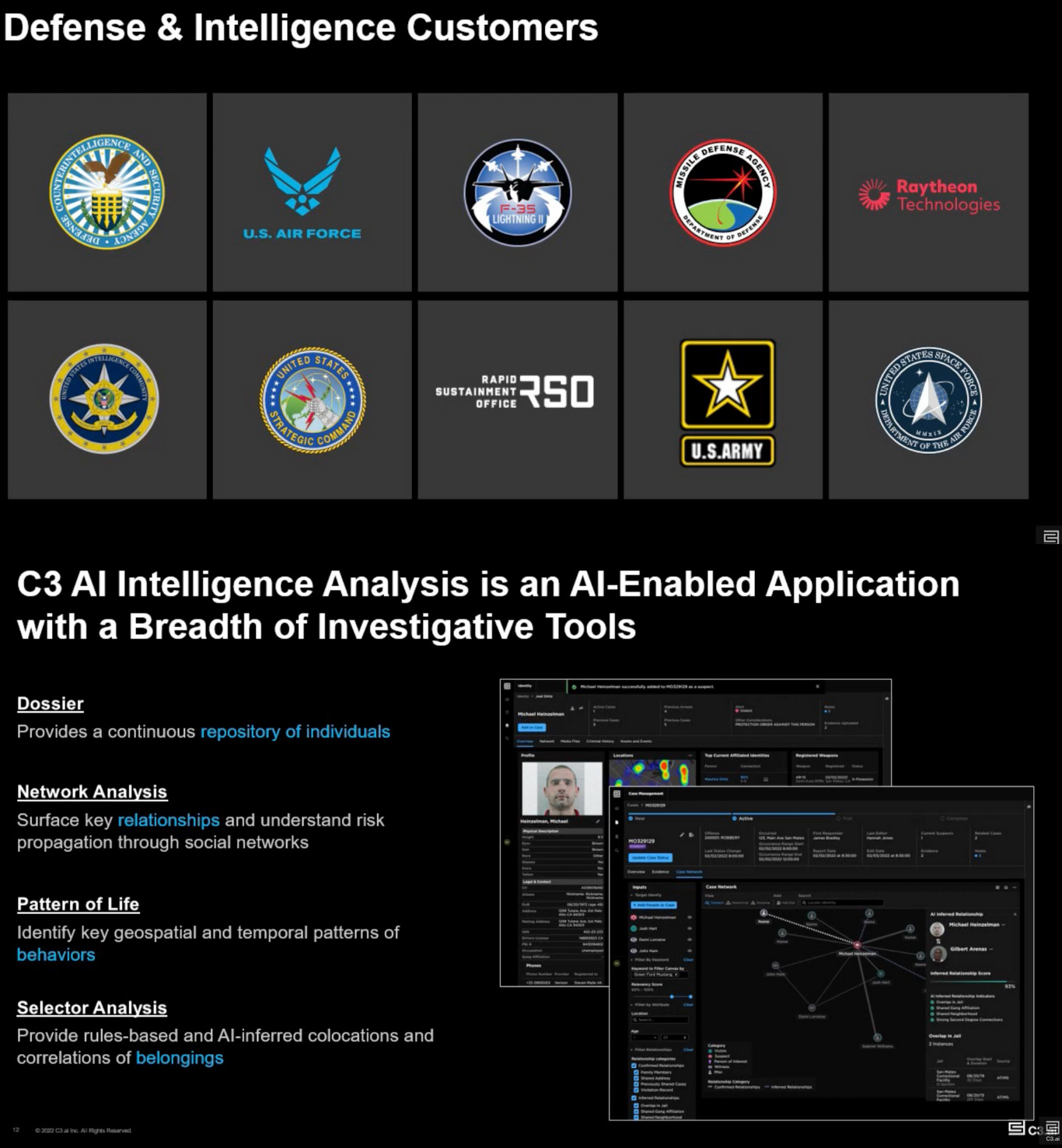
A presentation by C3.AI showing their Defense & Intelligence Suite [-]. As can be seen, the tracking of individuals is one of the purposes of their algorithms.
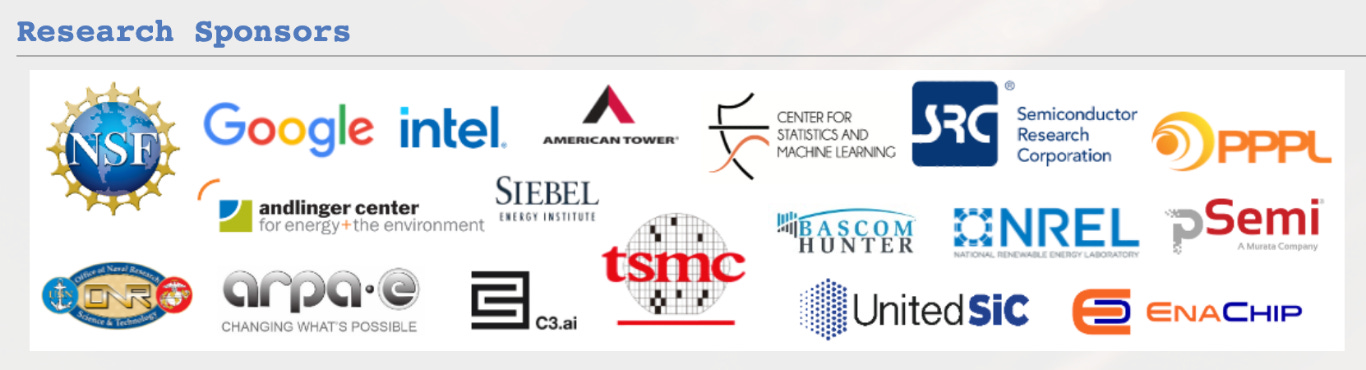
Chen Lab’s Research Sponsors as listed on Chen’s website.
Minjie Chen’s laboratory in the electrical engineering department has also received funding or collaborated with C3.AI along with Bascom Hunter. The two major semi-conductor manufacturers, T.S.M.C. and Intel sponsor Chen’s lab [-] [-]. In addition, though not a defense contractor, Semiconductor Research Corporation [S.R.C.] has also sponsored Chen’s lab; S.R.C. runs a program called the Joint University Microelectronic Program [J.U.M.P.] which aims to provide cutting edge scientific findings to the defense sector [S.R.C. has sponsored $4,404,269 of research at Princeton] [-]. pSemi has sponsored $304,198 [including the Chen lab] at Princeton and Siemens, which also has a student collaboration initiative at Princeton, has sponsored $1,057,164 [-] [-] [-].
I.B.M. has also sponsored $141,671 of research funds [-]. In addition to this, I.B.M. has a special relationship with Princeton via the I.B.M. Quantum Initiative [-]. In this partnership, Princeton and IBM maintain a research relationship as well as undergraduate summer research internships. Furthermore, Intel Corp. has sponsored $2,154,504 of research. The on-going research with Intel involves Kai Li and Sebastian Seung on topics within deep learning [-]. Via the electrical engineering department, Intel also has an affiliate undergraduate research internship [-]. Dean of engineering sciences, Andrea J. Goldsmith, also occupies a position on Intel’s board of directors. The company is not only a defense contractor but also makes up a huge portion of Israel’s economy [1.75%] and has crucial research and manufacturing facilities within the country [-] [-].
Goldsmith is also on the board of directors of Encharge A.I., a Princeton start up led by Naveen Verma of the electrical engineering department [-]. His company has also received a large $18m D.A.R.P.A. grant as well as funding from RTX/Raytheon. As per Verma’s own statements to the Financial Post: Encharge AI was ”born out of the support of D.A.R.P.A. and the D.o.D…. Even as we were spinning out, D.A.R.P.A. was helpful in getting us our first investors.”. The significance of the company for the military AI market and the reason for D.A.R.P.A.’s and the D.o.D.’s support is summarized in an excerpt of the Financial Post’s: “In addition to the mounting demands of private companies, the US government also has pressing needs for fast chips, Verma said. For example, the ability to run military applications of A.I. where power is limited, like in remote regions and aboard aircraft, is an increasingly critical defense requirement.” [-].
The process of how research can evolve towards a startup is not clearly defined at Princeton. Most likely, this depends on initiatives of professors combined with incidental circumstances. Regardless, Princeton regularly hosts industry representatives whether via invited talks or to directly listen and correspond with professors and administration.
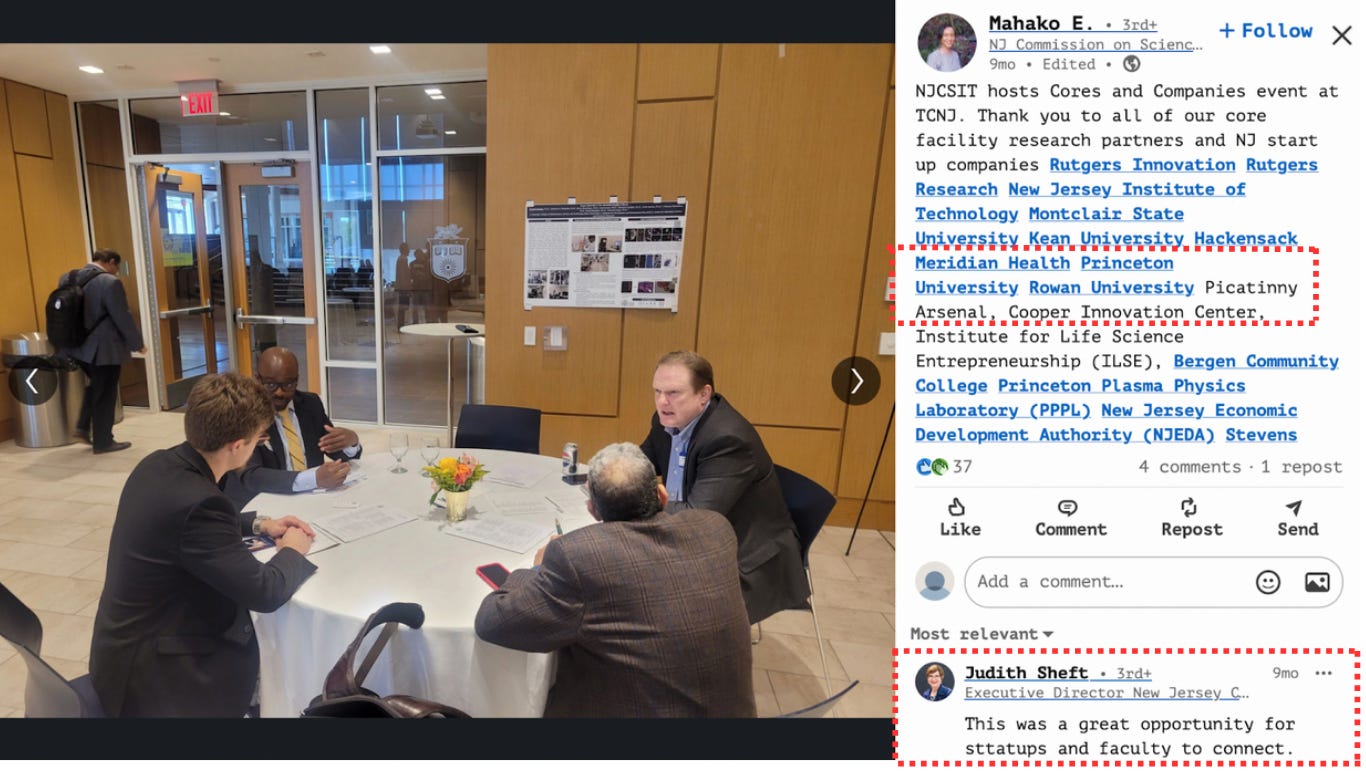
A congregation of researchers from Princeton and Picatinny hosted by Judith Sheft.
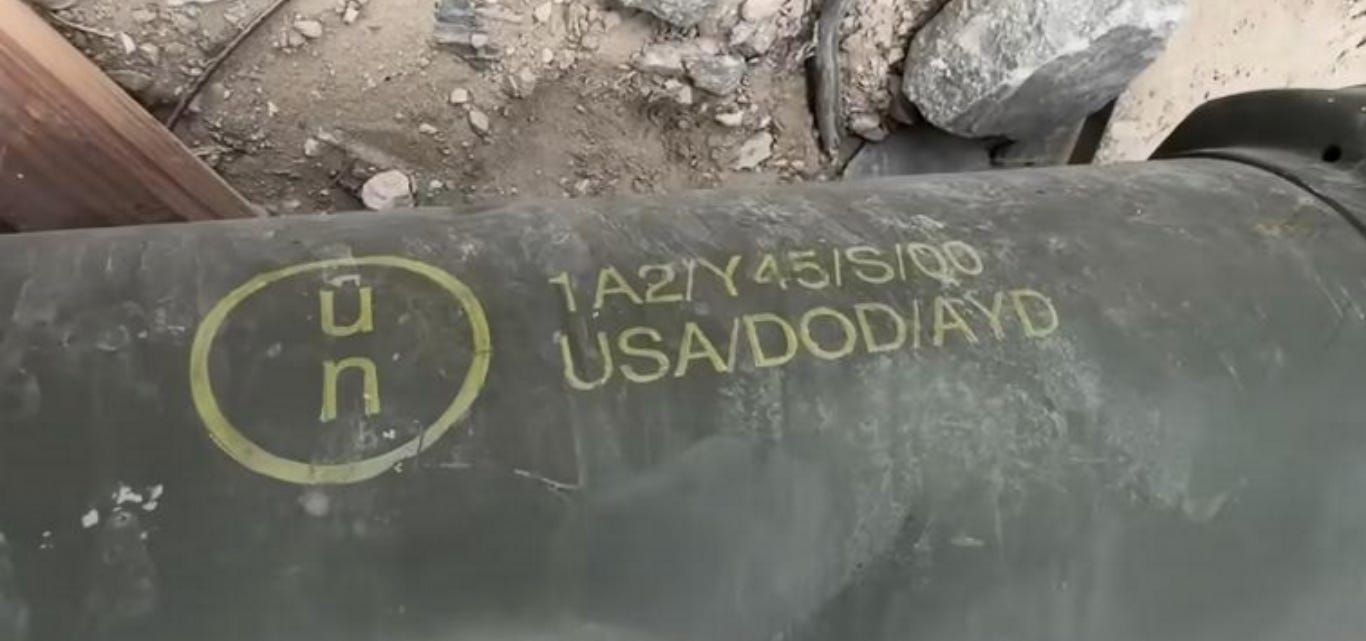
A photograph of a warhead in Gaza as documented by Al Jazeera. The code signifies that it was made in 2000 at Picatinny Arsenal, NJ, USA. [-] [-] [-].
Among other efforts for finding applications and increasing collaboration, Princeton’s Office of Innovations management includes New Jersey Commission on Science, Innovation and Technology [N.J.C.S.I.T.] executive director Judith Sheft [-]. Sheft hosts a bi-monthly meeting that allows N.J. university researchers, including Princeton’s, to correspond with industry and government, including Picatinny Arsenal. Picatinny Arsenal, among other activities, produces weapons, some of which have been used in Gaza. N.J. Business Magazine documented the following excerpt: “We’ll say to them: ‘Here’s a company that’s looking for [a particular type] of support,’” Sheft says. “‘Who has equipment that can help this company with a project?’” [-].
Princeton University’s and Picatinny Arsenal’s more intense correspondence in sharing knowledge, supplies and research goes back further and includes a 2016 agreement for the easy transfer of research and knowledge on energy efficiency [-].
In a nascent attempt to start up a new industry, Princeton has taken up a cross industry, government agency and university research initiative in collaboration with defense contractors like C.A.C.I., S.R.I. and Teledyne to develop new photonics technologies [-] [-]. It is named Advancing Photonics Technologies and is headed by Craig Arnold, Christine Galib, Sacha Patera, Jatanie T. Jonas, Alison Coakley, Spencer Reynolds and yet again Judith Sheft. Reynolds is a Princeton alum and the New Jersey Regional Engagement Principal for the US Department of Defense National Security Innovation Network [N.S.I.N.] and Regional Engagement Principal at Princeton.
In fact, another important player in military-relevant research programs is N.S.I.N., which focuses on investment in specific technologies, startups, and research projects. This amounts to programs on campus that provide researchers with direct access to Department of Defense assets as well as consultation and training. Given that N.S.I.N.’s mission statement is “Human Innovation Capital.”, the normalization of relationships with undergraduates could be considered a goal of the organization. The university joined in 2022 [-]. The stated aim of N.S.I.N., run by alumnus Spencer Reynolds under Princeton’s Office of Innovation, is the cultivation of talent for military contracting research and encouraging students to create startups with N.S.I.N. funding post-graduation. In one project, for example, Princeton students helped reduce the cost of repairs for B-1B bombers by $500k with a 3D printing solution method. N.S.I.N. is a subdivision of the Defense Innovation Unit X (D.I.U.x.) which is a venture-capital branch of the D.o.D.. D.I.U.x, was founded in 2016 by then-Defense Secretary Ash Carter who hand-picked Christopher Kirchhoff and Princeton alumnus and air force veteran Raj Shah. D.I.U.x. also works with C3.AI [-]. In 2022, Princeton also joined the Air Force regional research hub, another organisation which aims to increase collaboration between academia and military research.
Many researchers at Princeton also collaborate with Sandia National Labs, which is operated by Honeywell [and until 2016, operated by Lockheed Martin]. Largely it is the combustion/plasma groups in Mechanical and Aerospace Engineering and Physics and Astrophysical Sciences, Chemistry and the sensors/cyber groups in Electrical Engineering [-] [-] [-] [-] [-].

1 Palmer Square, Princeton, NJ is home to Princeton University’s Google DeepMind AI Lab. Photo obtained from Google Street Maps.
Though not necessarily or completely for military applications, another notable office space is the Google DeepMind A.I. lab at Princeton University [-]. It was opened in 2019 with ex-Google C.E.O. and Princeton alum Eric Schmidt and N.J. governor Phil Murphy. The significance of the lab is that Google DeepMind has military contracts both with the U.S. and Israeli governments [-]. Google also contracts cloud services to the Israeli occupation via Project Nimbus [-]. Whether Princeton has contributed directly to Google’s services abroad and for ethically questionable applications requires further investigation. Google has competed to sell its A.I. services to Israel, and its employees have requested further access to A.I. technology for the I.D.F. [-]. Much of what is studied at the lab are algorithms for autonomous behavior and navigation. On the website it states that they “have collaborations throughout Google US, India, Israel and Europe”. In addition, director of the lab, Elad Hazan and co-director, a former member of Unit 8200 and Princeton and Google employee, Yoram Singer have published several articles together [-] [-] [-] [-]. The 2018 article on Princeton’s website states: “This is a view of the main entrance to the lab, which will be led by Princeton computer science professors Elad Hazan and Yoram Singer.” [-]. Unit 8200 is a cyber-security/surveillance branch of the Israeli military, analogous to the U.S. government’s N.S.A., known for privacy violations.
To conclude, these details are only a sliver of the network of researchers, administrative employees and their activities at Princeton. Further investigation into large cross-university projects is necessary. For example, a large project between UPenn, Carnegie Mellon, Colorado School of Mines, DevCom Army Research Laboratory, George Mason University, Princeton and many others, is the Autonomous Resilient Cognitives Heterogeneous Swarms project [A.R.C.H.E.S.] [-]. The aim is to be able to create swarms of drones, each performing a particular task, which will be in large part for the purposes of warfare. Dhruv Shah is the representative from Princeton on the project [-]. More research into such projects would yield a very real glimpse into the further collaborations between industry, government and academia.
But ultimately, with what has already been shown, each detail helps construct a baffling simultaneity. More precisely, the coexistence of two worlds: one that is violent, exterior and of the “others” and one of apparently peaceful and civilized and collaborative polity. Meanwhile the technological developments originate in the latter and too often appear in the former; therefore signifying that violence is quite literally exported to the “others”. And the “others” need not be far either, as they can be the local immigrant community. This report maintains that the polity and “civilized” amiability maintained on campuses has neutered any necessary and difficult discourse for the monitoring of ethical standards. Ethical regulations and deliberations within the sciences are abysmal if not absent. Not all applications of studies that have emerged from the research at Princeton will lead to weapons or unethical ends. However, in a society where the means of production, both of arms and software, is centralized between Silicon Valley and the military industrial complex with a lack of political accountability, scientific discoveries are further centralized and primarily utilized by the state [policy studies are naturally utilized by states and thus need not require mention]. There is a glaring need for unionized bodies that govern and determine the ethics of studies and the ethics of new technologies or new applications of existing ones in order that university officials take responsibility and enact justified moral standards rather than deferring to those of governments.
A publication by Booz Allen Hamilton documents: “Israel’s victory over Hamas in 2021 was the first war to be won via the asymmetric advantage provided by AI, and the conflict in Gaza that started in 2023 continues to be characterized by AI as well as information warfare in the cognitive domain... Israel became the first country to use true drone swarms, deploying them in its 2021 conflict with Gaza, and is arguably the global leader in this technology because of their implementation of Elbit Systems’ Legion-X, a modular, heterogeneous, multi-domain C2 swarm system.” [-].
In addition, the application of A.I. in the battlefield has already occurred in Palestine. According to a +972 report [-], Israel has implemented three pieces of A.I. based software, “Lavender”, “Where’s Daddy” and “The Gospel”, to automate killings carried out by drones with no oversight. These programs have a substantial error rate, with high gratuity for suspected militant to civilian ratios. Other surveillance companies that have been used in the campaign against Gaza have been documented by SurveillanceWatch and include, but are not limited to: Ability, Inc; Airbotics; Anyvision; Assac Networks; Better Tomorrow; Blue Wolf; Briefcam; Camero; Cellebrite; Cortica; Digital Clues; Dream Security; Elbit Industries; Elsight; Evron System Ltd; G4S; General Robotics; I-Soon; Israel Aerospace Industries; Madeye AI; Magal Security Systems; MER Group; NSO Group; OOSTO; Palantir; Q Cyber Technologies SARL; QinetiQ; Red Wolf; Roboteam; Robotican; Shield AI; TKH group N.V.; The Gospel; UAV tactical systems Ltd; Videotec; White Wolf; XTend [-][-].
The development and use of these technologies is a trend. So much so that even on November 7th of 2023, Lt. Colonel Mike Benitez, “Director of Product” at Shield AI, which was used in Palestine, came to speak at Princeton [-]. In addition, Raj Shah of Shield Capital, who has strong associations with facilitating the product relationship between Shield AI and the D.o.D., came to speak this past fall as well [-] [-] [-].
Such autonomous drone systems do not have human oversight and therefore equates to a lack of accountability. Artificial intelligence is enabling the drone killings that occurred in Afghanistan, leaked by Manning and Assange, to be melded with giant repositories of data of the kind the N.S.A. and Unit 8200 have collected, as was leaked by Snowden. The U.S. government and its associate defense contractors funded and oversaw these developments, including, as evidenced, drone programs in Ukraine [-]. It will be the aim of these entities to replicate and advance such technologies and academics on American campuses will only enable it if they make no uncomfortable shifts of mindset, engagement or funding. And make no mistake, these tools have been and will further be turned inward. We have seen a dramatic rise of drone sightings being tested around military sites and while the D.o.D. has confirmed them and stated they do not know the operators of these drones, but do not assume it to be a national security risk, this response remains unconvincing given the contrasting melt down the government had last year about a straying Chinese balloon [-] [-]. Not only has there been a rise of these drone sightings in N.J., but they have been explicitly used against students on campuses [yielding another example of how repressive technologies are deployed against whatever group is deemed as “other”]. The most prominent example is Yale Police Department’s use of Skydio drones and anti-terrorism tactics against the student body it is intended to protect [-].
While there is no single individual that is solely responsible for this current ethical and moral failing, it remains a serious issue to tackle both on an individual and institutional level. Self-defeatist retorts that the status quo has always been so and can thus never change are not only unconvincing but also goes counter to any analytic attitude and scientific method. Such self-defeatism avoids facing an ethical and moral issue that lends itself to fundamentally libertarian values by giving free reins, including a free pass on ethical accountability and regulation, to the scientific and academic community, when in fact most of the dollars that fund their work is that of tax-payers.
02/06/25