


DropSite covered our national article which is being drafted into a full report. In the meantime, we will continue showcasing persons who took Israeli Ministry of Defense or Elbit Systems funding. We will also examine individuals who have collaborating with RAFAEL or I.A.I..
It may be news to some, but Elbit and Customs and Border Protection are long-time collaborators.
Back in 2023, Elbit won a contract with C.B.P. that was worth $1.8B for a “counter-intrusion” system consisting of surveillance towers [1 -]. In fact, this contract followed a $145M contract in 2014 for the concept of a “virtual wall” [2 -]. These surveillance towers are being installed in an attempt to patch failures to seal off the southern border with iron and steel. Elbit markets its system as a “Next-Gen” border [3 -].
On their website it states:
“1000+ miles US Southern Border at risk“
“200 miles currently protected by Elbit America IFTs [Integrated Fixed Towers]”
The company has installed over 50 such video surveillance towers. In fact, one of these Elbit towers is installed on Cochise County Community College [4 —]. The weapons manufacturer has also provided the Department of Homeland Security and C.B.P. with Hermes 450 drones [5 -]. CodePink has done a great deal of activism around this in North Dakota where the drones are tested [6 -].
Meanwhile in Palestine, Elbit has helped to create automated defense turrets with camera-mounted guns [7 -]. The project is estimated to cost $50M. In the midst of a global destabilization occurring as a result of climate change and poor diplomatic capacities, Elbit has experienced a backlog on its orders worth $32B [8 -].
But the parallel between what goes on at the southern border and along the borders of Gaza is worth digging into more as well. How do automated surveillance systems work?
A paper published by Haoran Wei and Nasser Kehtarnavaz at the University of Texas at Dallas uses a neural network (A.I. or machine learning) to process images collected by Elbit from “far field” video surveillance [9 -]. Nasser is the Erik Jonsson Distinguished Professor at U.T. Dallas and the editor-in-chief of the Journal of Real-Time Image Processing owned by Springer. Prior positions Kehtarnavaz held were as a visiting scientist at AT&T Bell Labs in 1984, at US Army TACOM Research Lab in 1995 and at Texas Instruments in 2001. Meanwhile Haoran Wei is a research engineer at Rivian and Volkswagen Group Technologies. Their joint paper, which was published in 2019, quotes a publication mentioning “The video surveillance market is currently valued at more than $35 billion and is estimated to grow to more than $65 billion in five years“. The data they used in the study consisted of “A dataset of far field video clips was made available for this work by the company Elbit Systems of America. The dataset consists of 32 video clips at 30 frames per second.“.
The “far field” aspect of the video surveillance signifies “the use of high-power lenses to enable monitoring at distances that are three to five miles away.”. In other words, these are extremely powerful surveillance capacities that Elbit has developed.
In addition, Elbit markets its equipment as being “battle-tested” or “combat-proven” [10 -]. The intended application for militarizing borders is explicitly stated by Wei and Kehtarnavaz following excerpt:
“The application of interest here for far field video surveillance involves monitoring borders from a far distance for illegal crossing or activities. More specifically, the application of interest involves monitoring borders from a far distance in order to detect persons and to identify the load they carry. The loads of interest include drug bundles and long arms.“
A.I. as most people know it comes in the form of a large-language model that does pattern recognition of text. The type of A.I. they used in this study is known as a convolutional neural network and in not so many words, works better for image processing. The aim of the study was to develop a very fast and effective convolutional neural network that, from low-resolution images, could distinguish between people who carried “bundles” or “long arms”. Those kinds of findings can then be expanded in applications by Elbit.
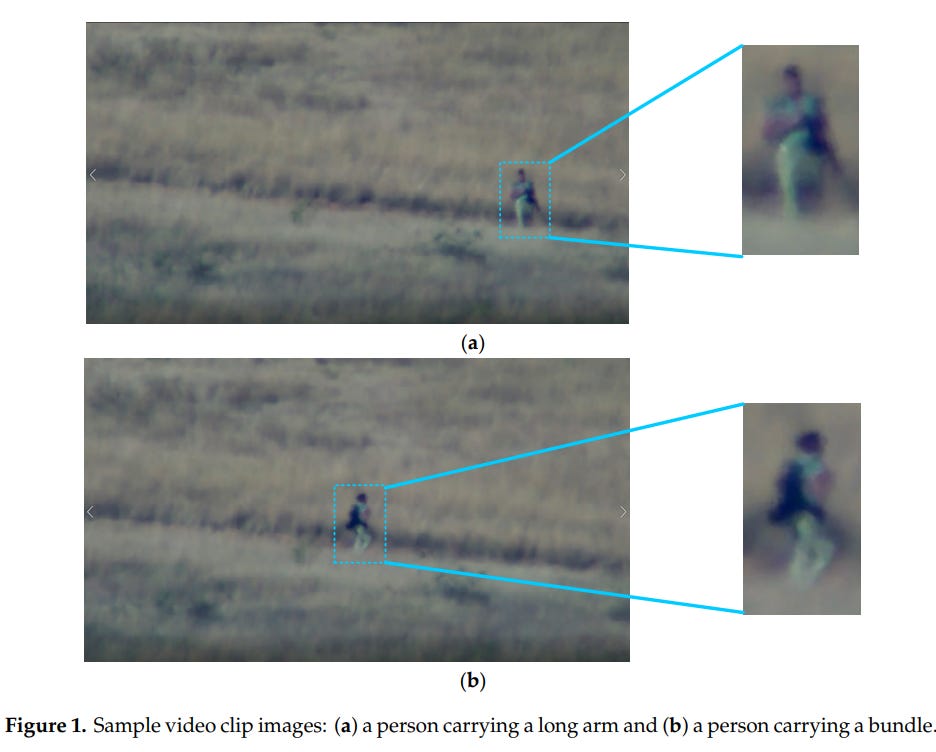
In the acknowledgements of the paper, it states “This work was funded by Elbit Systems of America through a contract with the University of Texas at Dallas.“. The Anti-War Initiative [A.W.I.] was, as of yet, unable to find a trace of these fiscal ties between the university and Elbit. Whether Elbit is registered as a foreign entity consistently or not in the United States is also unclear and would change the legal parameters of how public its funding must be.
From state audit documents, A.W.I. was able to find Elbit paying tuition valued at $514.5K between 2023 and 2025 to the University of Tennessee Knoxville [11 - 12 - 13 -]. This disclosure occurred as a result of Tennessee’s foreign disclosure law. A.W.I. was also able to find internal presentation documents of U.C.F.’s Mubarak Shah, a researcher at the Center for Research in Computer Vision, which cite $200K in funding from Elbit and provided them to The Nation [14 -]. Below we show a screenshot of the presentation that we found:
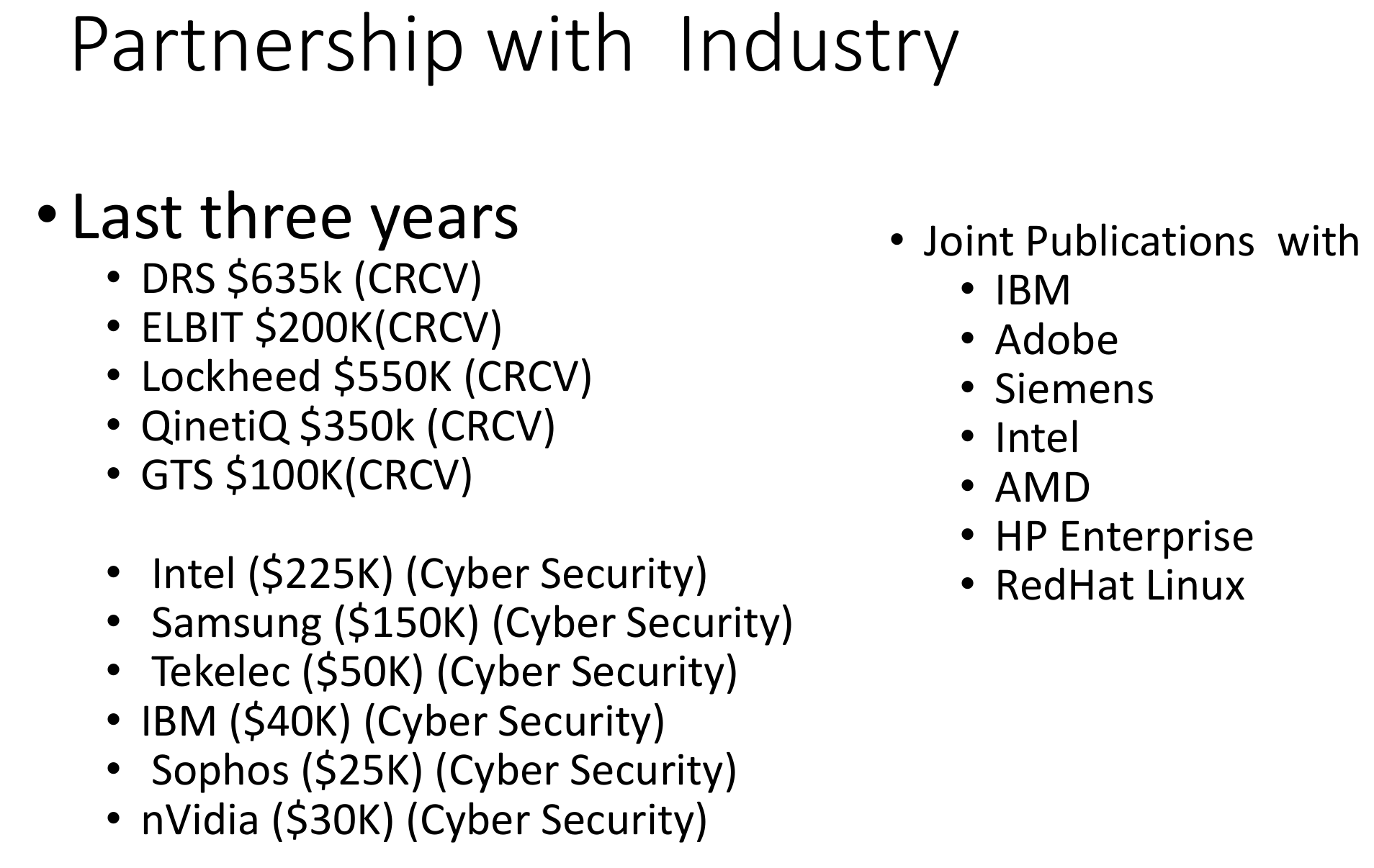
However, A.W.I. could not find a fiscal trace again. What studies were financed at U.C.F. and U.T. Knoxville are currently being investigated.
Turning back to Wei and Kehtarnavaz, though it is unclear whether their algorithm for image recognition was ultimately implemented or used as a stepping stone for a more powerful or efficient algorithm, their algorithm certainly helped to inform Elbit Systems’ video-surveillance A.I., whether here in the U.S. or in Palestine. Palestinian journalist Mohammed Mhawish captures how surveillance is used on the ground in Gaza:
“Surveillance allowed Israel to manage Gaza remotely and comprehensively. Intelligence sources and prior investigations describe systems that mapped neighborhoods, tracked social and familial networks, and analyzed behavioral patterns. Control did not require soldiers on every street, only access to required sensors, databases, and algorithms capable of rendering the population legible from afar.“ [15 -].
In Gaza specifically, this has been documented [16 -]:
“A new AI system will also be deployed along the border of the Strip, which will remain sealed within an automated perimeter in which anyone detected in the area is classified as a “target” by machine logic.“.
Far-field video surveillance further enables that type of management from afar. With automated turrets and and extensive surveillance capabilities, the Israeli state can further insulate itself from the violence its hardware carries out; thereby making war more akin to a capitalist purchase.
Elbit has contracts with militarized forces far beyond the Middle East and the U.S.-Mexico border. In fact, DropSite recently documented a sales pitch of Israel to the U.A.E. for surveillance drones [17 -]. The U.A.E. has purchased Elbit’s weapons systems by the billions [18 -]. Sudan is currently experiencing a genocide at the hands of U.A.E.-backed R.S.F. forces [19 -]. Elbit has been accused of supplying drones that are fueling the genocide in Sudan [20 -]. To only mention a few, Elbit also has contracts with police in Colombia to utilize the Target360 intelligence platform [21 -]. Other applications of its surveillance technologies have been seen in Brazil’s SISFRON to militarize borders yet again [22 -].
Documentation has also revealed that Elbit surveillance drones are being incorporated into Europe’s Mediterranean border surveillance system known as Frontex [23 -].
When virtually all major human rights organizations have classified what is happening to Palestinians as genocide—and Israel long before October 7 has openly described its strategy as “mowing the grass” [24 -]—it becomes a matter of fact that Wei and Kehtarnavaz have collaborated with a company that carries out genocide. If academics help to reinforce the militarization of borders, international suppression of dissent and genocide, then are the values of academia—advancing knowledge for humanity—actually being upheld?
The application of knowledge is, if anything, often more important than its production today. Everything is political, including research, both in the funding that sustains it and in what it produces.