



In the early 1970s, Eric Schmidt was a young man and protested the Vietnam War, knowing already at the time who Henry Kissinger was. In 1972, he entered Princeton University, leaving around 1976 with an undergraduate degree.
Schmidt would go on to Sun Microsystems and Novell and eventually become C.E.O. of Google in 2001. In-Q-Tel, the C.I.A. backed hedge fund, held shares at Google until 2005 in addition to investing in Keyhole which would later on become Google Earth [-]. Ultimately, it was at Google that Schmidt’s ultimate prominence came to be and that as Noam Chomsky would put it, his interests would become part of the national interest [-].
During his position at Google, Schmidt donated about $1m to Princeton in 2004 and served on its Board of Trustees from 2004-2008. After his trustee term, Schmidt donated $25m to Princeton as the Eric And Wendy Schmidt Transformative Technology Fund [-]. His net worth in 2011 was already about $7b, when he left his position as C.E.O. of Google and became the executive chairman of its parent company Alphabet until 2018 [-].
From 2008 onward, Schmidt began to attend the hyper exclusive annual Bilderberg meetings where he eventually met former Secretary of State and war criminal Henry Kissinger [now Schmidt occupies a position on its advisor board] [-]. An email from former General Petraeus, inviting a Gina Haspel [Director of C.I.A. 2018-2021 -] to the 2018 Bilderberg meeting, indicates their simultaneous presence at meetings [-]:
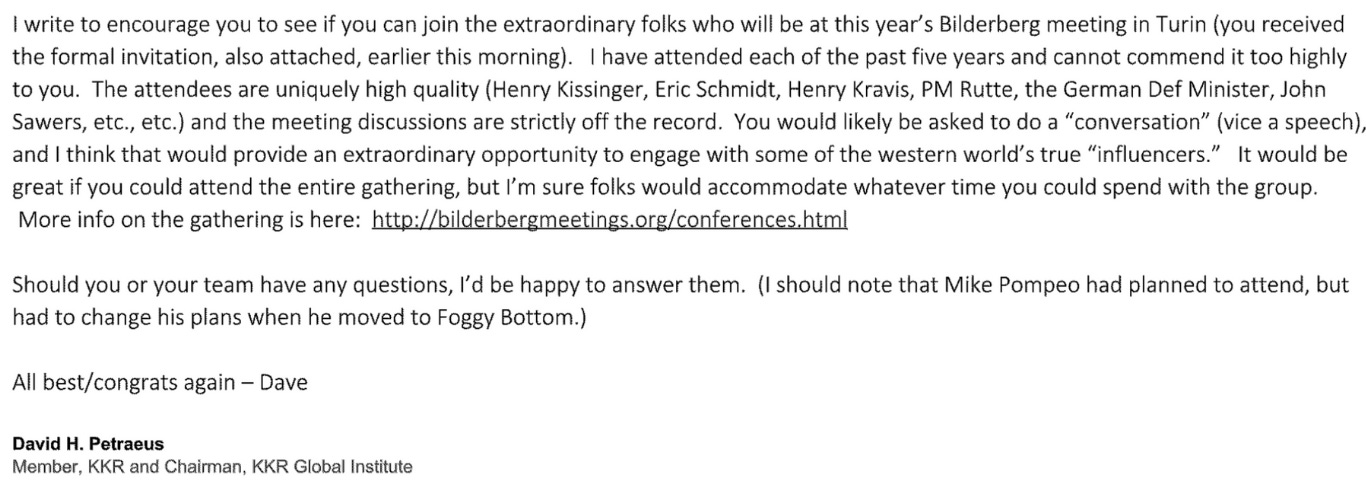
Despite Schmidt’s past as a Vietnam war protester, they developed a friendship that led to frequent collaborations, including numerous co-authored pieces. Much of Schmidt’s involvement in government quickly and soon followed. After stepping down as Chairman of Alphabet in 2018, though he remained as a technical adviser, Schmidt took on a new role in the D.o.D.. This included serving on the Defense Innovation Advisory Board while Google sought government contracts, including J.E.D.I. and Project Maven. It was forced to abandon these contracts by Google employees’ who protested collaboration with the military. Today, Google is a part of an analogous program, the J.W.C.C. [-]. During this time within the D.o.D., Schmidt’s most significant impact on the government came to be: he co-chaired the now disbanded “National Security Commission On Artificial Intelligence [N.S.C.A.I.]”, with Bob Work [Raytheon/RTX] along with Gilman Louie [In-Q-Tel], William Mark [S.R.I. International] and many others in addition to contributors Raj Shah [D.I.U.x.], David Kirchhoff [D.I.U.x.] [-]. From the commission, a 750-page report was produced that pushed for the government to aggressively accelerate development of A.I. in the interest of national security and defense. In particular, the report mentions China about 650 times and Russia 50 times or so. Schmidt has also added that the U.S. is behind China in A.I. development [-]. At best, it appears to be a case in which Schmidt, much like the U.S. government, projects a threat to justify extreme “defensive” measures, as was described in Robinson and Chomsky’s new book “The Myth Of American Idealism” [-]. For example: Character A believes Character B is plotting and planning to hurt them, therefore Character A, who believes themselves to be moral and just by matter of “fact”, “retaliates” or “proliferates” but is thereby justified and moral in their actions since it was out of “self defense”. Chomsky and Robinson’s thesis can be gleaned by the way they begin their book: “Every ruling power tells itself stories to justify its rule. Nobody is the villain in their own history.”.
In the past month, however, Schmidt has published a “Superintelligence Strategy” with Alexandr Wang [Scale A.I.] and Dan Hendrycks [adviser to Elon Musk’s xAI and Scale A.I.], advising the D.o.D. not to create a “Manhattan Project for A.G.I. [Artificial General Intelligence]” [-]. Why there is a difference between Schmidt’s former and most recent stances with respect to proliferation would be an interesting question to answer. Schmidt certainly has investments in the Chinese A.I. industry [-], therefore it is possible that these apparently antithetical positions are a strategy to increase profit, though simultaneously risking all out war. Ultimately though, their concerns are that a “superintelligent” A.I., arising from a recursive loop of improvements via proliferation could lead to a global instability once the “superintelligence” is achieved. These are largely fantastical notions cooked up in the idle time of elites disconnected from every day life [-], and ignore the deeper and more pernicious problems emblematic of the self-reinforcement of A.I., such as wealth inequality, racial disparity, and its blatant, deadly and punitive misuse by the military and law enforcement.
From the N.S.C.A.I. report, a few excerpts are included as screenshots below:
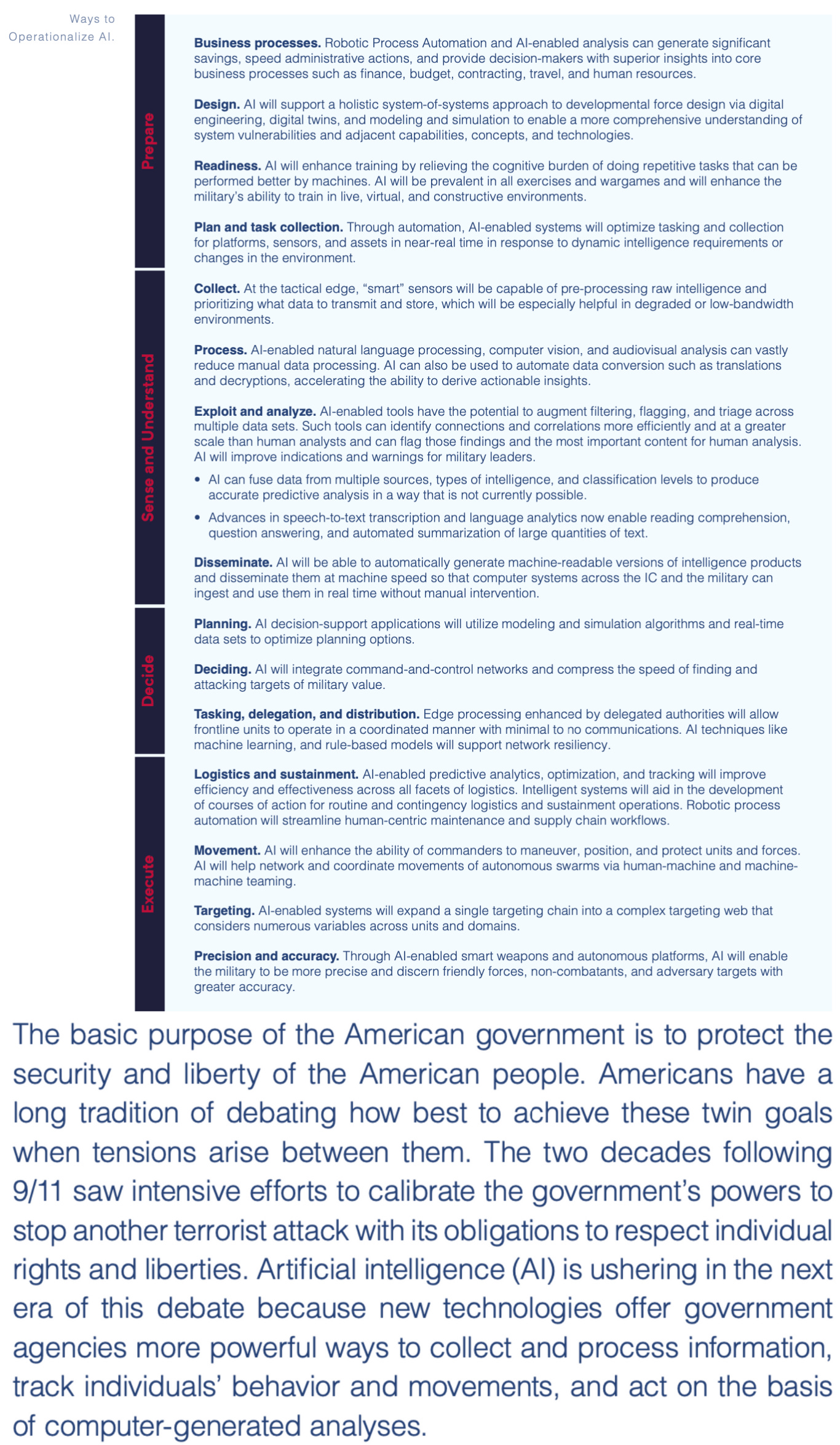
The report recommends an A.I. proliferation race that pushes for mass data collection for the purposes of producing the most fine-tuned A.I. model. There has been an enormous push for more and more data collection by tech and A.I. companies, and Eric Schmidt has been one of the agents pushing for the collection of big data [-]. It seems that the commission want to maximize the amount of data collected as well in order to predict the behaviors of individuals and predict an attack. This is the type of research that Princeton University has contributed to via work with C3.AI [- -]. The deep and entrenching risk is that these forms of data collection will be weaponized, including inwardly. Tangentially, Schmidt is focused or concerned on applications of A.I. for the development of bioweapons [-].
As a co-chair of N.S.C.A.I., Schmidt was also entrusted with the ethics of A.I.. The potential conflicts of interest were not lost on politicians. In 2022, Senator Warren, a long-time critic of these matters, questioned the D.o.D. regarding Schmidt’s own conflicts of interest as he alternated between government and private industry [-]. As Ochigame further wrote in The Intercept: “The majority of well-funded work on “ethical AI” is aligned with the tech lobby’s agenda: to voluntarily or moderately adjust, rather than legally restrict, the deployment of controversial technologies.” [-].
Ochigame further adds and cites a ProPublica article:
““Schmidt’s influence, already strong under [Secretary Ash] Carter, only grew when [James] Mattis arrived as [Trump’s] defense secretary.” The board includes multiple executives from Google, Microsoft, and Facebook, raising controversies regarding conflicts of interest. A Pentagon employee responsible for policing conflicts of interest was removed from the innovation board after she challenged “the Pentagon’s cozy relationship not only with [Amazon C.E.O. Jeff] Bezos, but with Google’s Eric Schmidt.” [-]”.
In reference to disgraced Epstein-associated M.I.T. scientist Joichi Ito, Ochigame also wrote: “The corporate, academic, and military proponents of “ethical AI” have collaborated closely for mutual benefit. For example, Ito told me that he informally advised Schmidt on which academic AI ethicists Schmidt’s private foundation should fund. Once, Ito even asked me for second-order advice on whether Schmidt should fund a certain professor who, like Ito, later served as an “expert consultant” to the Pentagon’s innovation board. Ito joined Carter at a panel titled “Computing for the People: Ethics and AI,” which also included current and former executives of Microsoft and Google. The panel was part of the inaugural celebration of MIT’s $1 billion college dedicated to AI. Other speakers at the celebration included Schmidt on “Computing for the Marketplace,” Siegel on “How I Learned to Stop Worrying and Love Algorithms,” and Henry Kissinger on “How the Enlightenment Ends.” As Kissinger declared the possibility of “a world relying on machines powered by data and algorithms and ungoverned by ethical or philosophical norms,” a protest outside the MIT auditorium [-] called attention to Kissinger’s war crimes in Vietnam, Cambodia, and Laos, as well as his support of war crimes elsewhere. In the age of automated targeting, what atrocities will the U.S. military justify as governed by “ethical” norms or as executed by machines beyond the scope of human agency and culpability?”.
Meanwhile, since the N.S.C.A.I.’s dissolution, Schmidt has formed the Special Competitive Studies Project [S.C.S.P.], with Bob Work, Raj Shah and Chris Kirchhoff as advisers, the latter two of whom have given talks at Princeton and helped found D.I.U.x. together with Secretary Ash Carter. The group’s aim is to push for the policies outlined in the N.S.C.A.I. report.
Schmidt’s stance on climate change also appears to entertain nihilism in favor of personal interests. When questioned by a panel on the resource hungry demands of A.I. and thereby it’s inherent conflict with climate change goals, Business Insider reported that Eric Schmidt responded as follows [-]:
“Presenters pressed Schmidt on whether it is possible to meet AI energy needs without disregarding conservation goals. Schmidt said he thinks “we’re not going to hit the climate goals anyway because we’re not organized to do it... Yes, the needs in this area will be a problem, but I’d rather bet on AI solving the problem than constraining it and having the problem.”.
During this time period, Schmidt also simultaneously co-authored a series of articles with Henry Kissinger on the potential negative changes that A.I. might bring [-] [-]. This included a book on the subject, The Age of A.I. and Our Human Future and most recently Genesis. Henry Kissinger also discussed the threat of China at a Google talk with Eric Schmidt as well as at the Council on Foreign Relations [-] [-].
In the mean time, since the 2010s, Eric Schmidt has also met with Israeli Prime Minister Benjamin Netanyahu on several occasions. In 2023, Netanyahu asked Schmidt to serve on his team of A.I. advisers, a position which he accepted [-] [-] [-]. In addition, he now owns A.I. and drone warfare company, “White Stork” which may have been renamed Project Eagle [-] [-]. He also possesses investments in defense contracting companies such as Rebellion Defense and Istari that aim to further integrate Silicon Valley tech with the defense industry [-] [-] [-].
In 2019, his personal foundation Schmidt Futures gifted Princeton the funds to start the Schmidt DataX Fund, a project that focuses on the use of on the use of artificial intelligence and machine learning in research programs [-]. Both Schmidt Futures and the DataX Fund have funded a plethora of scientists and their projects at Princeton University [-] [-] [-]. The foundation Schmidt futures has given over $1.6m to the university over the last 4 years as well. Schmidt also helped to open the Google A.I. DeepMind lab at Princeton, which provides A.I. services to the U.S. military and the I.D.F. in its genocidal campaign [-]. Furthermore, in 2020, Schmidt donated $5m to the university to create an indigenous studies professorship and also financed Princeton’s new computer science building, due to be completed in 2026 [-].
In addition, this past year, he has appeared at the Ash Carter Exchange with General Mark Milley, who is currently a lecturer at Princeton’s S.P.I.A. and sits on the advisory board of J. P. Morgan [-]. Also present were Palantir C.E.O. Alex Karp and C.I.A. director David Cohen. In honor of Secretary Ash Carter, who appointed Shah, Kirchhoff and Schmidt into D.o.D. positions, Schmidt’s S.C.S.P. hosted the Ash Carter Exchange Conference with Palantir, Lockheed Martin, Booz Allen Hamilton, Skydio, Amazon, Microsoft, Google as sponsors and the Council on Foreign Relations as an event partner [-] [-]. D.A.R.P.A. director and Princeton alum Stefanie Tompkins was also a guest speaker [-]. Milley and Schmidt have been interviewed by NPR to further discuss the role of A.I. and robotics in the U.S. military. They co-authored an article on the matter this year in a publication produced by the Council on Foreign Relations [-]. In this article, they reference Yuval Abraham’s +972 report on the use of A.I. algorithms in Gaza: “This new age of warfare will have normative advantages. Advances in precision technology could lead to fewer indiscriminate aerial bombings and artillery attacks, and drones can spare the lives of soldiers in combat. But the rates of civilian casualties in Gaza and Ukraine cast doubt on the notion that conflicts are becoming any less deadly overall—especially as they move into urban areas.... The Israeli military has used an AI program called Lavender to identify potential militants and target their homes with airstrikes in densely populated Gaza. The program has little human oversight. According to +972 Magazine, people spend just 20 seconds authorizing each attack”. However, these ethical concerns did not lead to any criticism of Israel. They were instead used to alert American officials to deploy these new technologies for the purpose of national security.
Along a tangent, though a revealing one, Alex Karp has made staunchly pro-Israel statements and expressed anti-campus-protest sentiments including at the Ash Carter Exchange. Karp and billionaire Peter Thiel are currently supplying Israel with their own A.I. and data organizing software services [including contracts with the I.D.F. -]. In addition, Karp has bragged about how Palantir software has been used to murder people [-]. Palantir is also working with Grumman, L3Harris, Pacific Defense and Anduril [another Thiel-backed company] to provide the U.S. Military with T.I.T.A.N., a mass-surveillance instrument [-]. Google and Anduril have also been working to co-integrate technologies for defense purposes [-]. Palantir has an unofficial pipeline of ivy-league students who intern at the company and then graduate to work there [-]. The heavily patriotic Palantir co-founder and hedge fund 8VC founder, Joe Lonsdale, has been a visitor to the Julis-Rabinowitz school at Princeton and published articles that criticize decolonial movements, including one titled “Western civilization is an idea worth defending - and reapplying” [-] [-]. Companies like Palantir and Anduril, both of which have vocally explicit pro-Israel C.E.O.s, have received $2m in funding from Augustine’s In-Q-Tel [-]. Karp furthermore has stated “The only time I’m not thinking about Palantir is when I’m swimming, practicing Qigong or during sexual activity.” [-]. Palantir received an initial investment of $2m, and its stock has skyrocketed from October 7th 2023 to October 7th 2024 with a 160% rise in stock price [- -].
At the Ash Carter Exchange, appearing alongside Milley and Schmidt, Karp exclaimed, in reference to campus protests, “we are the peace activists, and the peace activists are the pro-war activists”. Milley agreed stating “they’re out there supporting a terrorist organization.”. Later in the talk, Karp added “to Milley’s point, a democracy will sacrifice depending on its perceived legitimacy of its own cause and so you know we really have to be careful not to let our adversaries win the intellectual debate because there will be no battlefield, there will be no successful engagement if we just allow their attempts to corrode our culture to go intellectually unchecked” to which Milley appears to reply “that’s right” [-] [-].
Most recently, Eric Schmidt also came to speak at the university on November 20th, 2024 to market his new book on A.I., Genesis, with Henry Kissinger [-]. He spoke on many topics such as the ethics of A.I.. He, however, did not cite Israel’s use of A.I. in Palestine. He did state that “Milley is a great Princetonian”. Schmidt cited the kinds of interactions that can occur between the government and Princeton, including one student who developed a new computer language which became classified for the development of nuclear triggers. Furthermore, in reference to research questions and the topic of potential A.I. weapons developed by nation-states, Schmidt stated:
“To have something which is the world’s polymath, that can invent things that no one else can, that can solve every economic, physical and science problem. Might be world $1 trillion. The U.S. weapons program costs $1 trillion. This is probably a more powerful weapon than biggest weapons programs the U.S. sponsors. It makes sense... There’s an alternative view where there will be a diffusion of these techniques into much smaller models that are disparate, and then you have a huge huge problem of essentially proliferation. There’s a long literature around nuclear proliferation... In my undergraduate, there was an undergraduate who wrote his thesis and how to design the trigger for a nuclear bomb. And when the physicist, his supervisor, realized what he invented, he immediately caused it to be classified...
I worry a lot about the proliferation issue because we know evil exists in the world and we know that these systems are asymmetrically powerful...
Indeed I was privileged to be the person who launched the Princeton-Google collaboration...
The government needs to improve research access to these things [A.I. models] ... There is a program called N.A.I.R.R. [-] which I endorsed in my role as National Security Commission for Congress, and there’s a good chance that will come through, we need to find a way to get $100, $200, $300 million dollars into Princeton for that resource. And I’m going to help...”
N.A.I.R.R. is an organization that would be created by the Create A.I. Act, lobbied by Princeton. Evidently it is via this organization that Schmidt is hoping to funnel money into Princeton and more specifically the N.J.-Princeton A.I. hub cited in Part 2 [-] [-] [-].
The only mention of the events in Gaza were when he was asked by a first year graduate student about whether he had had any meetings with Netanyahu given Project Nimbus and his place on Netanyahu’s board of A.I. advisers. In a brief answer, Schmidt stated that he agreed “with the presumption in the question” and then simply said that he “had not had any such meetings of any kind”.
Ultimately, despite many differences between the individuals who have appeared in this piece, there appears to be a mutual singular agreement that American hegemony is the only thing worth preserving. Thus goes Schmidt, following Kissinger’s legacy with a technological advancement that appears to have made Schmidt into Kissinger’s Frankenstein. This is a reflection of a term that is best summed up by Theodore Roszak and another by Yanis Varoufakis: technocracy [-] and technofeudalism [-]. As wealth inequality soars, the upper classes distance themselves further and further from the working class, coming to believe that they do not depend on workers at all. Their perception of the world is increasingly simplified and aestheticised, to the detriment of critical analysis, locking them in remote bubbles that ignore the realities of most people’s day-to-day lives. Domestic wealth inequality is thus intimately connected to the colonial and imperialist motives currently wreaking genocide in the Middle East, and putting humanity itself at risk: they are in the hands of the same people. These people are Eric Schmidt and his clique of self-important technocrats, from whom Princeton University regularly receives gifts, and who are invited to speak and given lectureships, thus cementing the power of the military-industrial-academic complex.
03/10/25