



In our continued exploration of Princeton’s ties to Israel and militarism more broadly, we have already examined Princeton’s role as a defense contractor as well as Princeton’s direct personal ties to those who ideologically or materially support the Israeli regime. In addition, Princeton has helped to create several companies [Twinleaf, Encharge A.I.], which have participated in defense contracts both with the U.S. government and potentially even with the I.D.F. A common military strategy is to use drones and drone swarms as expendable tools, for which purpose they need to be as cheap as possible. Magnetometers, such as those manufactured by Twinleaf, aid drones to “sense” each other and thereby prevent collisions in swarms. Twinleaf’s cheap but sensitive magnetometers are therefore a great asset, though their collaboration with the IDF has not been confirmed. It is nevertheless important to explore the relationship of Princeton’s alumni to the military and militarism more broadly. The Israeli regime is only one particular instance of militarism as a career option following university.
For example, according to Section 117 Foreign Gift and Contract Reporting of the Higher Education Act of 1965, universities are required to disclose exchanges of money with foreign entities [-]. In addition to accepting funds from the Israeli Ministry of Defense, Princeton University, through a contract, was given $420k by Saudi agents in 2018. Over the last few years the Qatar National Research Fund most likely helped fund a Ph.D. at Princeton [about $54k]. Also through a contract [mentioned in Part 1, but repeated here for completeness -], Israel gave $335k between 2019 and 2023, which may coincide with funding for the Romalis group [D.S.C.A. 1000366232 -]. Similarly, Egypt donated $550k in 1998. A gift from Kuwait was given in 2019 to the tune of $300k. The majority of other gifts and contracts, however, have come from China, England, France and Hong Kong among others.
It will be important to explore all these ties in the future but for now, we will focus on sources of militarism from within the United States. Other pieces have explored American universities services rendered to the D.o.D. and the wider military-industrial complex. This includes Michael Klare’s piece in The Nation which examines the outsourcing of academic research by the Pentagon [-], such as projects on micro-electronics [J.U.M.P.], which Princeton is involved in [-], as well as other academic programs on hypersonics led by other universities. In addition, another important piece is I.C.A.N.’s Schools of Mass Destruction report [-]. Princeton’s role as a defense contractor was already explored in the cited piece [-]. Focusing on Princeton’s ties, we will begin with the Board of Trustees.
From Princeton University’s Board Of Trustees To The Military-Industrial Complex
Before listing relevant members of Princeton’s board of trustees, it should be noted that a number of them have greatly varying backgrounds. Each one was investigated, and those listed have the closest ties to the military as far as the author could elucidate. In addition, the foremost source on Princeton’s Board of Trustees is the bullet report created by the Fossil Fuel Divest Princeton student activist group [-]. The fossil fuel industry is intimately connected to militarism, but we will refer the curious reader to Divest Now’s source, and will not mention these particular ties unless there is a very direct connection with the matters at hand.
Highland Capital Partners Founder and Chairman Paul Maeder is on the Board of Trustees and the Princeton Entrepeneurship Council [-]. Highland Capital Partners is a highly influential hedge-fund. HCP has holdings in defense contractors such as Teal Drones [-]. It has also held fund-raising rounds for companies that are subcontracted by weapons manufacturers and defense contractors. For example, it helped raise $8m for Xometry, which serves Lockheed Martin, General Electric and the M.I.T. Lincoln Lab [-]. It also helped fundraise for Domino Data labs, which provides A.I. services to Lockheed Martin [-]. Maeder also made a major donation to Princeton that resulted in Maeder Hall in the Andlinger center. He also sits on the board of Exagrid, which serves defense contractors like Lockheed Martin, Northrop Grumman, B.A.E. Systems, and Raytheon.
Elizabeth Prus Myers, global chairman of J.P. Morgan, is on the Board of Trustees of Princeton and on the Board of Directors of the Bendheim Center for Finance. J.P. Morgan, as of 2023, has $355m of Lockheed Martin stock alone [ignoring investments and millions of shares in other defense contractors such as Raytheon, Booz Allen Hamilton etc.] [-] [-]. The prices of those stocks have only risen since Oct. 7th 2023.
Within the weapons manufacturing industry, Nandi Leslie, a principal technical fellow at RTX/Raytheon is on Princeton’s board of trustees [-]. Leslie is also an employee at the “Department of Defense Center of Excellence in Artificial Intelligence and Machine Learning” at Howard University. RTX/Raytheon, partnering with Israel’s Rafael Defense Systems developed and maintains the missile defense system known as David’s Sling and the Iron Dome [-]. RTX also ships offensive explosives and weapons to Israel.
The Board of Trustees also includes Princeton S.P.I.A. graduate Brad Smith, current Vice Chairman and President of Microsoft. Along with Oracle, Amazon and Google, it has been part of the Joint War Cloud Computing [J.W.C.C.] project as part of a DoD contract [-]. Microsoft has also received investments from the D.o.D. and In-Q-Tel to develop Adaptx, now known as Capturx, which develops programs that integrate field data [look further for more information on In-Q-Tel, a C.I.A. backed hedgefund founded by Princeton alum Norman Augustine]. In 2018, Brad Smith stated: “... we believe in the strong defense of the United States and we want the people who defend it to have access to the nation’s best technology, including from Microsoft. . . . To begin, we’ve worked with the U.S. Department of Defense [D.o.D.] on a longstanding and reliable basis for four decades. You’ll find Microsoft technology throughout the American military, helping power its front office, field operations, bases, ships, aircraft and training facilities” [-]. In addition, he has published other articles including one on the developments of cyber warfare in the Russian invasion of Ukraine [-]. The I.D.F. has also been the largest A.I. customer of Microsoft [-]. Microsoft has collaborated with Raytheon, B.A.E. Systems, Lockheed Martin, Peraton and others [-] [-] [-] [-] [-]. Smith recently published a blog post arguing against any restriction of A.I. chips to the following countries: “This includes many American friends, such as Switzerland, Poland, Greece, Singapore, India, Indonesia, Israel, the U.A.E., and Saudi Arabia. These are countries where we and many other American companies have significant datacenter operations” [-].
Josh Bolten is on the advisory board of BP International, which provides fuel for militaries across the world on top of stifling green technology innovation and being a direct contributor to global warming [-] [-] [-] [-] [-]. The lack of extra detail is not representative of any less complicity.
In addition, a few other trustees with other fossil fuel interests are well documented by the Fossil Fuel Princeton Divest campaign and include [-]: Blair Effron, Timothy Kingston and José B. Alvarez [the former two having been covered in Part 1 -].
Thomas Siebel is the billionaire owner of C3.AI, a defense contractor who collaborates with Raytheon, Palantir, Anduril, L3Harris and others. Siebel donated $4m to Princeton in 2015 alone to create a professorship in the History of Science [-]. Siebel is also on the Princeton Entrepeneurship Council and has given several talks for the university [-] [-] [-]. He was also a trustee from 2008-2011 [-] and his company sponsors several research laboratories at Princeton per a report on Princeton’s ties to the military [-]. According to an article in the Daily Princetonian, Siebel has given at least $6m to the university in total [-].
Amy Alving, who just finished their term as a Princeton trustee in 2023, is on the board of directors at Howmet Aerospace [-].
Yet Again, The Ex-Officio Princeton Trustee And The N.J. State Government’s Weapons Manufacturing
Within the political sphere, Phil Murphy, current governor of New Jersey, is an ex-officio trustee of Princeton University. New Jersey is one of the largest defense manufacturing centers for Lockheed Martin, Valcor Engineering, Picatinny Arsenal and B.A.E. Systems [-] [-]. Furthermore, the port of Elizabeth is one of the main export hubs for Zim and Maersk, two shipping companies that bring crucial war supplies [produced by Picatinny Arsenal, Lockheed Martin, Raytheon etc.] to Israel and illegal settlements. Furthermore, Picatinny Arsenal sub-contracted Israel’s Elbit Systems Of America in 2017 for a $102m mortar production contract [-]. Elbit has also sub-contracted work to Octal Corporation in NJ for R.O.E.M. motors, which are used for drones [-] [-].
In 2021, Lockheed Martin decided to move its Vertical Launching Systems production from Maryland to N.J., a move that was welcomed by Governor Murphy: “Lockheed Martin is one of the giants in the defense contracting industry and New Jersey is proud to call them a valued partner”. NJ.gov’s press release further expands [-]:
“Since 2012, Lockheed has made a total investment in New Jersey of $365 million, including the establishment of a state-of-the-art Solid State Radar Integration Site [S.S.R.I.S.] and the addition of a 47,000 square foot Advanced Product Development Center [A.P.D.C.] in Camden.”
New Jersey also holds offices and manufacturing sites of Raytheon/RTX, Leidos, Boeing, L3Harris, C.A.C.I., Sci-Tech, Twinleaf LLC and a plethora of cyber companies including Peraton, most prominently [-] [-]. In addition, Murphy once authored an article titled “We must continue to invest in N.J.’s military installations” in 2019, in which he states that the military is the second largest employer with economic gains in the billions[-].
“Today, New Jersey can boast tech sectors that promote pharmaceutical and life sciences, with Teva Pharmaceuticals selecting it as the base for its American headquarters, and companies like Check Point, Elbit Systems, SodaStream, and OrCam Technologies each having a presence too.”
In 2019, Governor Murphy, with then Representative Bonnie Watson Coleman, then Assembly Member Andrew Zwicker, Princeton University President Christopher Eisgruber, and former Google CEO Eric Schmidt, opened Google’s DeepMind lab at 1 Palmer Square, the center of Princeton town[-]. DeepMind provides A.I. and cloud-computing services to the IDF, under the heading of Israel’s Project Nimbus[-]. As of 2023, the state of New Jersey and Princeton University also jointly opened the N.J. A.I. hub, thus expanding upon the project of making N.J. a central A.I. hub on the East coast [-]. Additionally, Princeton lobbied for the Create A.I. Act of 2023 [H.R.5077] to provide more funding for A.I. at the state and university level via an organization named N.A.I.R.R., which Eric Schmidt has endorsed and is hoping will funnel further funds into Princeton [see Part 3 -] [-] [-] [-].
In an effort to bring in corporate sponsors, Murphy also announced that Microsoft [which again supplies A.I. services to the I.D.F.], CoreWeave, Princeton University and N.J.E.D.A. will gift $72m to the N.J. A.I. hub, primarily made up of Princeton researchers [-].
The N.J.E.D.A. is also a customer of Siebel’s C3.AI software platform [-].
The state government is clearly complicit in accepting defense contracts, and Governor Murphy’s position on the Board of Trustees necessarily involves Princeton in the production of arms and software that are then exported through Elizabeth to Israel. We will now turn to some of Princeton’s alumni who are defense contractors or have a connexion, past or present, to the D.o.D.
Some Notable Princeton Alumni, Donors And The Military
Not every single individual mentioned here is directly relevant to Princeton’s day-to-day. That being said, the majority have had some impact on campus. Some are important with respect to the overall formation of foreign policy and are worth mentioning for the following purpose: most of the alumni listed who are employees in the D.o.D. passed through Princeton’s School of Public and International Affairs. The author therefore extrapolates that S.P.I.A. effectively functions as a branch of the U.S. military’s education system. This attitude is demonstrated in the university’s own tweets [-]:
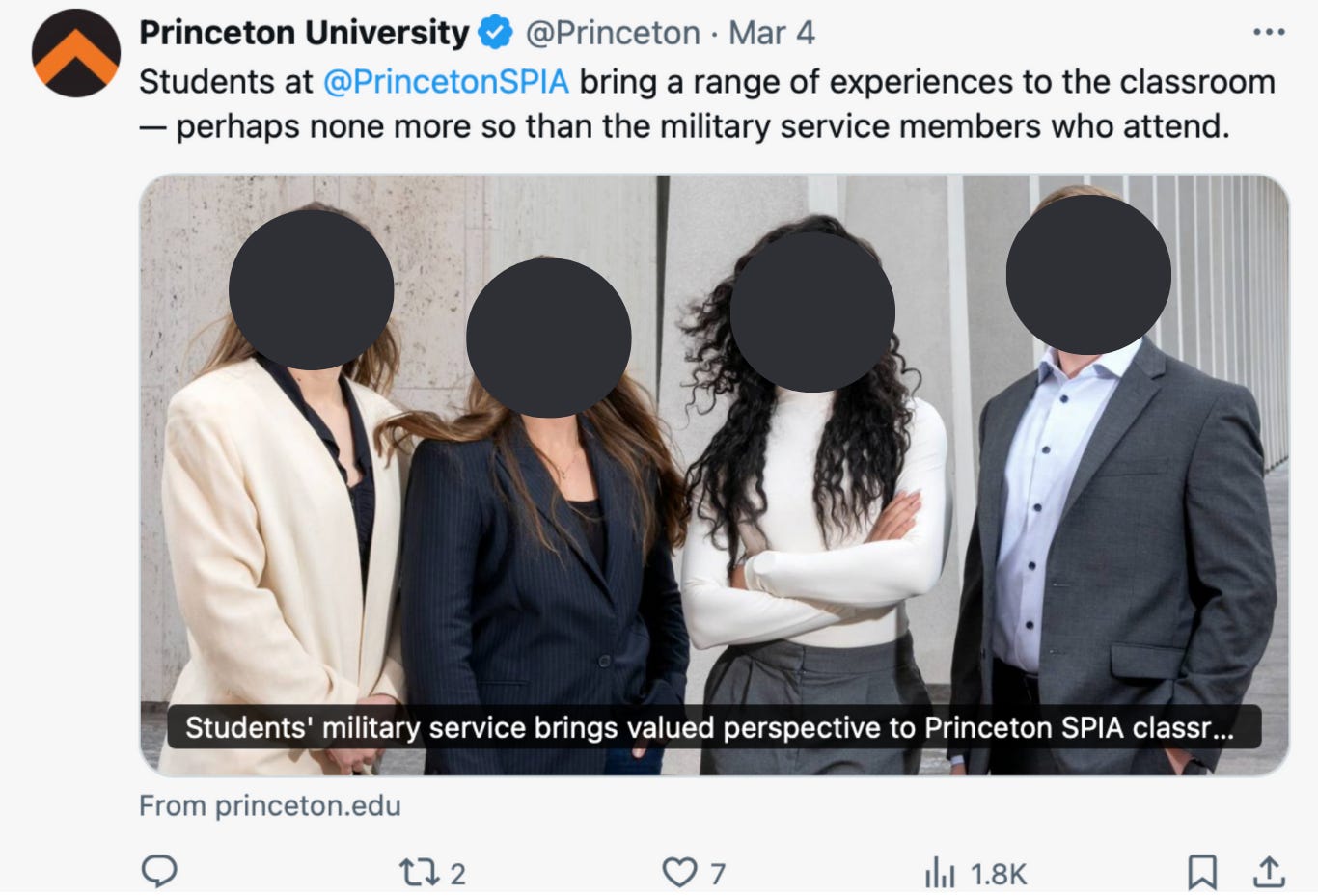
We now investigate individual alumni involved with or connected to the military:
Alumna Radha Iyengar Plumb is the D.o.D.’s Chief Artificial Intelligence Officer, before which she was an executive at Google and Facebook, and senior economist at R.A.N.D. Corporation[-]. Plumb is also an associate of Jacob N. Shapiro’s E.S.O.C., referenced in the first report [-]. Of course the D.o.D. contracts to a whole array of defense contractors but Plumb, specifically, also recently struck up a contract with defense-tech hybrid Anduril for $100m[-]. She has also contracted services from Palantir for over $500m including its A.I.-based Maven Smart System[-] [-]. The C.D.A.O. has also contracted C3.AI for logistics and force readiness [-] [-].
Princeton alum Stefanie Tompkins was the director of D.A.R.P.A. from 2021 to 2025. D.A.R.P.A. [Defense Advanced Research Projects Agency] is the agency that assigns research grants to institutions and companies for the development of new technologies, many of which, though not all, have defense purposes. It is nicknamed the “D.oD.’s mad science division”[-] and has lead a variety of projects including, under Tompkin’s leadership, the GXV-T program intended to streamline tank warfare, and a collaborative endeavour with the US Air Force to develop a hypersonic air-breathing weapon[-][-].
Pete Hegseth, class of ‘03, is now Secretary of Defense and will oversee the entirety of the D.o.D.[-]. Hegseth’s role will be deeply consequential during the Trump administration, and he is well-known to be hold belligerent views with respect to internal as well as external affairs[-]. In a recent call to Netanyahu, Hegseth stated that the U.S. was fully committed to Israel[-]. These views are representative of his historically pro-Israel stance[-].
James A. Hursch, S.P.I.A. graduate, served as a director on the D.S.C.A., or Defense Security Cooperation Agency, which helps the U.S. government receive foreign funding or provide funding for foreign entities, including in support of Israel’s genocide [-]. Hursch has also overseen F-35 and MQ-9 drone sales to the U.A.E.[-]. The D.S.C.A. is the same agency that helped facilitate the flow of funds from the Israeli Ministry of Defense to Princeton University. Under his directorship, U.S. arms sales hit new records[-]. He has since joined the Atlantic Council, a thinktank headed by defense contractors and petroleum executives[-]. Along with Hursch, Princeton alum Cara Abercrombie [S.P.I.A. graduate] served as president of the D.S.C. University, the D.S.C.A.’s educational institution [-].
Michael J.K. Kratsios, class of ‘08, was previously Chief Technology Officer under the first Trump administration. Since Trump’s recent re-election, he has been nominated as Science Adviser to the President. In spite of this appointment, Kratsios’ background is not in science but in politics. Prior to joining the government, he was chief of staff to Peter Thiel and a principal at Thiel Capital. Thiel is a defense contractor who has founded Palantir and funded Anduril, both companies being tied to A.I. and drone usage. He was also an employee of Scale A.I., which has military affiliations[-].
Princeton S.P.I.A. graduate and former Air Force member James Taiclet is the current C.E.O. of Lockheed Martin, a key supplier of fighter jets, attack helicopters, and missiles to Israel, often through the U.S. government’s Foreign Military Financing Program. Per Princeton Professor Jacob Shapiro, the “Army War College Military Education Level 1” (MEL-1) Fellows Program funds the development of relationships between active-duty personnel and academic institutions [-]. As a result, Princeton has had many government and military officials associated with S.P.I.A. [-][-]. On Oct. 7th 2023 alone, Lockheed Martin’s stock price rose from $400 to $435 [-]. Taiclet stated that the FY 2025 “presidential budget and additive supplemental funding will provide a strong underpinning for future growth over the next several years for our company.” [-]. Over the past year, as of November 2024, it has produced a 55% return. Given Taiclet’s bachelor’s at the United States Air Force Academy, it is possible that he went to Princeton under the MEL-1 fellowship. Recently, at the Reagan National Defense Forum of 2023, Taiclet stated that to improve national security would require “marshaling all of U.S. industry in the service of national defense... The U.S. is clearly ahead in the software sector but a lot of that is in the commercial sector and we have to bring that in... We [Lockheed Martin] also recruit from a wide range of colleges and universities all the way into high schools... But we need to focus on difficult skill sets like A.I. data sciencists, that is another compelling reason to partner with the tech industry because they can pay the rates that a data scientist deserves these days, a quick example, we have a team with Intel, Microsoft, Verizon, I.B.M. and Nvidia working on the application of digital technology to mission sets we have defined with the services... and we are getting access to some of their very best people and very best technology” [-]. Though James Taiclet has stated in interviews that Lockheed Martin does not get involved in policy, it actively lobbies Congress for financial returns and contracts along with contributing money to think tanks, most prominently the Council on Foreign Relations [-] [-]. In addition, Taiclet would like to create a network of telemetry collection across the globe to track the movement of objects “... there are cell phones taped to cell towers in Ukraine that are just on listening for air craft coming by or missile coming by and those are all networked into a solution for a commander to say that there are 50 Russian drones coming at you based off the sound waves picked up by these cell phones taped to these towers... we should have an acquisition path where if somebody comes up with an idea like that and presents it to the D.o.D., that we can scale it and have hundreds or thousands of those deployed in Europe, Middle East, South China Sea in say 6 months. We need an acquisition path like that” [-]. In other words, Taiclet is aiming to increase the scale of networks for data collection across the globe.
Another Princeton-associated military personnel is Master Gunner Sergeant Scott H. Stalker, who was a 2022 fellow of the “Irregular Warfare Initiative”, a joint effort involving the D.o.D. and Professor Jacob N. Shapiro’s E.S.O.C. at Princeton University [with S.P.I.A.], and the Modern Warfare Institute at West Point [-]. The “Irregular Warfare Initiative” was founded by active duty military officers at Princeton University. Its goal is to facilitate the exchange between academics and “Irregular Warfare practitioners”. The Doctrine for the Armed Forces of the United States defines Irregular Warfare as “a violent struggle among state and non-state actors for legitimacy and influence over the relevant population(s)” [-].
Another Pentagon official and Princeton graduate is General Mark Milley, a Princeton graduate who has now taken a position as visiting lecturer at Princeton University’s S.P.I.A. while also being a senior adviser to J.P. Morgan Chase [-]. Mark Milley has had a long military career, having participated in Operation Iraqi Freedom and the war in Afghanistan. During the Afghanistan war, Milley stated that Afghani soldiers were carrying on the fight themselves, but after Biden’s withdrawal from the Afghanistan war, Milley stated in a Congressional hearing that no length of U.S. occupation would have made a difference in the ultimate failure of the war [-] [-]. In addition, as was reported by Seth Harp of Rolling Stone, during this was, the C.I.A. encouraged a high rate of opium exports out of Afghanistan, thus helping to form a cartel that went high up in the Afghani government [-]. Milley stated during a talk in Princeton that he had no knowledge of this. More recently, Milley published a report on the development of A.I. in the U.S. military [-]. It outlines his belief that in 10-15 years, 25-30% of the U.S. military will be robotic. Since October 7th, Milley has affirmed his support for Israel. When speaking publicly at the Ash Carter Exchange Conference, he stated with respect to the use of A.I. and new technologies in warfare: “The idea that war is antiseptic and there’s wonder weapons out there, that we can somehow make it painless. . . to think that technology’s going to resolve the horrors of war. It’s not.” [-]. Milley further stated: “Before we all get self righteous about what Israel is doing, and I feel horrible for the innocent people in Gaza dying, but we shouldn’t forget that we United States killed a lot of innocent people in Mosul, in Raqqa, that we the United States killed 12,000 innocent French civilians. And here we are on the 80th anniversary of Normandy, on the prep fires for Normandy. We destroyed 69 Japanese cities, not including Hiroshima and Nagasaki. We slaughtered people in massive numbers, innocent people who had nothing to do with their government, men, women and children. War is a terrible thing. But if it’s going to have meaning, if it’s going to have any sense of morality, there has to be a political purpose, and it must be achieved rapidly with the least cost and you do by speed” [-].
Christopher G. Cavoli, ‘87, is a 4-star general who has, up until the Trump administration, been carrying out the military’s directive for a modernization of the U.S. military, in line with Milley’s own goals [-]. He often returns to campus for talks.
Princeton graduate and billionaire Amazon founder, Jeff Bezos, has donated $15m to the University. As a result, the Bezos Center for Neural Circuit Dynamics was named after him [-][-]. Amazon has links to the Pentagon, to whom it provides cloud services [-], and the Israeli Defense Force [-]. Bezos’ other company Blue Origin is also being considered for Pentagon contracts, as it focuses on develop aerospace technology [-]. Bezos a stated at a Wired 25 conference: “If big tech companies are going to turn their back on U.S. Department of Defense, this country is going to be in trouble” [-].
Furthermore, Princeton Graduate and “the Grandmother of A.I.” Fei-Fei Li was former chief scientist of A.I. at Google’s cloud company, and was particularly involved with Project Maven, which helped develop and implement algorithms for identifying objects and human beings in satellite imagery [-]. Li’s recent venture, a company named World Labs set to work on computer vision, has received $1b in funds, of which former Google CEO and Princeton alum Eric Schmidt supplied an undisclosed amount [-].
Former Trustee Norman R. Augustine And The Student Raj Shah
Perhaps one of the most important Princeton alumni is former trustee Norman R. Augustine, who is a former CEO of Lockheed Martin, a former faculty member at the Princeton Department of Mechanical and Aerospace Engineering and a former member of the M.A.E. advisory council [-] [-] [-]. As a brief aside, former senior fellow at Raytheon, Meredith Colket, is now on that advisory council [-].
His career initially included Assistant Secretary of Defense and Engineering, United States Secretary of the Army and head of the Defense Science Board. After his career in government, he helped oversee the 1995 merger between Martin Marietta and Lockheed Martin [-]. His influence on defense contracts is so enormous that he has a set of 52 aphorisms called Augustine’s Laws. These include the trend that every 20 years weapons contract costs multiply by a factor of ten [Law # 16].
As stated by William Hartung of the Washington Post in 1996: “Augustine’s power extends far beyond his C.E.O. position. Since 1987, Augustine has served as chairman of the Defense Policy Advisory Committee on Trade [D.P.A.C.T.], which provides confidential guidance to the secretary of defense on arms export policies... Over the next three decades Augustine spun through the revolving door from industry to government and back again... Augustine chose not merely to compete in the defense sector but to dominate it. His strategy has been to buy up parts of other defense firms. “I want to build a super company,” he said in a 1994 interview. In March 1995, he and Daniel Tellep, the C.E.O. of Lockheed, agreed to merge, forming Lockheed Martin Corp.... Lockheed Martin then sought reimbursement for $330 million in connection with its acquisitions of General Dynamics’ space division and General Electric’s defense unit. As of last October, at least $38.5 million had been paid out by the Pentagon. Augustine defends the arrangement as beneficial to the government, saying Lockheed Martin is being “very generous”... A brochure for Lockheed Martin’s new F-22 stealth fighter plane, subtitled “Peace Through Conventional Deterrence,” does just that: The pamphlet displays a map of the world showing the countries that now possess top-of-the-line fighters.”
It is important to note that Augustine erved on D.P.A.C.T. during his time as C.E.O. of Lockheed Martin and Martin Marietta. CodePink’s investigative podcast stated in reference to Augustine’s own revolving door path between the private and public sectors: “Augustine served on the Defense Policy Advisory Committee on Trade when he was the C.E.O. of Lockheed Martin. That had such a massive influence over arm sales, Lockheed Martin benefits in arm sales. And it also had a huge influence over Pentagon budgets, that kind of thing. Over 50% of our Pentagon budget, which is $800 billion this year goes straight to private companies like Lockheed Martin.” [-]. The Washington Post article remains relevant even decades later [-]:
“Augustine also has been a central figure in the defense industry’s effort to get the U.S. government to provide additional taxpayer support for arms exports. With fighter planes costing between $25 million and $50 million and potential foreign clients facing major budgetary crises, the number of cash-paying foreign weapons customers has been shrinking. New subsidies for arms exports have been on the industry’s agenda since 1988, when the D.P.A.C.T. recommended them to the incoming Bush administration. D.P.A.C.T.’s chairman, then and now, is Norman Augustine.... Lockheed Martin’s solution for the perils of arms proliferation: Buy more planes from Lockheed Martin. Augustine is a formidable opponent of post-Cold War proposals to cut defense spending. He argues that past efforts to convert defense contractors to civilian work have a record “unblemished by success” because “it has proven very difficult to produce pigs by running the sausage machine backward.” In his 1990 book “The Defense Revolution” (co-authored with Kenneth Adelman), Augustine advocated increased spending for a potent array of new weapons, from B-2 bombers to strategic missile defenses to “smart” munitions. In a speech last December, he referred to the defense industrial base as “the fifth armed force” and argued for stepped-up spending on weapons modernization to maintain a “dominant military force””. Readers are encouraged to read William Hartung’s article who is now at the Quincy Institute.
During Augustine’s time as C.E.O. of Lockheed, the F-22, F-35, Titan IV rocket and the C130j turboprop military transport aircraft were developed [-]. The F-22 and the F-35 are fighter aircraft used in various conflicts [-] [-] [-].
Furthermore his views on the Department of Defense budget seem to imply that he believes an increase in the D.o.D. budget is necessary as per a 2011 senate hearing:
“It has now been 20 years since the so-called “Last Supper,” at which D.o.D. gathered about a dozen of us who were running the major defense contractors at the time. We were told that the D.o.D. was going to be buying less equipment, given the end of the Cold War; that D.o.D. had no intention to pay for overhead for a lot of companies with half-full factories and no money to invest in R&D; and that it would be up to those of us from industry to solve the problem, D.o.D. wasn’t going to do it for us.... I still remember a chart that was shown on that occasion of 16 different categories of military equipment. In five of them the D.o.D. said they could only afford two industrial participants and in six of them they could only afford one participant. Shortly thereafter, 5 years later, 75 percent of the companies were gone, as were nearly half the people in the industry, about three-quarters of a million people... We sometimes forget that our defense sector has to compete with all the other industries in this country and in the world in fact for equity and for debt capital. Without that, they cannot modernize their facilities or run their businesses. There’s no place in the Wall Street Journal listing where there are asterisks that say “This company is a defense company; it’s excused.” [-].
His personal views on a number of topics are in the public sphere. They include extremely fringe views, including blaming school teachers for the 2008 economic crash [-], an idea so simplistic it is on par with flat-earth conspiracies. Following Law #16, Augustine believes the defense budget needs to be substantially increased, and the defense sector expanded and diversified in order to reduce costs, despite being the largest in the world by many orders of magnitude. This places Augustine firmly in a small camp of extremist believers.
Most recently, his gifts to the university resulted in the creation of new engineering professorships, one of which bears his name and is currently dedicated to robotics: Norman R. Augustine Professor in the M.A.E. department. Radhika Nagpal occupies the Norman R. Augustine professorship in the M.A.E. department and is currently carrying out an Office of Naval Research grant [N000142212616] to create underwater robotic swarms analogous to Elbit System’s C2 multi-domain heterogeneous swarms used in Gaza, as well as other drones used for anti-submarine warfare by the Pentagon [-]. When interviewed by Princeton Alumni Weekly about this donation, Augustine stated, “When I was CEO, almost the entire aerospace industry was led by people with Princeton degrees,” and mentioned competitors like McDonnell Douglas, Boeing, Westinghouse, and Grumman [-]. After he retired as Lockheed-Martin C.E.O., he went to Princeton as a faculty member, where he also served as a trustee [-].
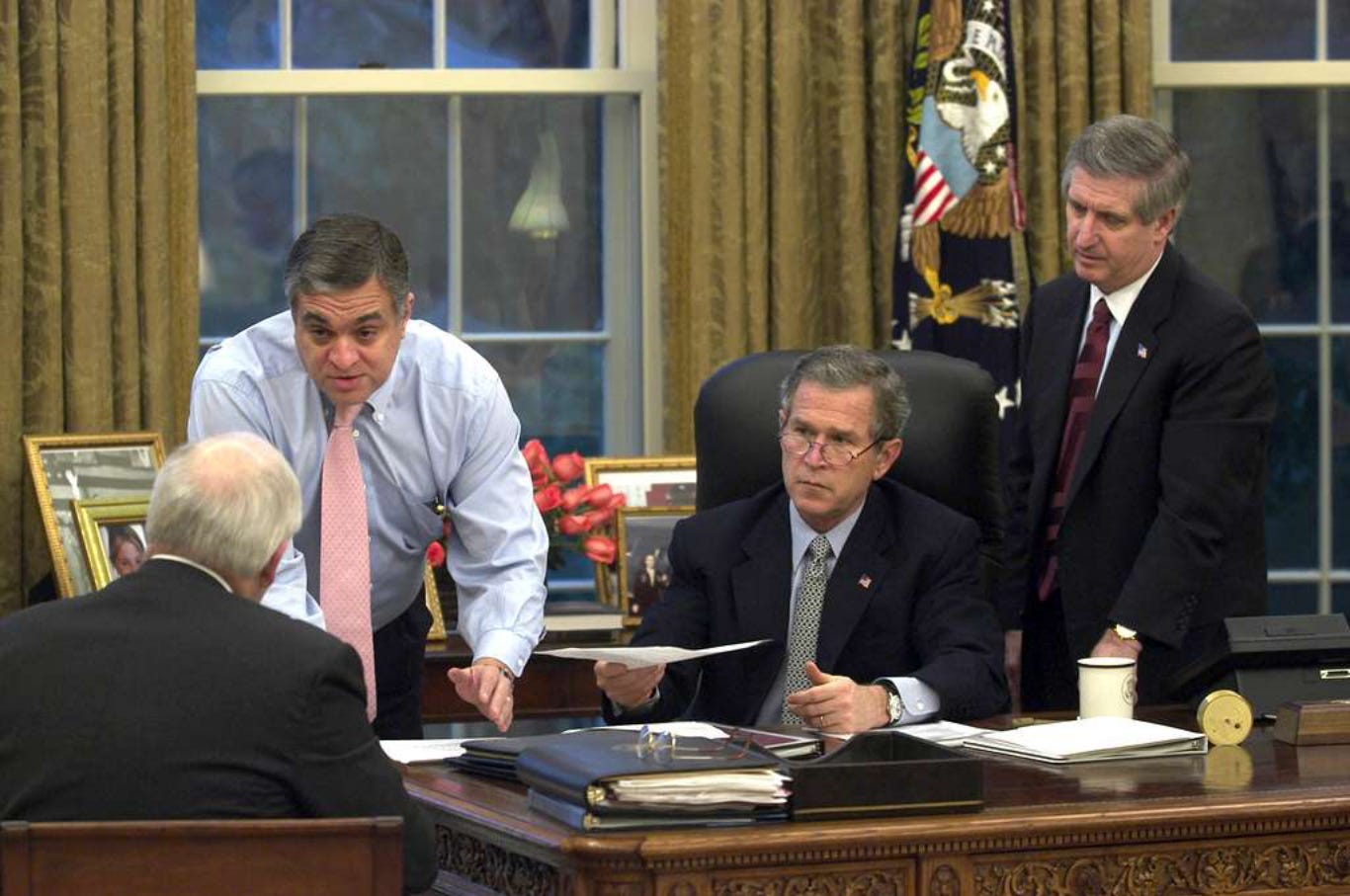
George Tenet in the oval office with the Bush administration
But it was also around 2001 that Augustine and Gilman Louie were called upon by George Tenet to deal with a financial and innovation crisis in the defense industry. Tenet oversaw the facilitation of torture as the director of the C.I.A. under the Bush administration. Tenet and others were noticing that technological expertise was leaving the defense/government sectors and ending up in Silicon Valley, where commercial products were the focus. Therefore, Tenet gathered Augustine and Louie to create In-Q-Tel, a C.I.A. backed hedge-fund where V.C., defense contracts and the C.I.A. unite to fund commercial and military technologies. In a 2015 Armed Services Committee hearing on Defense Acquisition Reform, Augustine testified: “Today, the leading edge of the state of the art and innovation is often to be found in ... Silicon Valley... This led to the establishment of an organization that we called In-Q-Tel, the concept of which was very simple: conduct business on behalf of the government with Silicon Valley and others as they would deal with any other commercial firms. I believe that it is fair to say that this has been an immensely successful endeavor from virtually every perspective.” [-]. In-Q-Tel is considered one of the government’s most successful defense contracting endeavors with a markedly venture capitalist ethos though it was funded with tax-payer dollars.
An email between employees at a prospective company H.B.Gary that was leaked on WikiLeaks reveals potential inner workings of the V.C. [-]:
“In-Q-Tel likes to make strategic investments in new technologies that will be important to intel agencies. In return for the investment dollars, they typically get software licenses, equity (not controlling interest), and board observer rights. Their investments typically range from $250k to $1.5M and take 3-9 months to complete once a company is on their radar. They typically don’t fund alone -- they bring in other investors (like a syndicate). Part of their funding would pay for pilots and test trials to facilitate technology transition into operating environments. They would require a type of S.O.W. to identify work to be done, milestones, and functions and features to be developed. They don’t fund classified work. They fund things that other customers will support in the long term by buying products -- this spreads costs out over many customers. They view their funding as augmenting commercial products. In-Q-Tel measures success by seeing how much it gets adopted, used, deployed and paid for by real customers (”technology transfer”). Pilots are a metric.”
In other words, In-Q-Tel invests in commercial infrastructure to have an “in” on civilian technologies for the purposes of gathering intelligence. Additional emails perhaps indicate that In-Q-Tel is no longer “officially” affiliated with the C.I.A. [-]. That being said, many of its board members and executives have ties to the C.I.A., such as former director Jami Miscik, who left in 2005 and now sits on the board of General Motors, Morgan Stanley, In-Q-Tel and the Council on Foreign Relations.
George Tenet explained how In-Q-Tel came to be and the strategy behind the endeavor in a memorandum to Inspector General Helgerson[-]:
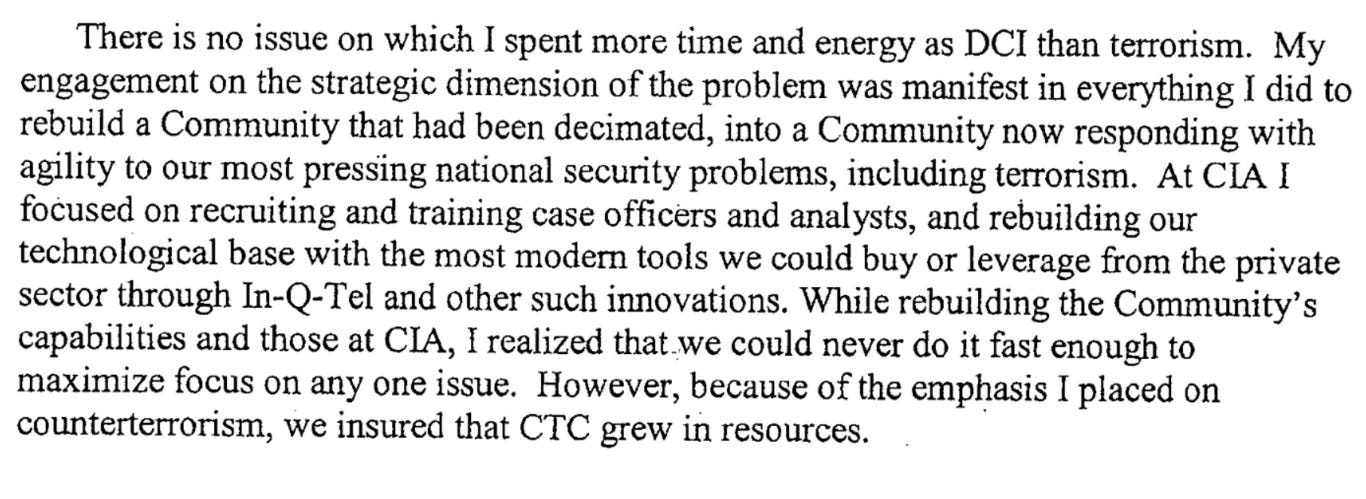
George Tenet added in his book At The Center Of The Storm: My Years at the C.I.A.:
“We [the C.I.A.] decided to use our limited dollars to leverage technology developed elsewhere. In 1999 we chartered ... In-Q-Tel. ... While we pay the bills, In-Q-Tel is independent of C.I.A.. C.I.A. identifies pressing problems, and In-Q-Tel provides the technology to address them. The In-Q-Tel alliance has put the Agency back at the leading edge of technology ... This ... collaboration ... enabled C.I.A. to take advantage of the technology that Las Vegas uses to identify corrupt card players and apply it to link analysis for terrorists [cf. the parallel data-mining effort by the SOCOM-DIA operation Able Danger], and to adapt the technology that online booksellers use and convert it to scour millions of pages of documents looking for unexpected results.” [-]
In-Q-Tel has funded Skydio, Anduril, Palantir, Microsoft, Google etc. It’s investments into military defense contractor Anduril may question of the above quote from H.B.Gary employees: “They don’t fund classified work”. Most recently, it funded Niantic, a company that stole every Pokemon Go player’s data in order to create a 3-D geospatial A.I. from the pictures on everyone’s phones[-], a massive and undisclosed privacy violation. Gilman Louie also happens to sit on the board of the company [-]. When considering the portfolio of In-Q-Tel, it becomes apparent that Augustine, Tenet and Louie have been the catalysts for the weaponization of civilian and user data. It is a weaponization characterized by A.I. and that uses civilian data to train algorithms or create data systems for warfare [-]. For further evidence, observe Taiclet’s comments made at the Reagan National Defense Forum quoted above. A 53rd law, in Augustine’s legacy, should not be an aphorism and rather blunt: “weaponize civilian life”.
Networks of information are being developed and weaponized against students as well. Steven Healy, former head of the Department of Public Safety at Princeton, helped found Social Sentinel, which scrapes information from students’ social media for the purposes of surveillance [-]. In addition, a former Palantir employee has helped oversee the camera expansion project at Princeton during their time in the Princeton Facilities Department [-] [-]. While it is not confirmed, it is not unlikely that these services have been used on Princeton’s own campus. Furthermore, it is important to emphasize that violations of privacy are, in spite of the name, not merely a private matter. Essential civil liberties such as freedom of speech are contingent on individual privacy, as surveillance necessarily causes or facilitates forms of censorship.
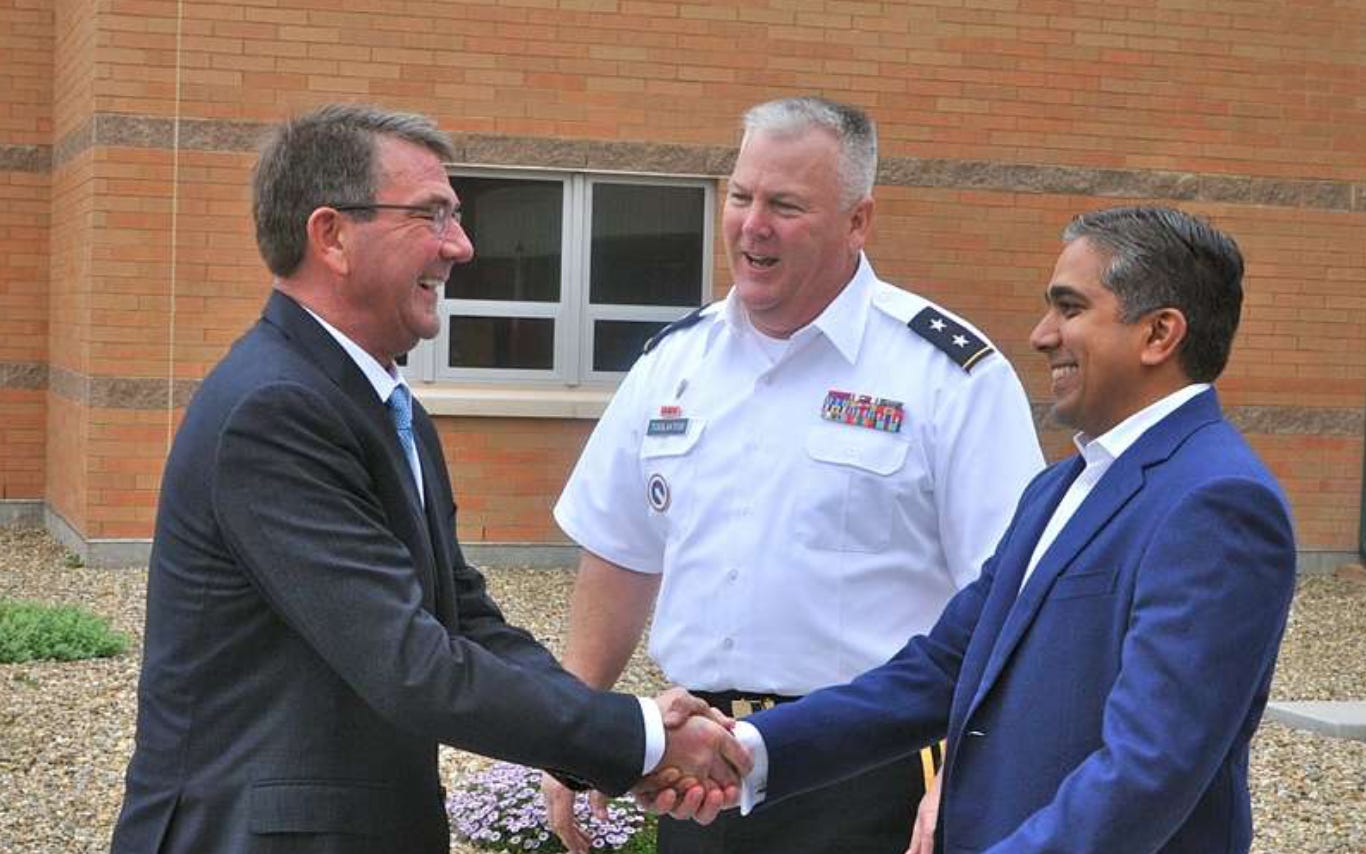
Secretary Ash Carter shaking hands with Raj Shah
Though Augustine is now quite aged, his influence is still being felt in the defense industry, not only as a result of his role in defense contractors, government positions and In-Q-Tel, but also as a mentor. Princeton graduate and air force veteran Raj Shah considers Augustine a mentor and appears to be following in his footsteps. In 2015, under the direction of then-secretary Ash Carter, he helped found Defense Innovation Unit X with Christopher Kirchhoff, which also created the National Security Innovation Network, and has become a venture capital arm of the U.S. Army. N.S.I.N. is hosted on Princeton’s campus as well to facilitate non-classified research between students and the military [see report on Princeton’s militarism -]. Today, Shah runs Shield Capital, a venture capital firm that invests in defense industries and also acts as a mediator between vendors and the D.o.D.. For example, Shah helped facilitate buyer-vendor relations between Shield A.I. and the D.o.D. [-]. Like Norman Augustine, he has been invited to come speak at Princeton [-] [-] [-] [-] [-]. Former Secretary Ash Carter is also part of the Shield Capital leadership [-].
In an interview on YouTube Channel “Combat Story,” Raj Shah recounts with pride his role in the Iraq war, which led to the deaths of hundreds of thousands of innocent civilians [-].
Today at Princeton...
The efforts that have led to passing Referendum #5, highlighting the student body’s support for divestment from arms manufacturers, echoes past demonstrations, including during the Iraq war at the hands of the U.S. military [-] [-]. During this time, students were arrested for protesting the war [-] [-], however a majority of students polled were in support of the Iraq war [-]. Today, the student body passed Referendum #5 with 68.5% of the vote, demonstrating the campus community’s more progressive values. The university has not acted on the results of this referendum, President Eisgruber even stating that referenda had no bearing in the University in spite of officials’ insistence that dissent should be expressed through proper channels. This is likely due to how profitable the Gazan genocide has been for Princeton trustees, donors and alumni. To achieve divestment will require that Princeton re-prioritize its students, staff and faculty rather than the “prestigious” ties or the investments it maintains [including the influence of donors]. Though divestment is the student coalition’s goal, this article has shown the deep complicity of Princeton decision-makers in all manners of warfare, and it is evident as a result that Princeton leadership must undergo significant modifications in order for the University to be aligned with the values it pretends to espouse. To begin, current trustees must be forbidden from voting on matters in which they have a conflict of interest. The Board of Trustees should also publish meeting minutes as the caretaking of students and the campus they live on is a matter of public interest. These immediate steps must be followed by an overhaul of the system by which trustees are appointed, in order to elect a governing body that is in service of the campus community’s interests, rather than the interests of capital. Continued pressure on trustees from campus activists is the only way forward.