


Summary: Princeton University proclaims that ideas, reasoning and intellectual endeavor are paramount to its mission: “In the Service of Humanity.” Despite this stated mission, it is difficult to find Princeton’s leadership enacting these values in the context of conflict and clashing interests in an international context. In fact, many of Princeton’s Trustees hold positions that conflict with the university’s supposed values of serving humanity: with Princeton Trustees in high-ranking positions in the defense industry, oil industry, venture capital, and the technological sector, their financial interests come into conflict with catastrophes such as climate change, genocide, and growing militarism worldwide. American universities—including Princeton—have done very little to respond to demands made by their students and protestors around the world for greater transparency and accountability for their institutions’ entanglements with perpetuating disasters, most recently in the context of Israel’s violations of international law and human rights in Palestine, which Amnesty International, Human Rights Watch, and multiple Israeli and international bodies have declared a genocide. This report therefore provides what the University will not: an exploration of the relationships between Princeton personnel—including trustees, donors, and prominent alumni—and the military as well as the Israeli government.
Introduction
The purpose of this series of documents is to explore Princeton’s ties to militarism and international conflict in the context of current foreign affairs. In particular, we must ask how foreign policy affects the research and conduct of universities amidst recent the United States’ recent sanctions on Russia and China, in contrast to unwavering support for nations such as the Saudi Government of Arabia, Israel, Qatar and the U.A.E. The documents focus on Princeton’s relationship to Israel, but lays the groundwork for future research that could be down with other authoritarian regimes worldwide. This report in particular describes how donors, prominent alumni, and trustees of Princeton have direct ties with, or interests in, military and foreign entities in Israel. We sidestep issues around Princeton employees, such as donations made by Title IX director Randy Hubert to the American Israel Public Affairs Committee, to focus on the important donors that influence many of the policy decisions at Princeton [-].
This work is even more important because publicly available records do not provide a clear picture of Princeton’s financial relationships with foreign entities. According to Section 117 of the Foreign Gift and Contract Reporting of the Higher Education Act of 1965, universities are required to disclose monetary exchanges with foreign entities [-]. These disclosures reveal a $335k contract between Princeton University and Israel from 2019 to 2023. This time period coincides with Israeli Ministry of Defense funding for the Romalis group in the Physics department referenced in our previous report on Princeton’s militarism [-] [D.S.C.A. 1000366232]. However, because the threshold for disclosure is $250k, such figures do not provide a complete picture of Princeton’s relationship with foreign entities—and in fact, Princeton has lobbied House bills that would reduce the threshold to $50k, which would thereby make foreign funding sources more public [DETERRENT ACT, Section 2a H.R. 5933 - -]. We have therefore focused on prominent donors, alumni, and trustees to show how money tied to international affairs influences Princeton in other ways.
Donors Don’t Matter, Do They?
The university maintains that its policy decision are independent from donor pressure. However, there has been precedent for Princeton making policy changes in response to donor concerns. In 2015 after the murder of Michael Brown, the Black Justice League staged a protest and occupied President Eisgruber’s office for 33 hours with a list of demands for racial justice, one of which was to remove Woodrow Wilson’s name from university buildings and programs. Eisgruber formed the Wilson Legacy Review Committee, a 10-member trustee committee that released a report in 2016 recommending against renaming [-]. However, in 2020, the Board of Trustees voted to drop Wilson’s name from what is now known as the School of Public and International Affairs, as well as from a residential college now known as First College, with Eisgruber citing the George Floyd protests [-]. Yet the reversal also came shortly after alumna and donor Kwanza Jones ’93 penned an open letter demanding that Princeton drop Wilson’s name, and alumna and donor Mellody Hobson ’91 donated $20m to establish a new Hobson College on the site of First College [-] [-]. It is not a coincidence that such reversal came after donors pressured the University to act.
In fact, donors are more important as ever. While young alumni are now donating less than ever with a recent sharp decrease from 52% of the class giving upon graduation in 2018 to 31% in 2022 [-], donations to Princeton are hitting record highs. The Annual Giving campaign brought in $67m just this past year and $82m in 2021-22 [-]. Universities—ostensibly in the service of humanity—are therefore increasingly beholden to private and corporate interests, reflecting a trend across a country where the top 1% possesses the same amount of wealth as the bottom 90% [-]. These Annual Giving donations are also not representative of the entirety of the donations that Princeton receives, as there is also a broader Venture Forward campaign which further accepts donations from uber-wealthy alumni [such as the creation of a new health center from Thomas Frist, a new bio-engineering building in part as a result of major gifts from Gilbert Omenn and Martha Darling, a new computer science building from Eric Schmidt, or a $100m donation from Gerhard Andlinger] [-] [-] [-] [-] [-] [-]. At UPenn, for instance, billionaire Ross Stevens threatened to pull a $100m donation in response to the UPenn’s handling of campus protests [-]. Donors and powerful alumni matter, as do trustees, who have complete discretion over divestment decisions at Princeton and whose meeting records are embargoed for 30 years. And given donor and trustee interest in the Israeli regime, the university will not divest from Israel’s violations of international law and human rights without active pressure—nor, for that matter, from defense contractors and fossil fuel corporations. Activism is required to either force the trustees go against their own interests or to pressure certain trustees with conflicts of interest to step down.
In the 1970s and 1980s, Princeton students fervently protested the university’s endowment ties to South Africa. President Goheen stated that the university would miss out on $3.5m of earnings if it were to divest from all 39 companies proposed by the students but at least offered some concessions, even if it were just an effective dialogue. In 1979, Larry Hamm and George Riley led South African protests at Princeton, including the 27-hour Nassau Hall sit-in and carrying signs stating “Get The Tiger Out Of South Africa” [-]. In contrast to President Goheen’s direct stance, President Eisgruber has offered no dialogue and insisted on the ambiguous position of institutional restraint [-]. In addition the university is more intransigent and harsher. It is taking the Clio Hall sitters to court as opposed to the students who participated in the Nassau Hall sit-in, for which only disciplinary warnings were distributed.
Even after the South African divestment protests, the university never divested and only did so when in 1994, it was completely pointless [-]. This is a reflection of the fact that university administration will never be exceptional in a corporate America. Therefore, direct pressure on trustees and donors is paramount. We will now explore these individuals.
Ties To Or Support For Israel On The Board Of Trustees
Based on donation data, major donors occupy 25% of seats on Princeton’s Board of Trustees, and about a quarter of the trustees are high-net-worth individuals worth over $10m [- -]. A thorough piece on the role of donors on Princeton’s campus and as climate denialists can be found here [-] with an excellent analysis of many of the trustee relations [-]. While alumni vote for 13 trustees, the process by which alumni are chosen and called to serve is purposefully opaque [-]. In addition, Charter Trustees and Term Trustees are internally selected and compose the majority of the Board. As a recent Princeton Alumni Weekly article states:
“Princeton wants alumni to think they have a voice, but the Board of Trustees is an opaque, largely undemocratic ladder that leads to extraordinary power well beyond the campus walls.”
The author has researched each current trustee on Princeton’s board, and Divest Princeton—the student activist group calling for fossil fuel divestment—has compiled a report on the board [-]. The following are those with the most explicit ties to Israel.
Among those with financial and employer ties is Salesforce Senior Adviser, Edward H. Felsenthal. Salesforce does a large portion of its development and business in Israel. Salesforce C.T.O. Meir Amiel stated in 2024, “Salesforce is committed to Israel. We leave politics out of the company” [-]. Salesforce appears to also have a reliance on Israel for technological competitiveness: “One of the reasons Salesforce came to Israel many years ago was due to the assumption that we could find a lot of talent around AI.”. Since the start of the genocide, Salesforce has increasingly deepened its ties with Israel via purchases of Israeli companies and shifting data centers [-] [-].
Princeton benefactor and Highland Capital Partners Founder and Chairman Paul Maeder: Highland Capital Partners is an enormously influential hedge fund which has historically had holdings in Israel and is highly likely to have kept such holdings [-]. Maeder has also made significant donations to the university, though the amount could not be obtained. It is, however, enough to have a hall within Andlinger Center—the result of a $100m donation—named after him. Maeder served as a term trustee beginning 2015 and was elected as a charter trustee in 2020 [-].
Elizabeth Prus Myers, global chairman of J.P. Morgan. Megalithic investing firm, J.P. Morgan Chase, has holdings in Israel and has offices in Israel [-]. It has only expanded its operations there since late 2023. J.P. Morgan has also financed $48k of sponsored research at Princeton in F.Y. 2023 [-].
Former executive chair and CEO of Celgene Corporation and Senate candidate, Bob Hugin: When Trump moved the U.S. embassy to Jerusalem, Hugin called it historic [-] [-]. Celgene, which sponsors research at Princeton [over $1m during the last 5 years], is a subsidiary of Bristol Myers-Squibb which holds offices in Israel [-] [-]. The Hugin Family Foundation Inc. “donated” over $2.6m to Princeton from 2009 to 2017, some of which was prior to Hugin’s position as a charter trustee on the Board of Trustees.
Anthony Yoseloff is a major donor to Princeton [having helped construct Butler college, which Yoseloff Hall is named after him] along with being a charter trustee [-] [-]. His political donations to mostly Republican candidates along with deeply pro-Israel politicians Josh Gottheimer [about $20k] and Bob Hugin [$5.4k] indicate his pro-Israel position. Yoseloff has also donated at least $1m up until 2019 to Princeton University.
James Yeh is C.I.O. of Citadel Investment operated by Kenneth Griffin who is deeply supportive of Israel [-]. Griffin called the student protests “anarchy” [-]. Yeh has also donated to the university [with Yeh college named after them] and predominantly Republican candidates. Yeh also donated $5.4k to Hugin’s political races.
Tim Kingston of Goldman Sachs has major holdings in Israel including offices [-].
Louise Sams of Turner Broadcasting Systems and now CoStar Group and the longest tenure of any trustee was once honored at an A.D.L. luncheon [-].
Blair Effron is another current trustee member, with important ties and a role in foreign policy, who will be covered below.
Note: There are extremely direct ties to Israel via militarism as well, but those are left to a later part of this series. Therefore, this list is not complete in all its ties to Israel and will be complemented later on.
The Ex-Officio Princeton Trustee And The NJ State Government’s Affairs With Israel
Within the domestic political sphere, Phil Murphy, current governor of New Jersey, is an ex-officio trustee of Princeton University. Though Murphy is unlikely to directly participate in trustee decisions, his place on the Board of Trustees marks the mutual interests and ties of Princeton University with the N.J. state government. Unsurprisingly, his position as a politician has implicated him as a supporter of Israel with ties to militarism. The two cannot be disentangled when speaking of Murphy because of certain organizations that are specific to the state of New Jersey.
Governor Murphy is a staunch economic supporter of Israel. By means of anti-B.D.S. pro-Israel laws applied to the N.J. pension fund, Murphy pulled $182m from Unilever, the parent company of Ben&Jerry’s in 2021. Ben&Jerry’s made anti-occupation statements and pulled its business from the occupied Palestinian territories [-]. Murphy is considering enacting this policy again over Japanese company Itochu, which has cut ties with Israel over the on-going genocide [-]. Although Gov. Murphy has called for a ceasefire, his remarks have shown at a consistent lack of understanding, and engagement with the issue, that defers to the I.D.F.:
:
“Let’s remember Hamas started this” [-].
In fact the ties between Israel and Gov. Murphy, and thereby the N.J. government run much deeper. As of 2023, the N.J.-Israel commission stated that: “Since Governor Phil Murphy was sworn in in 2018, foreign direct investment from Israel has multiplied four times and is today worth $347.1 million” [-]. NJ also had $1.72b in trade with Israel by the end of 2022. In addition, the state has a NJ-Israel commission to facilitate the exchange of technology and education between the two governments [-] [-].
In addition, a member of Princeton’s Office of Innovation, Judith Sheft, is also a member of the NJ-Israel State Commission. Sheft is often mentioned as an employee in our piece on Princeton’s militarism, who helps facilitate research relations between Princeton and defense contractors. In 2019, she was chosen to also be appointed as the Executive Director of the New Jersey Commission on Science, Innovation and Technology, which in part corresponds with the Israeli government [see report on Princeton’s Militarism for further details on Sheft -] [-].
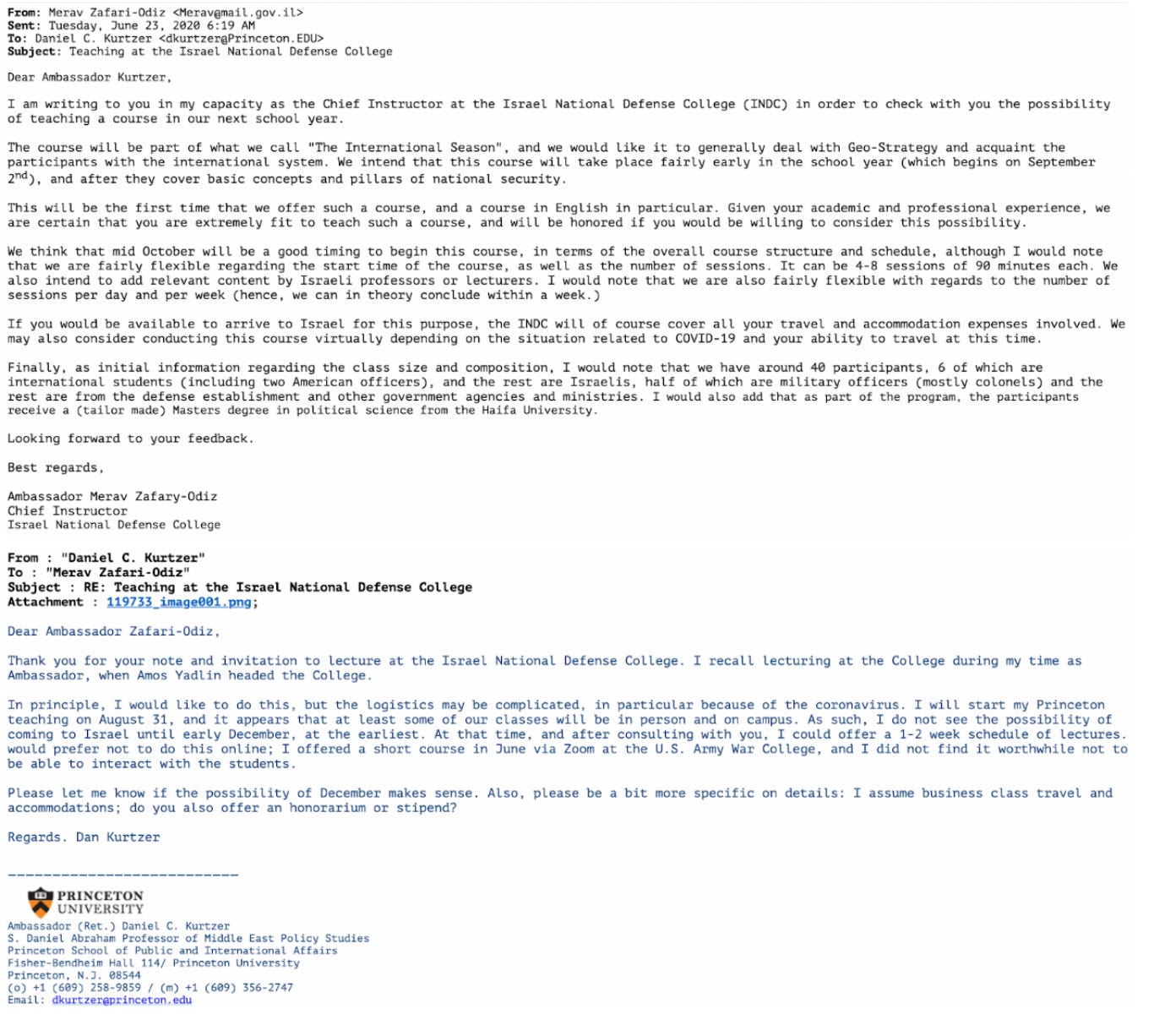
The N.J. Israel commission also hosts professors from several universities in New Jersey, along with having helped facilitate Memorandum of Understandings between Israeli universities and Rutgers, N.J.I.T., etc [-]. Interestingly, with respect to Princeton, Vivian Futran Fuhrman, another member of the N.J.-Israel Commission, works at Princeton’s Andlinger Center for Energy and the Environment as its Assistant Director for External Partnerships. [-]. Daniel C. Kurtzer, who was Ambassador to Israel under George W. Bush, is a member of the N.J.-Israel Commission, as well as the S. Daniel Abraham Professor of Middle East Policy Studies at Princeton [-]. Unsurprisingly, Kurtzer has also potentially gone to teach at the Israel National Defense College during the summer of 2021 as is documented in a Library-of-Leaks file [-]:
Kurtzer is also documented in the following pro-settlement exchange [-]:
“Kurtzer himself reiterated this point on Israel’s Channel 10 television: “Those commitments are very, very firm with respect to these Israeli population centers; our expectation is that Israel is not going to be going back to the 1967 lines.” When asked if these “population centers” were “settlement blocs,” he replied: “That’s correct.”” [-]
Another member of the N.J.-Israel commission, on the Education Committee, is defense contractor executive at Valcor Engineering, Lori Klinghoffer. This is to illustrate that the technologies and education meant to be exchanged are not just of the cultural type. Klinghoffer is Chair of the United Israel Appeal, an organization that assists in immigration and birthright trips to Israel. [-] [-].
In fact, the N.J.-Israel Commission plays a key role in facilitating defense contractor business, as demonstrated in the Atlantic County Economic Alliance [A.C.E.A.] N.J. 2021 annual report:
“In March 2021, the A.C.E.A. leveraged relationships with the N.J. Department of State’s New Jersey/Israel Commission to attract international aerospace firm, Israel Aerospace Industries [I.A.I.], to Atlantic County to showcase its state-of-the-art travel-safety products.” [-]. This aligns with the Commission’s long-term goals, as expressed by Mark Levenson of the N.J.-Israel Commission at the Propelify tech event:
“We want Israeli companies to open up their headquarters here in NJ” [-]
New Jersey has also collaborated with other Israeli cyber companies such as Pentera, which was given a B.I.R.D. Cyber award [-]. In 2020, Andrew Gross, in conjunction with P.S.E.G., hosted drone tech showings developed by Israeli defense contractor Elbit Systems to discuss collaborations with NJ state [-]. Elbit Systems has also invested in Atlantic County’s electricity infrastructure [-].
As Mark Levenson further stated:
“New Jersey is the only state in the union of the United States to have a state entity solely dedicated to Israel and New Jersey relationships”.
While a N.J.-Israel commission is a unique setup, it raises significant concerns. Under Holmes v. Jennison, a case that ruled state governments cannot engage in foreign affairs without federal authorization, the Commission’s role might be seen as a potential violation of states’ rights [-].
Princeton Benefactor Blair Effron And The Council On Foreign Relations
There are close connections between Princeton and the Council on Foreign Relations [C.F.R.], a think tank that aims to influence U.S. foreign diplomacy. It is so influential that it is known as Wall Street’s think tank. Its membership has been quite storied, with one of its most notable members being Henry A. Kissinger, whose influence over U.S. foreign policy is hard to overstate [-]. Kissinger was a pivotal architect of the U.S.-Israel strategic alliance, a foundation underpinning Israel’s strength and security today [-].
C.F.R. has extremely close connections with Princeton. It is currently headed by Princeton graduates C.F.R. President Michael Froman and Vice-Chair Blair Effron. Froman is regularly featued in Princeton Alumni Weekly [- - - -]. He also came to speak at Princeton on Feb. 12th, 2025 and stated a pro-occupation stance, as it defers to Israel’s judgement with respect to abandoning its own ceasefire deal: “I think the challenge of Phase 2 [of the ceasefire] is that it fundamentally involves Israel negotiating its withdrawal from Gaza, and without knowing what the future of Gaza is, who’s going to provide security? Who’s going to govern? What the economic reconstruction plan is... It’s hard for any Israeli government to agree to negotiate a withdrawal at this point.” [-]. Froman’s comments ignore the original ceasefire deal wherein Israel agreed to sequentially withdraw itself from Gaza; Israel has reneged on its agreement to withdraw from the Philadelphi corridor during Phase 2 [- - -]. These comments also ignore Israel’s abandonment of its cease-fire agreement to allow aid to flow into Gaza, along with its broader ethnic cleansing including the largest displacement of people in the West Bank since 1967 [- -]. Furthermore, this interview structurally implies that the Palestinian people do not have, nor deserve to have, any autonomy over their own fate.
Effron, a regular donor to A.I.P.A.C., is a part of the Century Society, the C.F.R. leadership group of Annual Fund benefactors; he donated over $100k to C.F.R. in 2022, 2023, and again in 2024 [-] [-] [-]. Effron has been a Princeton trustee since 2016 [-] [-]. He has donated enough to have several buildings on campus named after him: the Effron Center For The Study of America and the Effron Music Building [-] [-]. In addition, the Cheryl and Blair Effron Foundation gave $500k between 2010 and 2014 alone [-]. David M. Rubenstein, the chairman at C.F.R., has been on the Woodrow Wilson School Advisory Council at Princeton and regularly donates to C.F.R. in excess of $100k [-] [-]. In addition, he founded a hedge-fund, the Carlyle group, that is deeply invested in arms manufacturing and defense contracts. Through its private equity arm, the Carlyle Group has held significant stakes in companies such as Booz Allen Hamilton (previous holdings), ManTech, and Two Six Technologies [-] [-] [-]. As late as 2018, Akerson from the Carlyle Group was on Lockheed Martin’s Board of Directors [-]. In addition, Princeton trustee member Timothy Kingston is also a member of the C.F.R..
The C.F.R.’s current membership is strongly pro-Israel. Notable members include Lloyd Blankfein (Goldman Sachs), Mark Penn (Stagewell Private Equity), Josh Harris (Apollo Global), Malcolm Hoenlein (Conference of Presidents of Major American Jewish Organizations), Stephen Schwartzman (Blackstone), who have all donated to A.I.P.A.C. [-]. In addition, another member Thomas Dine played a crucial role in A.I.P.A.C.’s rise as a former executive director. The current C.E.O. and the National Director of the Anti-Defamation League (A.D.L.), Jonathan Greenblatt and Abraham Foxman, are also members of C.F.R.. Former C.F.R. president, Richard Haass, wrote an op-ed in late 2023 stating his support for Israel. Billionaire and Princeton benefactor Michael R. Bloomberg, who supports pro-Israel policies and donates to A.I.P.A.C., is also a member and major donor to C.F.R. [-].
Jami Miscik, former C.I.A. Director of Intelligence and Vice-Chair of C.F.R., serves on the boards of Morgan Stanley and In-Q-Tel, an C.I.A.-backed hedge fund founded by Princeton donor and former C.F.R. member Norman Augustine [-] [-]. Following Augustine’s legacy, Lockheed Martin CEO James Taiclet also holds a seat on the CFR board. In 2022, Taiclet contributed $25,000–50,000 to the organization [-]. Lockheed Martin supplies Israel with weapons and naturally for profit.
C.F.R. also has various members involved in technology and arms manufacturing. Two Google executives reside on its board of directors: James Manyika and Ruth Porat. Eric Schmidt and Princeton alumni Fei-Fei Li are also members of C.F.R. [-]. Eric Schmidt is also a regular donor to C.F.R. [-]. In addition, General Dynamics and Lockheed Martin have associations with the C.F.R. through Charles Hooper and Jeh Johnson. Other arms manufacturing executives associated with C.F.R. include Heather Wilson (Google and Lockheed Martin) and Ann Marie Fudge (Northrop Grumman) [-]. Raytheon, Northrop Grumman and Google have also additionally aided Israel [-] [-].
C.F.R. has major corporations among its donor members, including J.P. Morgan Chase, Morgan Stanley, Goldman Sachs, Amazon, Meta, Apple, Microsoft, Google, Blackstone, BlackRock, Lockheed Martin, Northrop Grumman, Booz Allen Hamilton, Merck, and others. Many of these corporate members have senior executives or leadership personnel serving on C.F.R.’s board, highlighting the close ties between corporate influence and policy development.
Despite taking giant and numerous donations, the C.F.R. states that “it takes no institutional positions on matters of policy” before every interview or talk it gives.
Federally Facilitated Research With Israeli Universities And The Binational Foundations
Aside from donors and trustees, what other barriers to divestment could there be? It turns out that the federal government often facilitates ties with Israeli universities and sectors of government, such as the previously referenced D.S.C.A. funding to the Romalis group. Accepting this form of funding creates barriers to academic and overall divestment. Though these grants do not determine anything in terms of policy, it is important to acknowledge them as an additional obstacle to complete divestment given the research funding that is received as a result of the collaboration between the U.S. and Israel governments. Of course these sources of funding are only one part of the research ecosystem of collaboration between Princeton and Israeli universities [of which there would be too many to list, though it would be fruitful to investigate some for possible military purposes]. In addition, the funded research summed up below does not infrequently have military applications.
D.o.D. facilitated grant with Hebrew University of Jerusalem on algorithms to produce images of objects hidden around corners for example and in low-light conditions, which is useful for computer vision: $383k in F.Y.18. This grant is highly likely to be used for military purposes [HR001116C0027 -]
With Tel Aviv University on algorithms for Cryo.-E.M. imaging: $1.58m over the last 2-3 years [R01GM136780 -].
The U.S.-Israel Binational Science Foundation and the Binational Industrial Research And Development Foundation are organizations which facilitate research projects between American and Israeli universities and industry. Though the foundation states that it only funds studies of fundamental learning and for non-profit purposes, evidence shows that it often coincides with military research funding as well. Princeton has published numerous articles [too many to collect] over the years that have been facilitated by such foundations. To name a few: Bogdan Andrei Bernevig who researches topological states is often a recipient [along with being often sponsored by the Schmidt Fund For Innovative Research] [Navy Funded N00014-20-1-2303 B.S.F. Grant # 2018226 - - -] and Antoine Kahn [U.S.-Israel B.S.F. Grant # 018349 -, collaborators at Arizona University were funded by Naval grant N00014-22-1-2379] and H. Vincent Poor on 5G-6G mobile communications research [U.S.-Israel B.S.F. CCF-1908308 - - in collaboration with the N.S.F.] and Noga Alon on mathematical cryptography and theoretical computer science [Grant # 2018267 -]. Over the last 5 years alone the U.S.-Israel B.S.F. has financed about $425k at Princeton in sponsored research [-].
To Achieve Divestment From Israeli Apartheid
In summary, divestment from Israel will require that the university cut research ties to Israeli universities [especially the illegal Ariel settlement -] along with refusing U.S.-Israel B.S.F. funding. In addition, its trustees and advisers would have to be forced to go against their own interests rather than serving in the public interest of its community. Therefore, the only path suitable to divestment is to carry out actions and strikes that raise the cost so much so that it forces administration to rebel against the trustees and thereby apply bottom-up pressure on these individuals who possess enormous wealth and power.
03/03/25