

The U.C.’s financial ties to the military extend beyond its investments. Where U.C.’s money goes, research funding follows. The U.C. regularly accepts research funding from agencies within the Department of Defense and military contractor partners. Inevitably, research funded by these sources caters to military interests.
Academic research funded by D.o.D. agencies constitutes a critical portion of the process for developing military technologies. Historically, research into high risk technologies is supported by government funding, exploiting cheap labor from academic workers at universities for the military’s benefit. In venture capital parlance, D.o.D. funding agencies provide “seed money” for research that align with US “national security” interests. These research projects constitute the UC’s most direct contributions to the US military apparatus.
In just one year, Israel dropped over 70,000 tons of explosives on Gaza, more than five times the weight of the nuclear bomb dropped on Hiroshima, in an area three times smaller. Such devastation and carnage is the outcome of an advanced pipeline of research and development, including work carried out at academic institutions. U.C.L.A. labs conduct research in bomb manufacturing, hypersonic missiles, laser weapons, A.I.-assisted targeting, and military aircraft—all technologies that are directly implicated in the bombing of Gaza. These U.C.L.A.-led research programs fuel the early development of next-generation military technology used to perpetrate ongoing and future genocides.
The U.C.L.A. community, especially workers whose labor feeds into this body of military research has a right to know the extent of U.C.L.A.’s research in fueling violence around the globe. The public deserves to understand the implications of association with an institution with a vested interest in bloodshed. It is imperative that U.C.L.A.’s military research programs are thoroughly scrutinized, and we further demand that U.C.L.A. sever all ties with these projects. Below, we highlight several labs, their links to military funding, and their collaboration with defense contractors.
Bomb Manufacturing
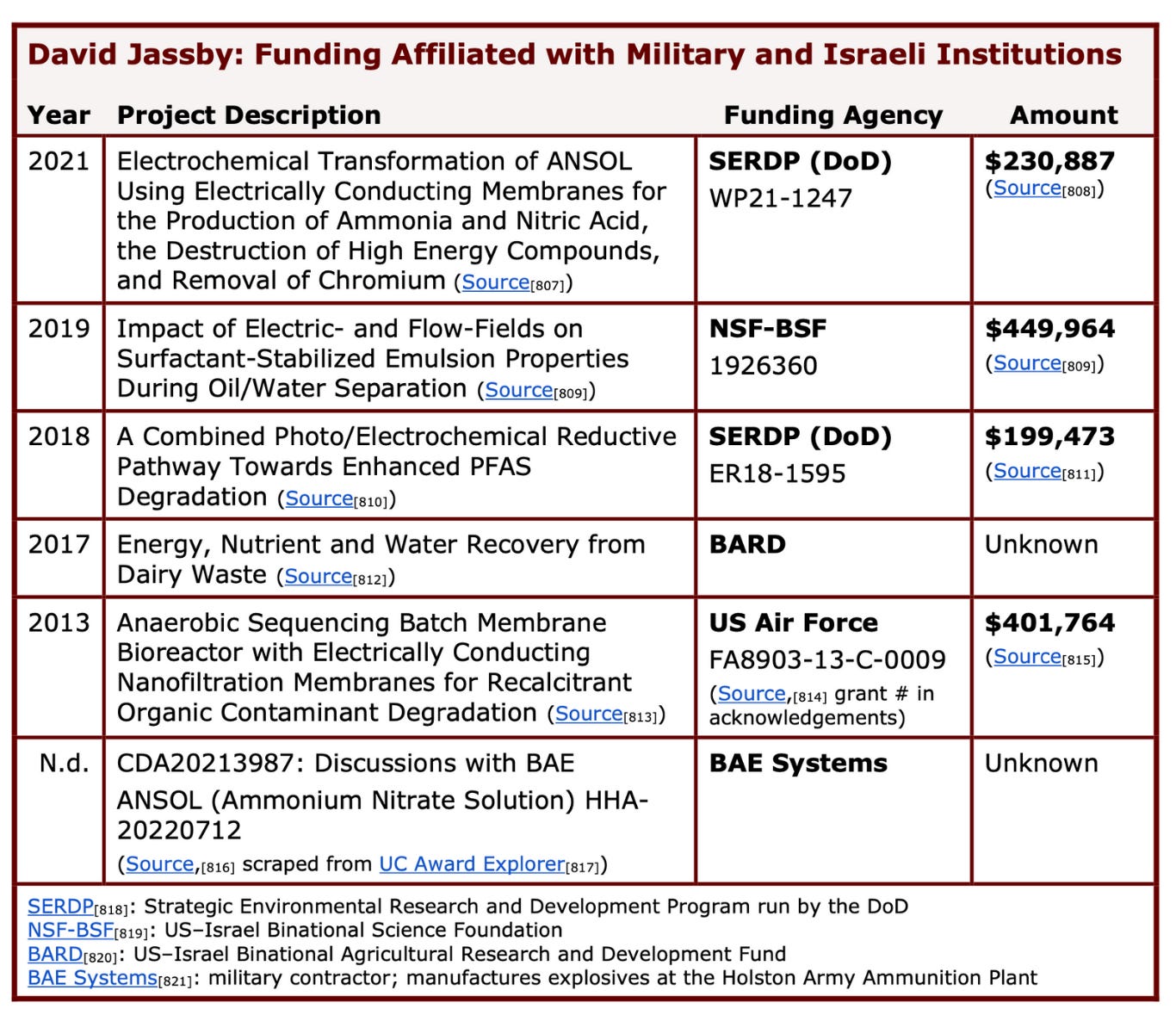
The Water Technologies Group, led by U.C.L.A. Professor of Civil and Environmental Engineering David Jassby, contributes to a D.o.D.-funded project aimed at improving B.A.E. Systems’ bomb manufacturing process. B.A.E. Systems is contracted to operate the Holston Army Ammunition Plant, a facility that produces explosives used for munitions such as the 155M artillery shells and Hellfire missiles that the U.S. supplies to Israel. In 2021, Jassby was awarded a grant funded by a SEDRP initiative exploring the “valorization of waste streams from manufacturing explosives”—in other words, Jassby was awarded a grant aimed at making bomb production more cost-effective. To conduct this research, the Jassby group procures A.N.S.O.L., a waste product from explosives manufacturing, from the Holston Army Ammunition Plant via a “Materials Transfer” facilitated by B.A.E. Systems. In other words, the production of bombs directly fuels this research program.
Public-facing information portrays this research program as an ecologically conscious initiative. Quite contrastingly, the aim of “valorizing waste” from manufacturing bombs is driven by motivation to increase economic efficiency, allowing for the production of more bombs which in turn fuel environmental pollution. Significantly, Jassby’s lab website omits any mention of this lucrative partnership with B.A.E. Systems. When it comes to providing the means for perpetrating genocide, institutional structures readily mask their complicity.
Jassby also has extensive ties to Israeli military development, including a variety of projects funded by U.S.–Israel bilateral agencies (see table above). These projects involve collaborations with Israeli institutions including Technion-Israel Institute of Technology and Ben Gurion University. In addition to his work on explosives manufacturing, Jassby’s “wastewater treatment” and “water desalination” projects, while sounding innocuous, carry geopolitical implications, especially as Israel weaponizes access to ammonium nitrate (fertilizers) and water to sustain its apartheid system. Building off this research, Jassby cofounded Active Membranes, a wastewater treatment start-up that recently carried out pilot desalination programs in Israel. Ever keen to commercialize its research programs, UCLA has invested in Active Membranes through Venture at UCLA Anderson and Magnify at CNSI.
Hypersonic Missiles
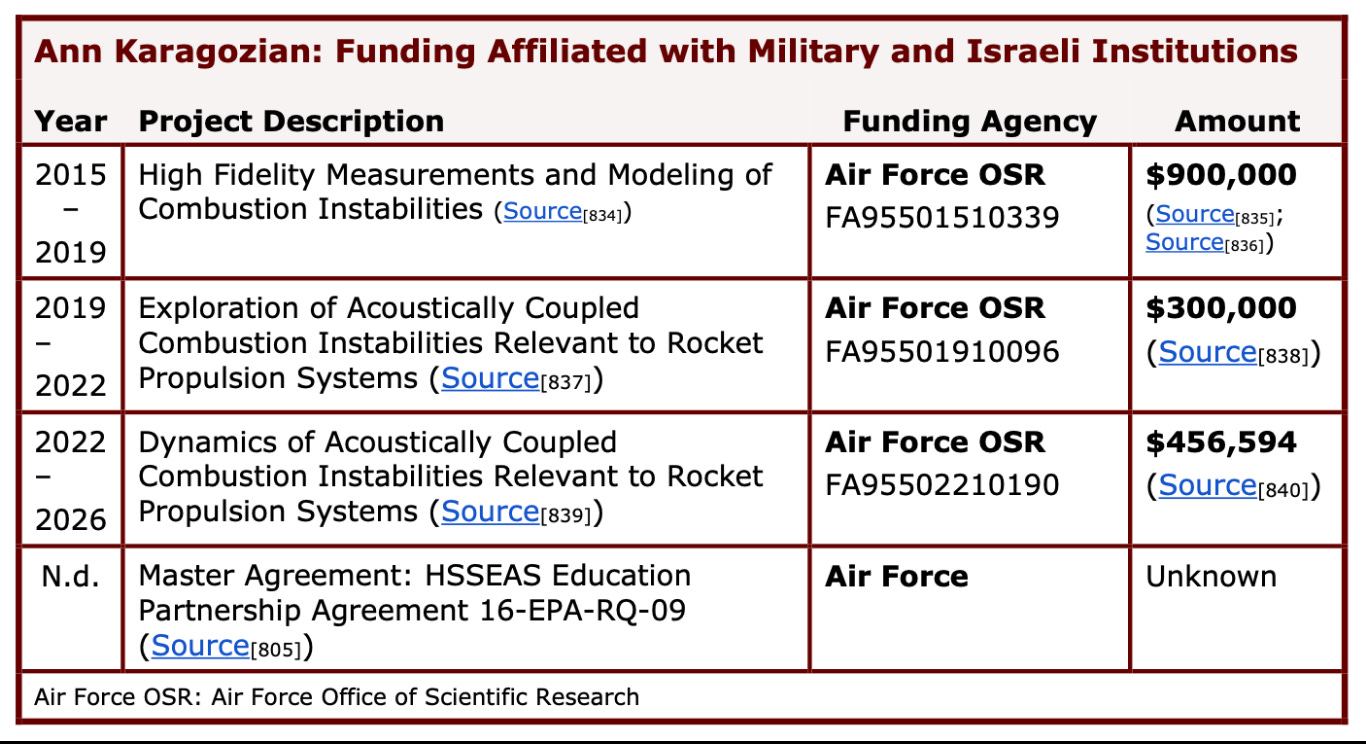
UCLA collaborates extensively with the Air Force Research Laboratory at Edwards Air Base via the Collaborative Center for Aerospace Studies. Professor Ann Karagozian, who leads the Energy and Propulsion Research Lab, conducts research testing air-launched missiles using F-15 aircraft, with the objective of developing missiles that can reach hypersonic speeds in the Mach 3-6 range. Karagozian has sat on numerous Air Force Science Advisory Boards, with chilling titles including “Targets and Effects, Long Range Strike Study” and “Hard and Deeply Buried Targets.” According to available documentation, Karagozian has received at least $1.6M in Air Force Funding for her work. Karagozian’s CV also boasts a long list of students that have gone on to work in the defense industry, including for companies such as Raytheon, Boeing, Aerospace Corporation, Defense Innovation Unit, Northrop Grumman, Lockheed-Martin, and Air Force Research Lab.
Military Aircraft
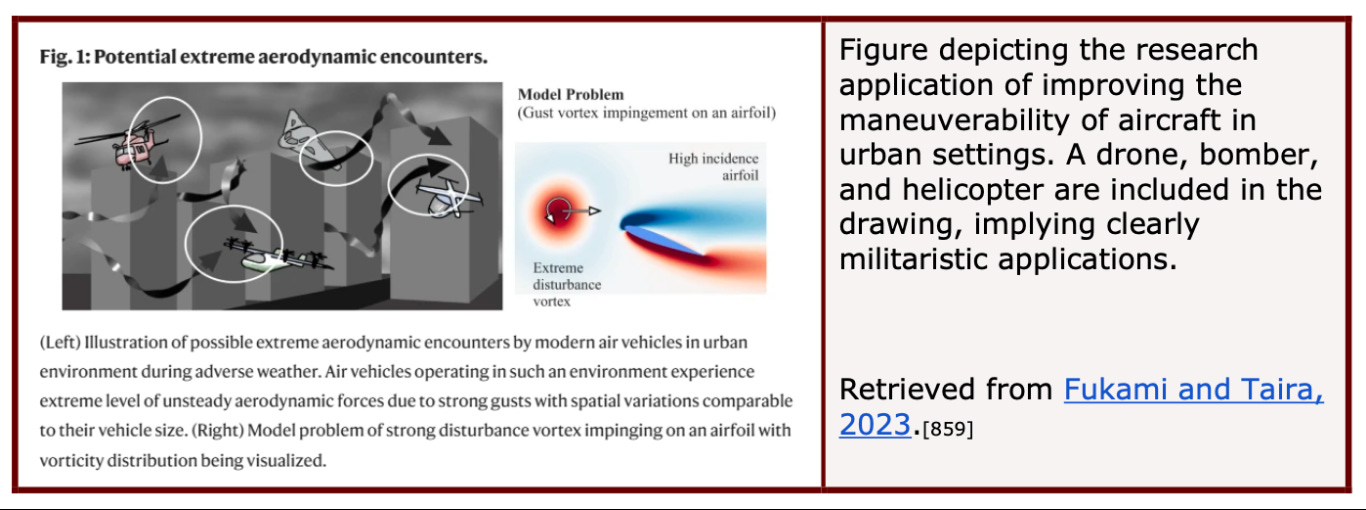
UCLA employs Professor Jason Speyer, whose 50-year career has made him an expert on “the guidance, navigation and control systems of vital aerospace and military craft.” Speyer, who previously worked for Boeing and Raytheon, currently holds the Ronald and Valerie Sugar Chair of Engineering, a position that was established through a $1 million donation. It should be noted that the donor and namesake of this chair, Ronald Sugar, was C.E.O. and chairman of Northrop Grumman from 2003–2010, a period during which defense contractors profited greatly from the US invasions of Iraq and Afghanistan. Speyer’s publications include DARPA-funded research on optimizing drone strikes, optimization models for battle, missile guidance and defense, and autonomous flight for fighter jets. In parallel with his research at UCLA, Speyer helped found and served as CTO of SySense, a start-up founded “by a group of engineers from UCLA” focusing on autonomous flight that lists the Air Force, Navy, Boeing, Lockheed Martin, and General Atomics as customers. Throughout his career, Speyer has also held at least two positions at Israeli universities and is a signatory on this letter condemning UCLA students protesting Israel’s genocide. Articles describing Speyer’s research provide further insights into the trajectory of his research throughout his career. A UCLA mechanical engineering press release recognizes the application of Speyer’s work in the Patriot missile system, Advanced Fighter Technology Integration in F-16s, and autonomous flight formation for pairs of F-18s. Given Israel’s widespread use of drones, F-16s, and autonomous guidance systems in its bombing campaigns, it is entirely conceivable that Speyer’s decades of research at UCLA is directly linked to Israel’s genocide against Palestinians. UCLA also hosts research aimed at developing the next generation of military aircraft. Professor Kunihiko (Sam) Taira, PI of the Computational and Data-Driven Fluid Dynamics Group, received the top DoD faculty award (a Vannevar Bush Fellowship worth $3 million) for a project titled “Extreme Aerodynamics: Grasping the Unknown Skies,” with a stated aim of enhancing DoD capabilities by establishing a “new field of extreme aerodynamics [to] support the designs and operations of next-generation air vehicles.” This article describes the challenge of this research—improving the maneuverability of next- generation small air vehicles in urban or mountainous terrain—and states its envisioned application: the deployment of drones used in defense and surveillance in urban environments.
Taira’s CV[860] discloses further funding from the DoD, including $8,308,563 for projects on which he serves at PI and $6,591,549 for projects on which he is co-PI. While Taira’s research is still in its early phases, it’s easy to imagine—especially given the precedent set by senior colleagues at UCLA—how this work will make its way into military drone technologies of the future.
A.I.-Assisted Targeting
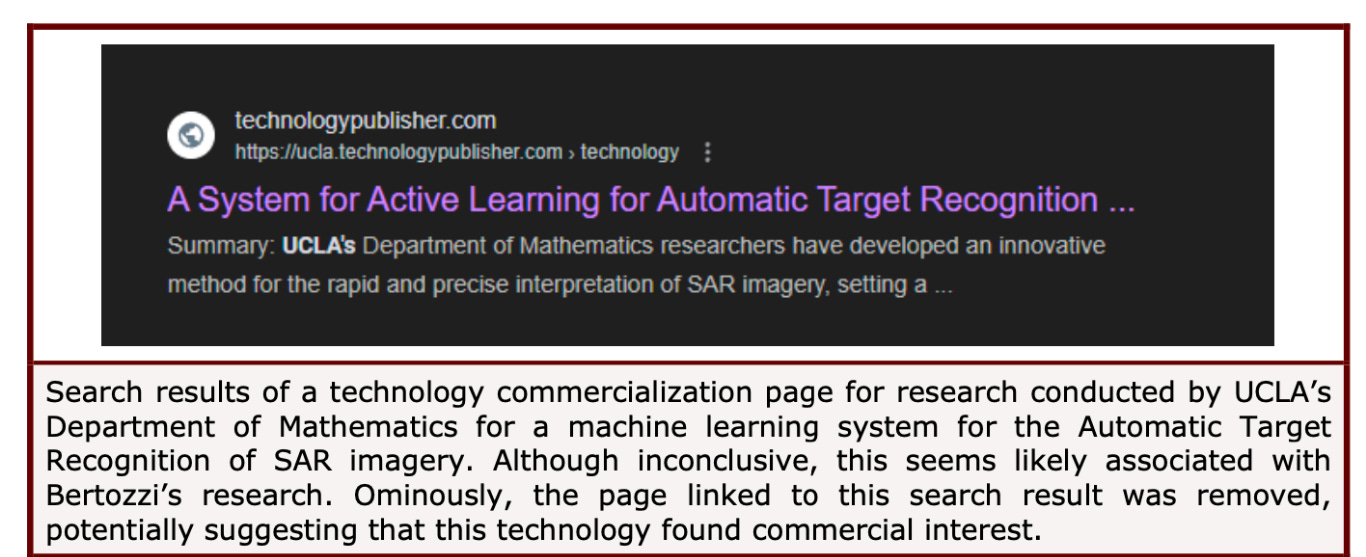
Given Israel’s widely reported use of AI-assisted targeting for airstrikes in Gaza and Lebanon, UCLA’s DoD-funded research on Automatic Target Recognition is especially detestable. Professor Andrea Bertozzi was awarded a $400,000 grant from the National Geospatial-Intelligence Agency, a military intelligence arm of the DoD. This grant yielded a proceedings paper titled “Novel batch active learning approach and its application to synthetic aperture radar datasets,” which was recognized as “Best Student Paper” at the SPIE Defense Conference. This work essentially proposed a system for partially supervised active learning to enhance the Automatic Target Recognition algorithm.
Similar algorithms for “target detection” are used in “Habsora” (or “The Gospel”), a key feature of the IDF’s “mass assassination factory” that emphasizes “quantity and not on quality.” Automatic Target Recognition is a feature heralded by Israeli arms manufacturer Rafael for its use in SPICE-family air-to-surface missiles, developed in partnership with US military contractors. Even more alarming, this technology was marketed on the UCLA Technology Publisher database. It has since been removed from the platform, suggesting that some external organization has already acquired this algorithm. While the applications of this algorithm are still unknown, it is absolutely conceivable that it will be used in missile guidance or target selection systems.
Although much of Bertozzi’s work is couched in relatively benign language, these detailed descriptions reveal a program of research that serves military and policing agendas in developing technologies to target oppressed and marginalized people. DoD funding has quietly adapted Bertozzi’s machine learning research into a tool of war and oppression. Bertozzi’s research made integral contributions to PredPol, the predictive policing software company led by former UCLA professor Jeff Brantingham. As revealed in a series of investigations by the Stop LAPD Spying Coalition, Bertozzi and Brantingham collaborated on a project funded by the Army Research Office to develop algorithms that predict “insurgent activity” based on data obtained from the US’s invasion of Iraq. PredPol was subsequently adopted by the LAPD and used to predict areas of higher crime in Los Angeles. PredPol rapidly expanded across multiple cities through the financial backing of investors including the UCLA Venture Capital Fund. The Stop LAPD Spying Coalition ultimately led a successful campaign that ended the LAPD’s use of PredPol, but research in target recognition algorithms continues to brew in UCLA labs. From Palestine to LA, research in AI-assisted targeting leads to violent repression against Black and Brown communities, and it is imperative that we demand accountability from the UC for its research activities.
Laser Weapons
Futuristic weapons systems are also developed at UCLA. Researchers at UCLA’s Beam Control Lab (PI Steve Gibson, Co-PI Tsu-Chin Tsao) are developing laser weapons. Gibson and Tsao’s labs were part of a Multidisciplinary Research Initiative (MURI) managed by the DoD’s Joint Technology Office on High-Energy Lasers. One project, titled “Tactical High-Energy Laser Weapon Alignment System Architecture Efficiencies,” received $6.1 million in funding from the Office of Naval Research (ONR Grant #:N000140711063) to develop “high-performance laser weapons” that “deliver energy to the target through the atmosphere in applications including the high altitude Airborne Laser (ABL), low altitude tactical battlefield scenarios, and marine scenarios.” The project’s stated objective is to “improve the performance of high energy weapons systems in the range of scenarios of interest.” These descriptions appear in a document available on the project’s website.
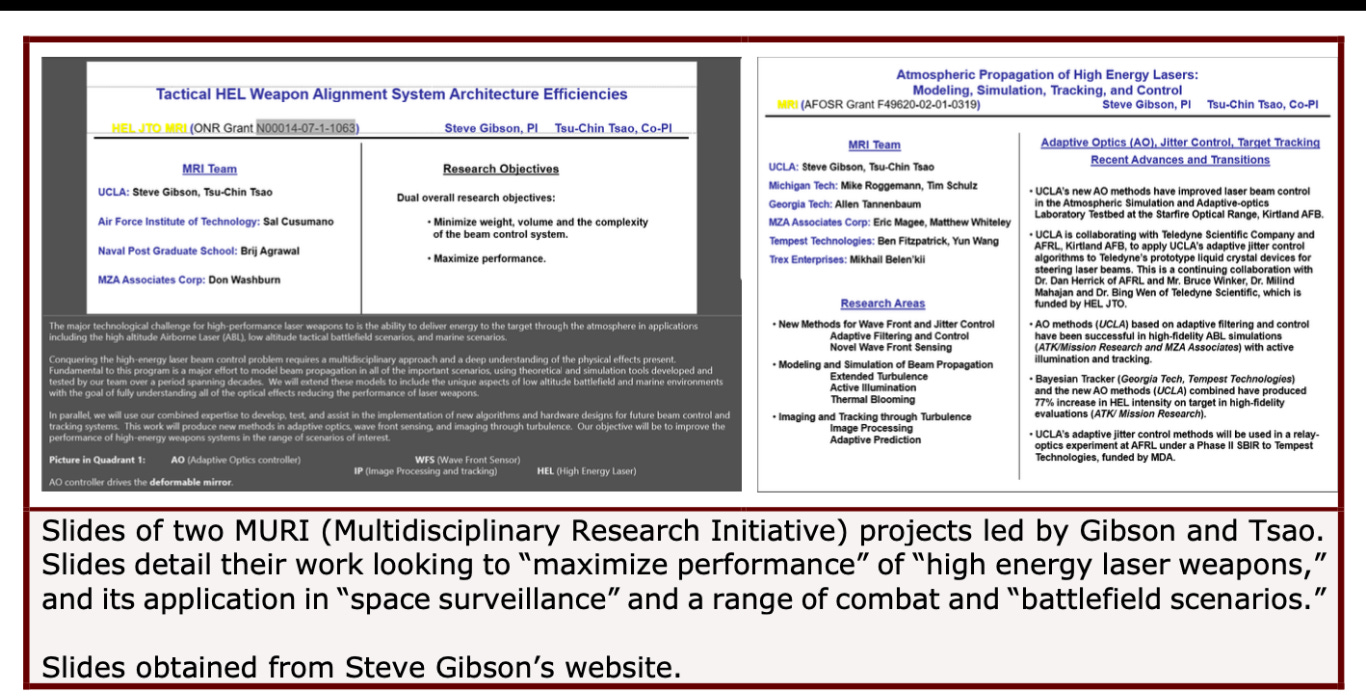
This High Energy Laser JTO MURI project also received funding from the Air Force Office of Scientific Research (AFOSR Grant: F4962002010319; award amount unknown). This project, titled “Atmospheric Propagation of High Energy Lasers,” worked to realize the DoD’s ambitions “to provide the technology to make HEL (high-energy laser) systems more effective and also to make them lighter, smaller, cheaper, and more easily supportable on the battlefield. In general, efforts funded under this program element are chosen for their potential to have major impact on multiple HEL systems and on multiple Service missions.” Indeed, research produced at UCLA aimed at improving laser beam control using adaptive optics is already being integrated with military industrial technologies. In the MURI project’s final report, UCLA researchers disclose some of the collaborations and applications resulting from this work with military partners. Some direct quotes include the following:
“Recent improvements in laser power and wave front control technology for space surveillance and laser anti-satellite and anti-ballistic missile weapons has motivated interest in extensions and alternative uses of this technology. Of particular interest are directed energy weapons, such as lasers. The agility and speed with which laser weapons can operate, combined with potential pinpoint accuracy and low collateral damage associated with these weapons make laser weapons highly desirable for a variety of applications, including high altitude Airborne Laser (ABL), low altitude tactical battlefield scenarios, and marine scenarios. However, considerable fundamental scientific work must be conducted to bring these weapons to the battlefield with the capability to deliver energy to the target through the atmosphere in each scenario of interest.”
“UCLA’s methods for adaptive control in adaptive optics are being used in a Phase II SBIR to MZA Associates Corporation for mitigation of aero-optics effects in directed energy weapons, funded by MDA.”
“UCLA plans to collaborate with Teledyne on control of their new liquid crystal spatial light modulator for wavefront control of high energy lasers. In recent months, Professors Gibson and Tsao have been invited to present our research to beam control groups at Northrop Grumman and Aerospace Corporation. Those visits initiated plans for future collaborations.”
“The close collaboration among UCLA, AFRL and Teledyne Scientific Co. has been very productive in several ways ... Teledyne based the re-design of the driver for the two-axis device partly on the performance of an earlier single-axis device in control experiments at UCLA. ... UCLA students and faculty have had the opportunity of working with an exciting new class of hardware being developed in industry for Air Force missions. The experimental results reported in [16, 15, 17] were obtained from a jitter control experiment in UCLA’s beam control laboratory with the Teledyne liquid crystal device. Most recently, UCLA Ph. D. student Pawel Orzechowski has worked with AFRL and Teledyne researchers to set up a similar experiment at the Starfire Optical Range, and we plan to continue this collaboration.”
“During the following year, UCLA’s adaptive jitter control methods will be used in a relay-optics experiment at AFRL under a Phase II SBIR to Tempest Technologies, funded by MDA.”
“UCLA faculty and students will continue the current collaboration with Dr. Dan Herrick and others at AFRL and Teledyne Scientific Co. on control of liquid crystal devices for beam steering. While the recent experimental research in UCLA’s beam control laboratory on these devices has been quite productive, it is even more exciting now that UCLA’s control algorithms are being implemented in the jitter control laboratory at AFRL’s Starfire Optical Range at Kirtland AFB. Liquid crystal technology for beam control also is being developed by other defense contractors, including Raytheon, and we expect to develop collaborations with such companies.”
This research on adaptive optics has “improved laser beam control in the Atmospheric Simulation and Adaptive-optics Laboratory Testbed at the Starfire Optical Range, Kirtland AFB.” Starfire Optical Range is essentially a facility testing the use of lasers to disable satellites (Administration Researches Laser Weapon).
Other Research
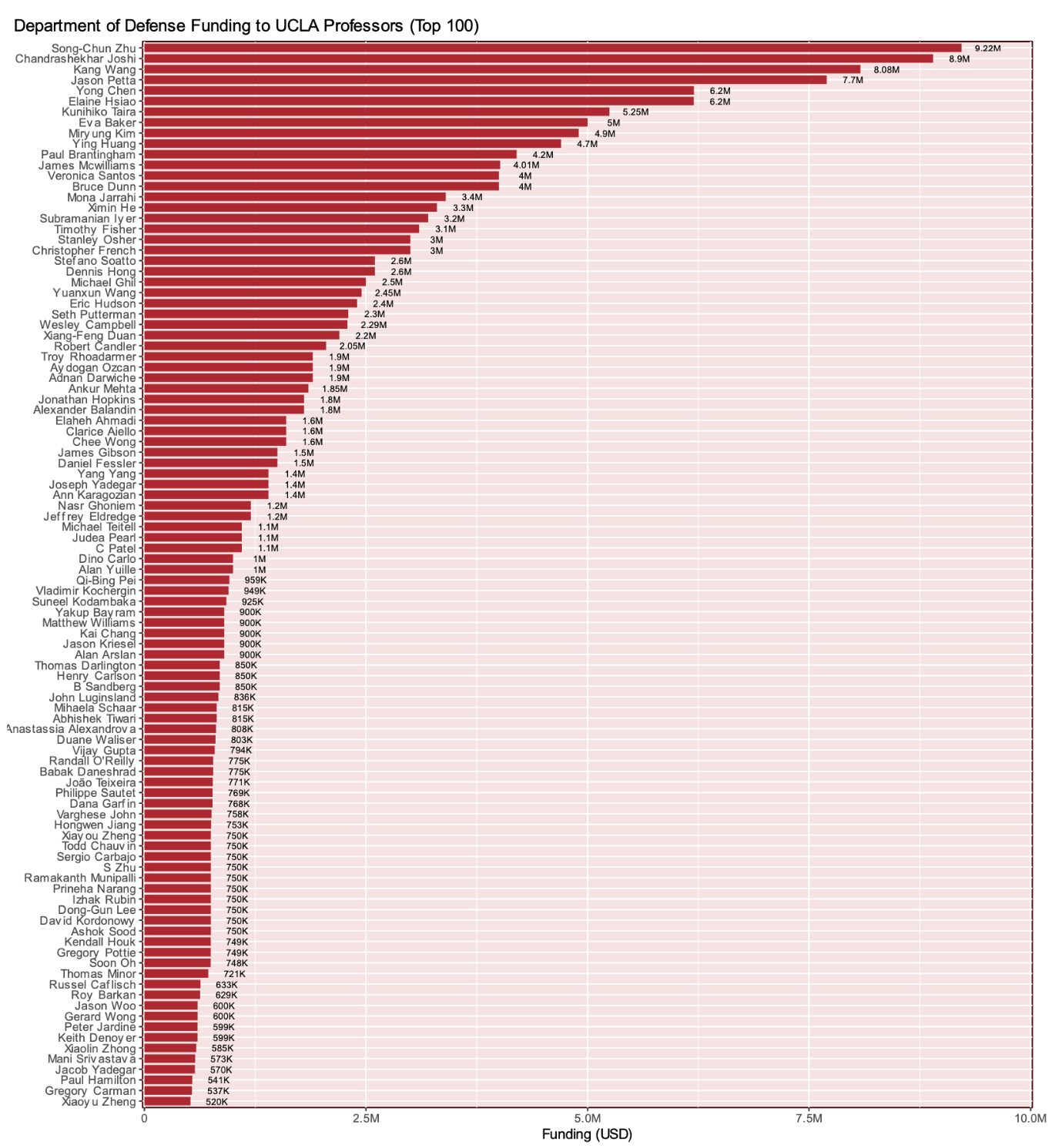
The above accounts have focused on researchers whose work fuels the testing and development of military bombing capabilities, perhaps the most grotesque form of warfare perpetrated by the US and US-supported militaries like the IDF. However, DoD agencies fund many other researchers at UCLA whose work supports various US military interests. The graph below shows the 100 UCLA professors receiving the most DoD funding (excluding the Congressionally Directed Medical Research Program), compiled from a database of publicly available information regarding DoD funding. This data likely provides an incomplete picture of just how much military funding UCLA researchers receive. For example, it does not include funding for projects in which UCLA is a sub-contractor for other institutions, nor does it include funding through which UCLA researchers collaborate with industry partners on SBIR/STTR grants. The only source that would paint a complete picture of the UC’s military funding (for whom, how much, and from which agencies) is the restricted SPX Contracts & Grants internal database.
Commercializable Technology
Once proof-of-concept is achieved in UCLA labs, the next step for military-funded research is commercialization by seeking out industry partners and early-stage investors. The UC plays an active role in this process through its various seed investment arms and its publicly searchable database of commercializable technologies (UC-wide database; UCLA-specific database).
Using keyword searches in these databases, we have found that UCLA’s commercializable technologies are marketed for applications in surveillance (night vision cameras, video optimization, video labeling, satellite/geospatial surveillance, and physical sensors), lasers (missile defense, beam intensity and stability, optimization framework), drones (modular drones), and military vehicles (hardware components, hypersonic aircraft).
UCLA’s commercialization efforts reveal other concerning projects, including attempts at recreating Havana Syndrome, the widely publicized but unsubstantiated ailments experienced by diplomats and CIA agents at the US embassy in Cuba and elsewhere. UCLA is currently seeking partners to purchase a technology with the title “Systems for Covertly Creating Adverse Health Effects in Subjects.” In their pitch, UCLA describes this technology as “a novel less-than-lethal method for creating [adverse] health effects in human subjects by directing undetectable waveforms toward the subject. This method might be capable of causing the ‘Havana Syndrome.’” UCLA has facilitated the development of a weapon that deliberately causes psychological distress and further seeks to commercialize the product through outside partnerships.
Academic Boycott
Internship Programs
Each year, UCLA Computer Science and Engineering Departments partner with some of the largest defense contractors in the US to secure student internships and job opportunities. UCLA also hosts annual career fairs in which they consistently highlight and publicize their invitation of representatives from defense companies, including specific promotion of Lockheed Martin, Raytheon, Boeing, and Northrop Group. Raytheon, Boeing and Lockheed Martin are featured on a list of companies who have hired the most mechanical and aerospace engineering students at UCLA. UCLA also has a specific faculty liaison for Lockheed Martin, Teaching Professor Paul Eggert of the Computer Science Department. In addition, both Lockheed Martin and Northrop Group are fiscal sponsors of SOLES (Society of Latinx Engineers and Scientists) at UCLA. Through consistent advertisement of defense companies through career fairs, internships, and job opportunities, UCLA promotes and encourages students to work in defense, rather than focusing on jobs to mitigate harm through climate change or health engineering fields. UCLA has an array of career avenues and job opportunities available to highlight; however, they internationally cater their Computer Science and Engineering departments to defense companies which they also happen to be invested in.
UCLA Y&S Nazarian Center for Israel Studies
Beyond the grants, labs, and research funding described above, UCLA maintains much more explicit ties to Israeli institutions. UCLA houses the Y&S Nazarian Center for Israel Studies, led by Director Dov Waxman. This Center has a long history of hosting and sponsoring detestable speakers and promoting unethical, misleading, and hateful narratives surrounding Palestine. Just recently, in February 2024, the Center invited Former Israeli Foreign Minister Tzipi Livni to speak on campus. Livni was a key decision maker in Operation Cast Lead, a 2008 IDF mission which killed 1,400 Palestinians, the majority of whom were civilians. The United Kingdom issued a warrant for Livini’s arrest citing her role in overseeing war crimes against Palestinians. Despite protests from students, UCLA has continued to host anti- Palestinian Israeli scholars, university administrators, and government officials on campus, with funding and support from UCLA.
Study Abroad In Israel
UCLA also maintains connections to several Israeli universities through study abroad programs, fellowships, seminars, academic agreements, and research collaborations. The Y&S Nazarian Center offers scholarships for students to study at the Hebrew University of Jerusalem and Israel Institute of Technology Technion/Neubauer—as part of the UC Education Abroad Program—as well as Ben Gurion University. UCLA offers the Mudie-Glaser Scholarship for Study at the Hebrew University of Jerusalem and the Harry C. Sigman Scholarship for Study in Israel through the Nazarian Center. The Nazarian Center also offers fellowships and other funding opportunities offering up to $10,000 for faculty, postdoctorates, graduate students, and undergraduate students who commit to research, presentations, travel, or course development promoting Israel. In September of 2023, UCLA established a new partnership with Hebrew University funded through the Rosalinde and Arthur Gilbert Foundation to research school violence. UCLA was awarded $1.3 million through this partnership to conduct research in both California (under Social Welfare Professor Ron Avi Astor of the Luskin School of Public Affairs) and Israel. After the initial pilot year, this partnership pledges to create a UCLA–Hebrew University Center operated jointly by the two universities. These institutions systematically discriminate against Palestinians while materially, culturally, and intellectually perpetuating occupation and genocide. By providing funds for students to visit a colonial state occupying Palestinian land, UCLA directly contributes to systems that uphold occupation, genocide, and apartheid.
Strategies For Boycotting
This section has examined current UCLA research programs aimed at making modern weapons systems deadlier and more devastating. While this section focuses primarily on technologies used to perpetrate the bombing of Gaza and Lebanon, research conducted at UCLA has far-reaching implications that serve to support the objectives of the military and police apparati more broadly. As with its investment portfolio, the UC relies on a lack of transparency to avoid public scrutiny of its research practices. Full disclosure of academic partnerships and funding sources is essential to ensuring accountability and empowering UCLA students and employees to make informed decisions, including participating in collective boycotts. As a public research institution, UCLA has a responsibility to prevent societal harm and to ensure that its research priorities are driven by its academic community—not by external funders.
To counter the war industry’s influence in STEM research, it is essential to understand and critically evaluate the sources, intentions, and outcomes of research funding. Military interests permeate countless research grants, through direct support by institutions such as the Department of Defense and DARPA and through less obvious channels, including the National Science Foundation (NSF) and National Institutes of Health (NIH). Knowing who funds a project and for what purpose is vital, as research aims are often masked or ultimately repurposed for military applications. For instance, predictive policing technology—which has been used to profile and over-police minoritized communities—was developed through algorithms designed to forecast seismic activity in China. This common trajectory demonstrates the importance of examining funding structures and commercialization practices to ensure that research does not surreptitiously support militaristic goals. Disclosure of military-focused research is just one step in a broader commitment to boycotting. By demanding the development of institutional policies regarding ethical funding, collaborating with unions and advocacy groups, and leveraging precedents like transitional funding, researchers can foster a shift toward ethically sustainable research practices at UCLA.
Boycotting strategies have been a central part of organizing within STEM departments (see this informative special issue from Science for the People on Organizing the Lab), underscoring the potential impacts of empowering informed, collective decision making by researchers. Historically, groups like Researchers Against War (RAW) have exemplified the success of organized boycotts. RAW has shown that principled resistance to military funding in research can yield significant results, including initiating bargaining processes within individual departments. A Labor Notes article written by graduate students at UC Santa Cruz (UCSC) documents efforts that have resulted in collective agreements by researchers to refuse military funding and other military-aligned projects. The UCSC Physics department highlights the importance of demanding transitional funding that allows labs to refuse military-aligned grants while maintaining operations. Transitional funding is an especially viable pathway for labs and their workers to align with ethical standards without sacrificing productivity.
We recommend the following boycotting strategies for STEM workers to refuse labor that may
be funded by or catering to military and/or Israeli institutions:
Research Funding Sources: Use tools like the Federal R&D Funding Database, NSF Award Search, and NIH RePORTER to uncover links between grants and military interests.
Foster Transparency: Share and discuss funding origins within labs to identify ethically questionable grants.
Organize Internally: Start with lab discussions, then progress to collective statements or events to raise awareness.
Engage Departments: Raise ethical concerns in department meetings or through joint letters to leadership.
Implement Boycotts: Refuse to participate in seminars, cancel colloquia, or suspend activities tied to military funding.
At the end of 2024, a majority of UAW 4811 workers voted to extend their contract until December 31, 2025. This agreement includes the creation of a transitional funding program on every UC campus. However, these programs only fund six students per campus, per year (i.e. two graduate student employees each quarter). Aside from their inadequate financial support, these programs also fail to address potential retaliation or professional insecurity that may affect graduate student workers leaving their research positions. While transitional funding is one first step for affording graduate student workers more agency regarding their labor, an academic boycott requires large-scale changes to grant all UC employees the right to divest their labor from research supporting wars and genocides.
03/15/2025