

I. INTRODUCTION: THE UNIVERSITY IN A TIME OF GENOCIDE & AUTHORITARIANISM
Report Summary
Research agendas at Rice University are funded and shaped by millions of dollars from the American weapons industry and the Department of War, the branch of the United States government that oversees U.S. military operations and research. Additionally, Rice has numerous research links with major weapons manufacturers, defense contractors, foreign militaries, extractive energy companies, and surveillance and other technology corporations complicit in human rights violations around the globe, from Gaza to the United States. Over the past 25 years, Rice has received $335.64 million in research funding from the Department of War, renamed from Department of Defense in 2025.i Rice maintains numerous direct institutional collaborations and partnerships with various branches of the US military through dedicated programs in the Office of Research and the Baker Institute.ii This report considers numerous examples, including: in 2019, Rice established the “Rice National Security Research Accelerator,” a $30 million cooperative agreement with the Army for research on advanced materials and next-generation networks, specifically for intelligence, surveillance, and reconnaissance, and also funded by the Department of Homeland Security. In 2024, the Air Force Research Laboratory (AFRL) opened the International Research Innovation in Nanotechnology (RISING) Center at Rice, in partnership with India’s Ministry of Defence, intended to align with technological goals of the U.S. Air Force/Space Force Science and Technology 2030 Strategy.iii Championed by Rice’s Momentous campaign, the new Center for Membrane Excellence dedicated to “energy, environmental sustainability and chemical processing”iv is led by faculty seeking and securing funding from sources such as the Department of War, US-Israel Binational funds,v ExxonMobil, and at least one DoW contractor. In 2025 Rice launched its AI Venture Accelerator (RAVA) with Google Cloud, which has well-known partnerships with entities active in Israel’s scholasticide and genocide in Palestine, namely providing cloud and AI services to the Israeli government and military. Rice also pioneered and implemented an AI research security program that is likely being used by the Texas government to surveil public university faculty. Such programs already raise ethical questions about Rice’s new campaign to become a leading university in “Responsible AI.”
Individual Rice faculty projects also advance military agendas, most notably in electrical and computer engineering, computer science, chemistry, bioengineering and biosciences, physics and astronomy, and psychology. Consider a few examples: in 2020, a Rice research project received $9.8 million as part of the Next-Generation Nonsurgical Neurotechnology program for the Department of War to “connect the brains of warfighters to computers to enable fast, effective, and intuitive hands-free interaction with military systems” including unmanned aerial vehicles.vi Rice has received at least $4.5 million in faculty research funding from Lockheed Martin Corporation, the largest U.S. weapons supplier to Israel. Northrop Grumman, the world’s third-largest military company, has funded over $660,000 for faculty research projects in Bioengineering, BioSciences, and Electrical and Computer Engineering. Northrop Grumman manufactures weapons used by the Israeli military against Palestinian civilians and surveillance technologies used by US immigration authorities to monitor the US-Mexico border.vii Raytheon Technologies has funded over $2.5 million for two notable Rice faculty projects in the Department of Computer Science and the Department of Electrical and Computer Engineering since 2021. Companies such as Lockheed Martin, Northrop Grumman, and Raytheon are all major contractors with the Department of War and the Department of Homeland Security (which oversees Immigration and Customs Enforcement, or ICE). Additionally, the Israeli Ministry of Defense is funding a multi-year Rice faculty project in the Department of Computer Science.
The dramatically shifting research funding landscape in 2025 is important context for this report. Federal funding for rigorous scientific research has been significantly slashed since the inauguration of President Trump in January 2025, with a notable exception: funding from the Department of War. This report notes a distinct continuation and intensification of interest in, desperation for, and reliance on military and private funding for scientific research. Already, a significant source of private funding originates from the oil and gas industry, reflecting long-standing relationships between Rice and fossil fuel firms. Historically, Rice has received tens of millions of dollars in scientific faculty research project funding from energy corporations such as Shell, ExxonMobil, Chevron, Schlumberger, Aramco, ConocoPhilips, and Total.
Thus, in coming years, a significantly greater percentage of Rice’s research funding will likely originate from the Department of War, private weapons contractors, and energy corporations. This raises ethical concerns about how military and private corporate interests will shape scientific knowledge production and ownership in higher education. This report thus asks the Rice community to consider:
What should research and science be for? Is the current research incentive structure for faculty at odds with the goals of safeguarding the environment and promoting human well being?
How does increasing military-funded research reshape the university’s relationship to violence, empire, and systems of global oppression? Similarly, how does fossil fuel industry-funded research shape the university’s research, teaching, and institutional priorities?
As Rice launches its new massive institutional investment in AI, with dozens of hires in the next few years, how can the Rice community ensure that AI research and funding is not weaponized for militaristic purposes? Historically, Rice pushed to be a leader in nanotech,viii which over the years has increasingly relied on weapons and military funding; how can Rice safeguard its new scientific investments against repressive future use, true to its stated commitment of “responsible AI”?ix
How might Rice ethically incentivize other measures of scientific success and importance, beyond grant number and size?
What would it mean for the Rice community to refuse complicity in systems of war, environmental destruction, and political repression? What might an ethical, anti-war university look like?
KEY FINDINGS AND REPORT CONTENTS
This report examines the state of Rice University’s participation in the war industry and its complicity in global violence, destruction of human lives and dignity, and human rights violations, enacted through multiple forms of ideological and material collaboration. These include:
Notable intensification of Rice’s formal institutional connections with the Department of War and militaristic entities in the past seven years. In particular, Rice is attempting to position itself as a leading research hub for nanotechnology, human-computer interfaces, military wearables, and AI that can align with US military agendas. Some examples:
[2019] Office of Research establishes the Rice National Security Research Accelerator (RUNSRA), a $30 million cooperative agreement with the Army for intelligence, surveillance, and reconnaissance research. RUNSRA is funded by the Department of Defense and Department of Homeland Security (agency overseeing Immigration & Customs Enforcement [ICE])
[2022] Baker Institute signs a Memorandum of Understanding with the US Army
[2023] Office of Research begins Defense Research Advancement (DRA) initiative
[2024] Office of Innovation establishes the International Research Innovation in Nanotechnology (RISING) Center for the Air Force Research Laboratory in partnership with India’s Ministry of Defence intended to align with technology goals of the U.S. Air Force/Space Force 2030 Strategyx
Rice hosts the US Assistant Secretary of Defense for Science & Technology to explore “areas of alignment between Rice’s research strengths and the Department of Defense technological needs and priorities”xi
New Rice faculty research project with the Israel Ministry of Defense; Rice Business School begins offering a scholarship for Israeli military soldiers, with recruitment language targeting those who have served since 2023, during the documented period of genocide in Gaza
[2025] Rice launches its AI Venture Accelerator (RAVA) with Google Cloud, which has well-known partnerships with entities active in Israel’s genocide in Palestine, the DoW, and DHS (including ICE)
Rice began the process of entering into a $550,000 strategic collaboration with Locksley Resources, a critical minerals company, focusing on securing antimony (crucial for producing ammunition, explosives, propellents). The initiative “supports the Trump administration’s executive orders to secure domestic supply chains for critical minerals”
Directly conducting scientific research for the U.S. Department of War: Rice has received about $334 million from the DoW between 2000-2026; Rice faculty conduct research for, consult, serve as fellows, and receive awards for the Department of War and its military branches including the Air Force, Navy, Army, and Marines.
Using “dual use research” to obscure military research funding and usage: The nature of much of Rice’s military research remains largely obscured from public view, as faculty and the university often publicly highlight the “civilian” applications (i.e. medical, commercial) of the research, while neglecting to mention its military funding sources, ownership, and warfare applications
Research collaborations and connections with private weapons, defense, and surveillance actors that profit from warfare such as numerous oil and gas corporations, RTX (formerly Raytheon Technologies; at least $2.5 million in faculty research funding since 2021), Advanced Micro Devices (key supplier for military technology), Northrop Grumman, and Lockheed Martin (at least $4.5 million since 2010, including over $540,000 since 2021)
Donor and other entanglements with entities and militaries that actively uphold apartheid and enact genocide. Examples include launching as a new business school scholarship aimed at those who served in the IDF during its documented period of genocide in Gaza; formal institutional and research collaborations with Israeli universities that materially support genocide and occupation; receiving donations from companies with known direct connection to the genocide in Gaza; a multi-year faculty research project funded by the Israeli Ministry of Defense since 2024
Rice is openly violating the ethical investment commitments it signed in 2022: Rice committed to becoming carbon-neutral by 2030 and signed the UN Principles of Responsible Investment (PRI), which includes provisions on ethical investment and financial transparency. However, Rice has so far declined to provide detailed information regarding its investments, and its known continued partnerships with the oil and gas industry undermine measures to minimize carbon emissions on campus
Hostile campus climate for anti-war social justice activism: Rice campus has experienced new restrictive speech and demonstration policies in 2024; the weaponization of anti-discrimination policies to intimidate anti-genocide activism; undemocratic blocking of two Student Association resolutions on divestment for Palestine (2024) and the Sudan (2025); Rice was given an ‘F’ rating for free speech in 2025 by the Foundation for Individual Rights and Expression (FIRE) in 2025; pattern of harassment of students, staff, and faculty who have spoken up against genocide in Palestine; institutional normalization of violence and militarism.
Report Methods and a Call for Financial Data Transparency
The findings for this report were largely gathered from publicly available information such as institutional reports and newsletters, faculty and university websites, university tax and audit forms, and government funding and donation data. In much of Rice’s public-facing materials, its research funding sources, particularly related to the military, energy corporations, or defense contractors, are rarely mentioned. Rice has also been successful in hiding its likely financial complicity in genocide, apartheid, and war by refusing to disclose the majority of its investments. In Fall 2024, Rice’s undergraduate student body successfully passed a referendum to disclose university investments. Three other referenda on ethical divestment from genocide also received the majority of the student vote. In response, Rice Management Company doubled down on refusing transparency and published a divestment statement claiming that it would not invest, or divest, according to support for “political or social positions,” despite signing onto a UN ethical investment agreement in 2022. To date, this “divestment statement” remains the first and only significant text on Rice Management Company’s main webpage, and Rice’s investments remain largely hidden from public view.
Additionally, unlike some other universities, Rice’s Office of Research does not provide public and centrally compiled funding information. However, the Anti-War Initiative provides important research tools (https://antiwar.io/research-tools) to search funding data for the Department of War. For example, the publicly-accessible database of the Defense Technical Information Center, a branch of the Pentagon that evaluates scientific studies for potential military use, provides centralized data which the Rice Office of Research does not make readily available. While such information is all publicly accessible (to date, January 2026) it takes time to find and understand. Private donation and research funder data is even more difficult to obtain. Thus, this report is an incomplete and working document; the authors welcome the campus community to anonymously submit any additional data for updated report versions.xii
Report Organization
[II] Rice’s roles in engineering violence through institutional support and faculty research
[III] Rice’s financial investments and entanglements with war industries
[IV] the state of campus anti-war activism and administrative responses to date
[V] conclusion and future questions for the university community
Joining an Anti-War University Movement
Finally, this report on Rice joins dozens of other reports generated from campuses across the country by groups of everyday faculty, staff, and students who are concerned about the role of American universities in perpetuating military violence. The most recent Israeli genocidal campaign in Palestine since 2023 has re-energized calls to re-examine and challenge institutional support for the Israeli military, its United States military allies, and private collaborators. Since 2025, it has also become increasingly clear that surveillance and destructive technologies tested in Palestine and war zones can and will directly become tools of repressive governance globally, including in the United States and by authoritarian state agencies such as Immigration and Customs Enforcement (ICE).
Anti-war activism thus links many issues facing the globe today, from political repression and authoritarianism to climate change. Indeed, the US military is the single largest carbon polluter on the planet, and the Gaza genocide is both enabled by fossil fuels sold by US firms and a major source of planet-heating emissions. An early, conservative study estimated that emissions from the first 60 days of Israeli strikes in Gaza emitted more CO2 than the annual output of up to 33 low-emitting countries.xiii Thus, this report is produced in solidarity with the broader nation-wide anti-war movement that seeks to make transparent our universities’ active roles in generating and normalizing militarism, in hopes for a different kind of university in the future.
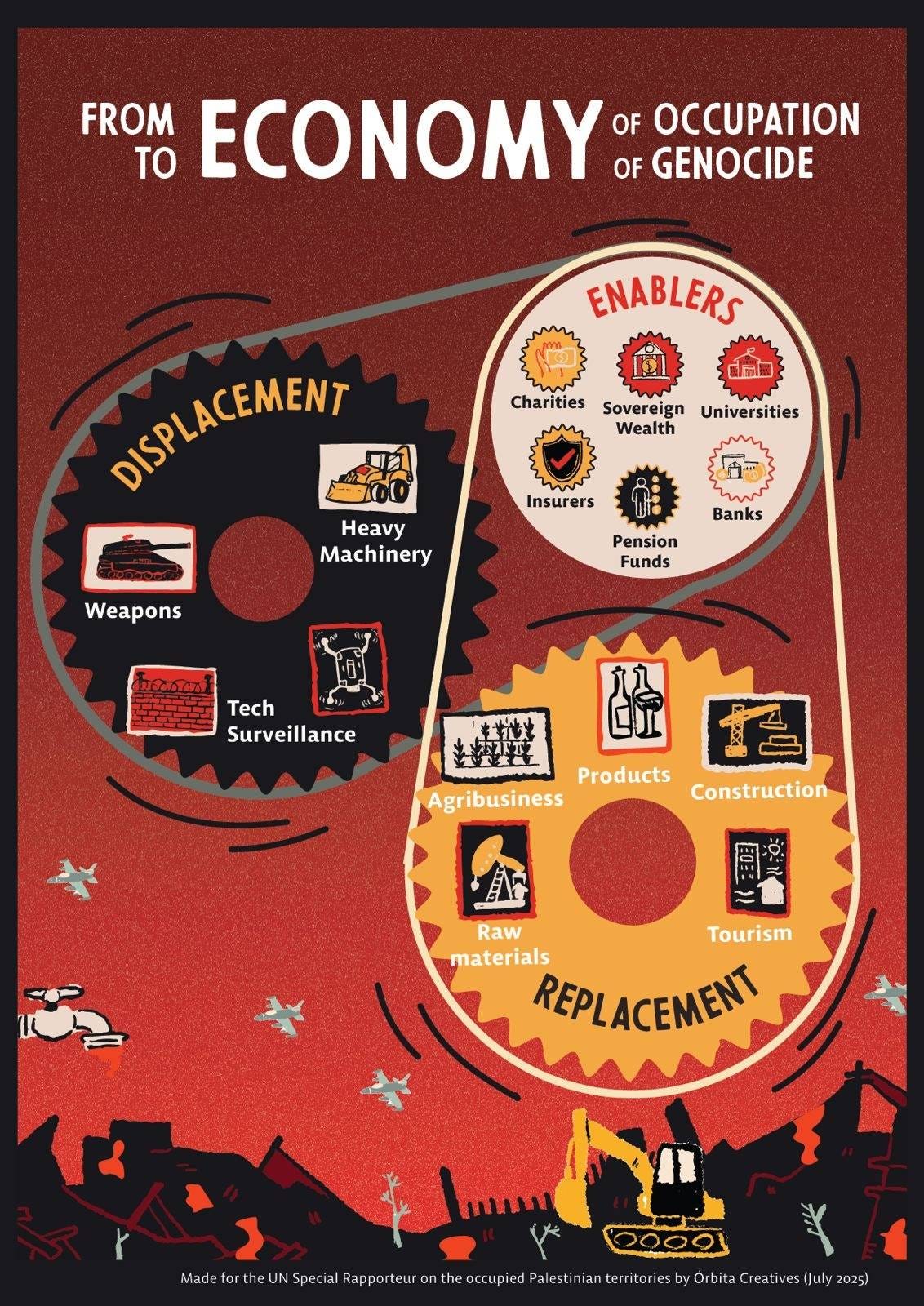
Source: 2025 Report “From an economy of occupation to an economy of genocide” by UN Special Rapporteur Francesca Albanesexiv
Table of Contents
I. INTRODUCTION: THE UNIVERSITY IN A TIME OF GENOCIDE & AUTHORITARIANISM
Rice and the Department of War; shifting research funding landscape
Key findings and report contents
Report methods and a call for financial transparency
Joining an anti-war university movement
II. ENGINEERING VIOLENCE: RICE SCIENCE & RESEARCH FOR WAR
Summary
Hiding militarism in plain sight: A note on ‘dual use’ research
Formal institutional entities
Rice’s Office of Research initiatives: Defense Research Advancement (DRA) and Defense Advanced Research Projects Agency (DARPA) trainings; Rice University National Security Accelerator (RUNSRA); National Security Innovation Network (NSIN)
Others: Baker Institute Memorandum of Understanding with the Army; International Research Innovation in Nanotechnology (RISING) Center; Rice AI Venture Accelerator (RAVA)
Faculty research projects
Examples of military technology research projects at Rice
Known links & collaborations with weapons & surveillance contractors
Distinguished professors; Department of War fellowships & awards
III. NORMALIZING MILITARISM: ENTANGLEMENTS WITH GENOCIDE & WAR
Material and financial entanglements with militarism: donors, contracts, Board of Trustees, training a labor pipeline; refusing disclosure and unethical investments
Symbolic and material support for Israel’s genocide and apartheid: university relations, contracts; scholarship; events
IV. STATE OF CAMPUS ACTIVISM & ANTI-WAR SPEECH
Repressive campus climate: blocked student votes; harassment of students, faculty, staff; weaponization of anti-discrimination civil rights
Hiding behind “institutional neutrality”: new restrictive demonstration policies; administrative messaging; anticipatory overcompliance to right-wing politics
V. CONCLUSION & QUESTIONS FOR AN ANTI-WAR UNIVERSITY
VI. ACKNOWLEDGMENTS & ENDNOTES
II. ENGINEERING VIOLENCE: RICE SCIENCE & RESEARCH FOR WAR
Chapter Summary
For decades, American universities have collaborated with the United States government, the weapons and defense industry, and surveillance and technology companies in a profitable pattern that has indirectly and directly contributed to violence, death, and human rights violations at home and abroad. Rice directly collaborates with the Department of War and private war-related entities, explicitly contributing to military interests and operations. Rice is well-known for its historical research strengths in the space industry since 1959, as a research hub and a pipeline training the next generations of engineers;xv students joke they come to Rice inspired to work with astronauts and NASA and instead unwittingly end up as designers for the aerospace weapons industry.
This report chapter outlines how research agendas at Rice are currently actively funded and shaped by millions of dollars from the “defense” (war) industry and the Department of War, the branch of the United States government overseeing U.S. military operations and research (formerly the Department of Defense from 1949-2025). Over the past 25 years, Rice has received $335.64 million in research funding from the Department of War.xvi Rice has direct collaborations and partnerships with various branches of the US military through the Office of Research, the Baker Institute, and individual faculty projects.xvii
Rice research projects also have numerous links with major weapons contractors, defense entities, and other technology corporations complicit in human rights violations around the globe and specifically in Gaza at this moment. For example, Rice has received at least $4.5 million in faculty research funding from Lockheed Martin Corporation, the largest U.S. weapons supplier to Israel. The Israeli Ministry of Defense is currently funding a multi-year Rice faculty project on multiagent robotic learning in the Department of Computer Science. Raytheon Technologies funds projects in the Department of Computer Science and the Department of Electrical and Computer Engineering.
Importantly, university-military collaborations are only likely to intensify and grow in coming years, which should prompt university members to seriously consider its ethical implications. Since the second presidential inauguration of Donald Trump in 2025, scientific research across the country has faced severe cuts across many federal funding agencies. This has significant impacts for institutions like Rice, which received 59% ($129 million) of its $218 million of research funding in 2024 from federal sources like the National Science Foundation, National Institute of Health, Department of Defense and Department of Energy.xviii The Trump administration’s proposed 2026 budget includes cuts of up to 55% for the NSF, although Congressional majorities have opposed this plan in favor of more modest cuts.xix By contrast,the Department of War’s budget is expected to jump dramatically; its proposed 2026 budget is $1.01 trillion, a 13.6% increase from the previous fiscal year.xx
The shifting landscape of research funding portends shifts in research priorities at institutions reliant in any part on federal funds. Faculty at Rice have already become increasingly desperate for research funding sources. In casual conversations with engineering and sciences faculty at Rice, faculty have revealed increased interest and reliance on military and corporate funding sources, which in turn shape university-wide research agendas. Such desperation was already observable in Spring 2025, when Rice’s Office of Research initiative for military collaborations hosted trainings for faculty interested in applying for military research funding. These trainings, which featured propaganda videos glorifying the U.S. military, were attended by over 100 Rice faculty members.
This report section outlines Rice’s formal institutional collaborations with military and defense entities, and highlights individual faculty research projects that promote military agendas and interests. Rice’s Office of Research and Office of Innovation already has multiple institutionalized initiatives dedicated to providing support for Department of Defense collaborations. These include Defense Research Advancement (DRA), the Rice University National Security Research Accelerator (RUNSRA), the National Security Innovation Network (NSIN), and the International Research Innovation in Nanotechnology (RISING). Through these, the Office of Research hosts Department of Defense official visits and provides material support for research collaborations. Rice’s Center for Energy Studies at the Baker Institute has a Memorandum of Understanding to provide expertise to the Army Civil Affairs Psychological Operations Command, signed in 2022.xxi Numerous Rice faculty and their labs receive funding and fellowships to develop trainings, applications, and technology for branches of the Department of War such as the Air Force Office of Scientific Research, The US Army Corps of Engineers, Army Research Office, Defense Threat Reduction Agency, Defense Advancement Research Projects Agency, and the Office of Naval Research.
Rice has research connections, scholarships, and other entanglements with institutions that directly contribute technical, military, and material support of apartheid and genocide in Israel. In addition to its research collaborations with entities like Lockheed Martin Corporation, Raytheon, Northrop Grumman, and the Israeli Ministry of Defense, Rice faculty have collaborated with Weizmann Institute of Science, which has direct collaborations with Israel’s top weapons manufacturers, such as Elbit Systems and Israel Aerospace Industries, and has introduced additional benefits for student soldiers serving in the Gaza genocide since 2023.xxii Through an undergraduate research scholarship, Rice supports students to go to universities such as Technion-Israel Institute of Technology which partners with Elbit Systems and Rafael Advanced Defense Systems, one of Israel’s largest government-sponsored weapons manufacturers.xxiii
“DUAL USE” RESEARCH: MILITARISM HIDING IN PLAIN SIGHT
Rice’s new biannual glossy research magazine features a plethora of scientific discoveries and advancements, particularly in nanotechnology and medical fields. Notably, the magazine highlights what are called the “civilian” or “commercial” sides of some of these research projects, avoiding the significance of military application and funding driving some of these projects.
“DUAL USE” research: research that can be developed for both military and civilian use, which enables Rice and other universities to obscure the darker sides of research funding and applications.
One example of this is a $9.8 million project funded by the Department of Defense that is explicitly for connecting military personnel’s brains to military technology systems directly. The project is a key part of the Next-Generation Nonsurgical Neurotechnology program to “connect the brains of warfighters to computers to enable fast, effective, and intuitive hands-free interaction with military systems” including unmanned aerial vehicles.xxiv Previous projects funded by the same entity tested out pilot brain-computer interface technology for fighter jets on a paraplegic research subject in 2015. Although that project’s stated intention was to help disabled veterans with robotic prosthetics, researchers also connected the research subject’s brain to a F-35 fighter jet pilot simulator successfully.xxv More recent brain-computer interface research tested mind-control operations for drones.xxvi Despite the funding agency’s own explicit stated military goals, faculty profiles and many university research descriptions solely highlight the civilian application.
Key question: How can Rice’s scientific community advocate for important medical and scientific research that is not developed or co-opted for militaristic purposes?
Rice Department of Defense Grants, by agency from 2020-2025
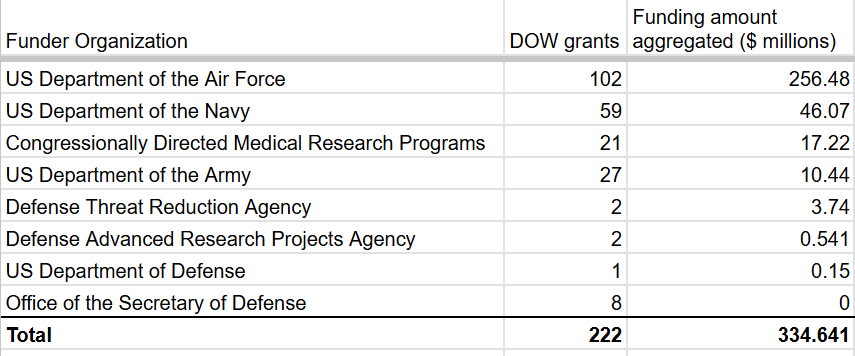
Source: Defense Technical Information Center (retrieved December 2025)xxvii
FORMAL INSTITUTIONAL ENTITIES
Rice’s Office of Research
Image: Rice website header for the Office of Research’s Defense Research Advancement (retrieved June 2025)xxviii
Defense Research Advancement (DRA) initiative
Rice’s Office of Research has a Defense Research Advancement (DRA) initiative that coordinates and facilitates collaborations between the Department of Defense, industry, and academia. In an attempt to become a “primary hub for some of the key technology innovations for the DoD,” the DRA supports collaborations particularly related to “dual-use” applications and technologies (can be used for both civilian and military purposes). Its website states that the DRA is committed to “enhancing national security through disruptive innovation and technology acceleration” and being a “trusted partner in defense research and innovation, recognized for our contributions to national security and technological advancement.”xxix
DRA arranged and hosted visits from military officials to “explore areas of alignment between Rice’s research strengths and the Department of Defense technological needs and priorities.”xxx For example, official visitors include the Deputy Assistant Secretary of the Navy for Research, Development, Test and Engineering in 2023xxxi and the US Assistant Secretary of Defense for Science and Technology (ASD S&T) in 2024 who toured six labs “working in research areas relevant to DoD interests.”xxxii Research areas of technological interest to the ASD S&T include “advanced materials, biotechnology, quantum science, future generation wireless technology as well as developing system capabilities for hypersonics; positioning, navigation and timing; nuclear delivery; and human and uncrewed platforms.”xxxiii
According to Rice’s assistant vice president for the Office of Research and DRA head, “Rice has the resources and potential necessary to empower manufacturing innovation for dual-use applications. I believe Rice has the potential to become the primary hub for some of the key technology innovations for the DOD much as we led the development of nanotechnology in previous decades.”xxxiv
Military Propaganda at Faculty Trainings for Funding
In Spring 2025, over one hundred Rice faculty and researchers attended DRA-hosted workshops with titles such as “Unlocking DoD Funding: Essential Training for Success” which encourage and support faculty applicants for Defense Advanced Research Projects Agency (DARPA).xxxv These online trainings showed short propagandistic videos featuring Hollywood-style depictions glorifying military and surveillance operations, before speakers emphasized to researchers that there is abundant funding available. Trainings emphasized that DARPA is looking for scientific innovations that predict future threats to build the “next generation of researchers to impact the national security ecosystem.”
In particular, DARPA trainings emphasized the unusual speed of the funding process and the vast size of available funding. For example, in contrast to most tedious bureaucratic application processes, applicants could simply submit a seven-minute amateur video pitching their ideas, receive a response within 24 hours and funding released as fast as two weeks later. DARPA has Young Faculty Awards that provide researchers with $250,000 base annual salary for two years and potentially $300,000 for a third year. DARPA speakers noted that faculty often did not request enough funding, and that awards could go up to $499,999 million, just below a limit that would need additional governmental approval. As one DARPA speaker enthusiastically impressed onto faculty about funding: “Sky’s the limit!”


Image: Examples from Spring 2024 DARPA training videos: American flags and military imagery; sleek tech and surveillance aesthetics; scientists working out difficult problems; a figure in cowboy hat controlling and watching a drone. The “DARPA HARD” slogan refers to the program’s commitment to cutting-edge tough research problems.

Image: Slide from April 2025 Faculty DARPA training on military & profitable tech development
Rice University National Security Research Accelerator

Image: Rice University National Security Research Accelerator website (retrieved Sept 2025)
In 2019, Rice established a multi-year $30 million cooperative agreement with the Army to advance fundamental science research with applications in intelligence, surveillance and reconnaissance.xxxvi Rice was chosen by the Army Futures Command to partner with the Army Research Lab (ARL) to “develop advanced materials and next-generation” and created the Rice University National Security Research Accelerator (RUNSRA). According to its website, “RUNSRA is setting the stage for bringing new, disruptive research technologies — transformative research — to the National Security enterprise so that it can increase its current and future capabilities. RUNSRA partnerships between world-class researchers at Rice and other institutions will help define innovative paths for modernization of the United States Defense.”xxxvii
“This is all about modernization for the United States Army,” as the director of the Army Combat Capabilities Development Command at the Army Research Laboratory (ARL) stated, “Our relationship with Rice is setting the stage for bringing new, disruptive research technologies — transformative research — to the Army so that it can increase its capabilities in the future.”xxxviii RUNSRA attempts to facilitate multidisciplinary partnerships across campus to “enhance Nationalism security by accelerating the discovery, development, and transition of technologies into military and civilian applications through scientific and engineering collaborations with academia, business, industry, and government partners.”
Funding for RUNSRA comes from DoD’s Defense Advanced Research Projects Agency (DARPA), the Department of Energy, the Department of Homeland Security, and other agencies.”xxxix According to a 2024 university tax document, Rice listed a $29,877 project with Stanford University funded by DHS for “Centers for Homeland Security,” possibly for RUNSRA.xl In 2025, RUNSRA’s advisory board includes various deans, and its personnel consists of 25 faculty and staff, including the President of Rice University, Assistant Vice President, and various endowed and distinguished faculty.xli
RUNSRA hosts events to share Department of War research priorities with Rice faculty. For example, the DoD principal director for microelectronics delivered a lecture in 2024 to faculty that “outlined the vision of the Office of the Under Secretary of Defense (OUSD) for Research and Engineering and emphasized the importance of semiconductors in maintaining U.S. competitiveness, enhancing energy efficiency and ensuring national security.” The lecture “called on universities and private industry to collaborate with the government in advancing microelectronics technologies, noting that such partnerships are crucial for national security and economic growth. ‘What universities are really good at is developing great ideas, and what we want to try and do is turn those ideas into capabilities for the Department of Defense as well as other opportunities for commerce and agencies and the private industry.’”xlii
National Security Innovation Network (NSIN)

Image: National Security Innovation Network (NSIN) websitexliii
The Rice Office of Research collaborates with the National Security Innovation Network (NSIN), which is a component of the Defense Innovation Unit, a Department of War program office. The main goal of NSIN is to connect the DoW with academia and entrepreneurs, or in their own words: “responsible for engaging program offices (such as the Office of Technology Transfer) through acceleration and research opportunities for Rice University spin-offs, faculty through providing networking opportunities and chances to provide consultation to DoD research efforts potentially leading to subsequent grant opportunities, and students through funding for start-ups, paid fellowships, college credit capstone projects, and direct hiring events.”xliv
Rice’s NSIN projects have been sponsored by the United States Coast Guard and the Army Research Laboratory. The Coast Guard project focused on building a “micro-vessel” (a small, difficult-to-detect, and autonomous vessel used to detect narcotics smuggling), and another project focused on aerodynamic changes to an aircraft’s wings during flight. Additionally, Zeta Energy – a company started out of Rice University – was recently selected for the NSIN Emerge Accelerator Program to connect with stakeholders inside DoD acquisitions.xlv
International Research Innovation in Nanotechnology (RISING) Center
In 2024, the Air Force Research Laboratory (AFRL) opened the RISING Center at Rice, a collaboration between AFRL, Rice University, the government of India’s Defense Research Development Organization (DRDO), and the Indian Institute of Technology (ITT), Kanpur. According to its website, RISING is “dedicated to advancing the development of nanomaterials—extremely small materials with massive potential applications in areas like aerospace, electronics, and defense.” Projects include sensors for human health monitoring, high purity 2D materials growth via chemical vapor deposition, or CVD, conformal and flexible electronics for munitions and energy harvesting materials technology.xlvi Its projects are intended to align with technology development and manufacturing goals of the U.S. Air Force/Space Force Science and Technology 2030 Strategy.xlvii
Baker Institute Memorandum of Understanding with US Army
Rice’s Center for Energy Studies at the Baker Institute has a Memorandum of Understanding to provide expertise to the Army Civil Affairs Psychological Operations Command, signed in 2022. Baker’s Center for Energy Studies leads and supports the training program and is designated an “Energy Functional Specialist” for the Army unit’s civil affairs. According to Rice News, “The USACAPOC, under the Army Reserve Command, is responsible for addressing the Army’s needs related to civil matters before, during and after conflicts” and “The Baker Institute’s Center for Energy Studies was selected to lead and support the training program, which will take the form of workshops, conferences, student internships and mission assignment opportunities and provide a platform for outreach to organizations in the wider military and energy sectors. The MOU with CES is part of the “Energy Functional Specialist” designation of the Army unit’s civil affairs function for strategic, operational and tactical civil affairs, military information support and information operations capabilities.”xlviii
Rice AI Venture Accelerator (RAVA)
In April 2025, Rice University and Google Public Sector launched the Rice AI Venture Accelerator (RAVA). This initiative aims to foster an ecosystem where startups can access Google Cloud’s AI-optimized sandbox, data sets like AlphaFold, and a unified development platform via Google Vertex AI Platform.xlix Google Cloud has known partnerships with entities active in Israel’s genocide in Palestine, namely through Project Nimbus and a strategic partnership with the Israel National Cyber Directorate. Project Nimbus is a $1.2 billion joint contract with Google Cloud and Amazon Web Services in 2021 to provide cloud services and AI to the Israeli government and military (IDF).l In 2023, Google Cloud also announced a strategic partnership with the Israeli National Cyber Directorate as part of Israel’s “Cyber Dome” mission. Google Cloud also profits from substantive government contracts including the Department of War and the Department of Homeland Security, including rapidly expanding ICE forces.
FACULTY RESEARCH
Rice faculty regularly receive fellowships and funding from the Department of War. According to the Defense Technical Information Center, Rice has received $334.64 million in total.
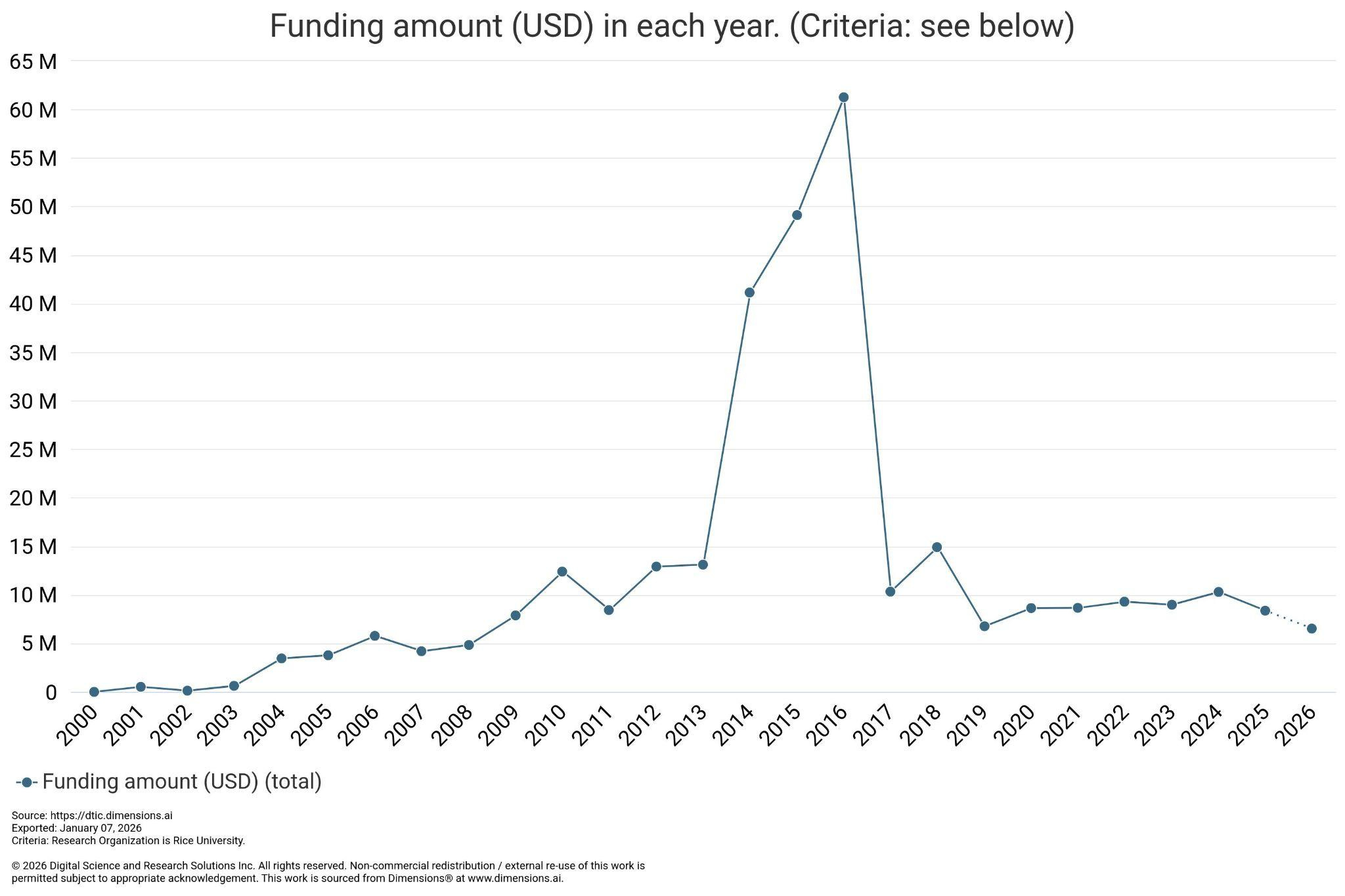
Source: Defense Technical Information Center, retrieved January 2026li
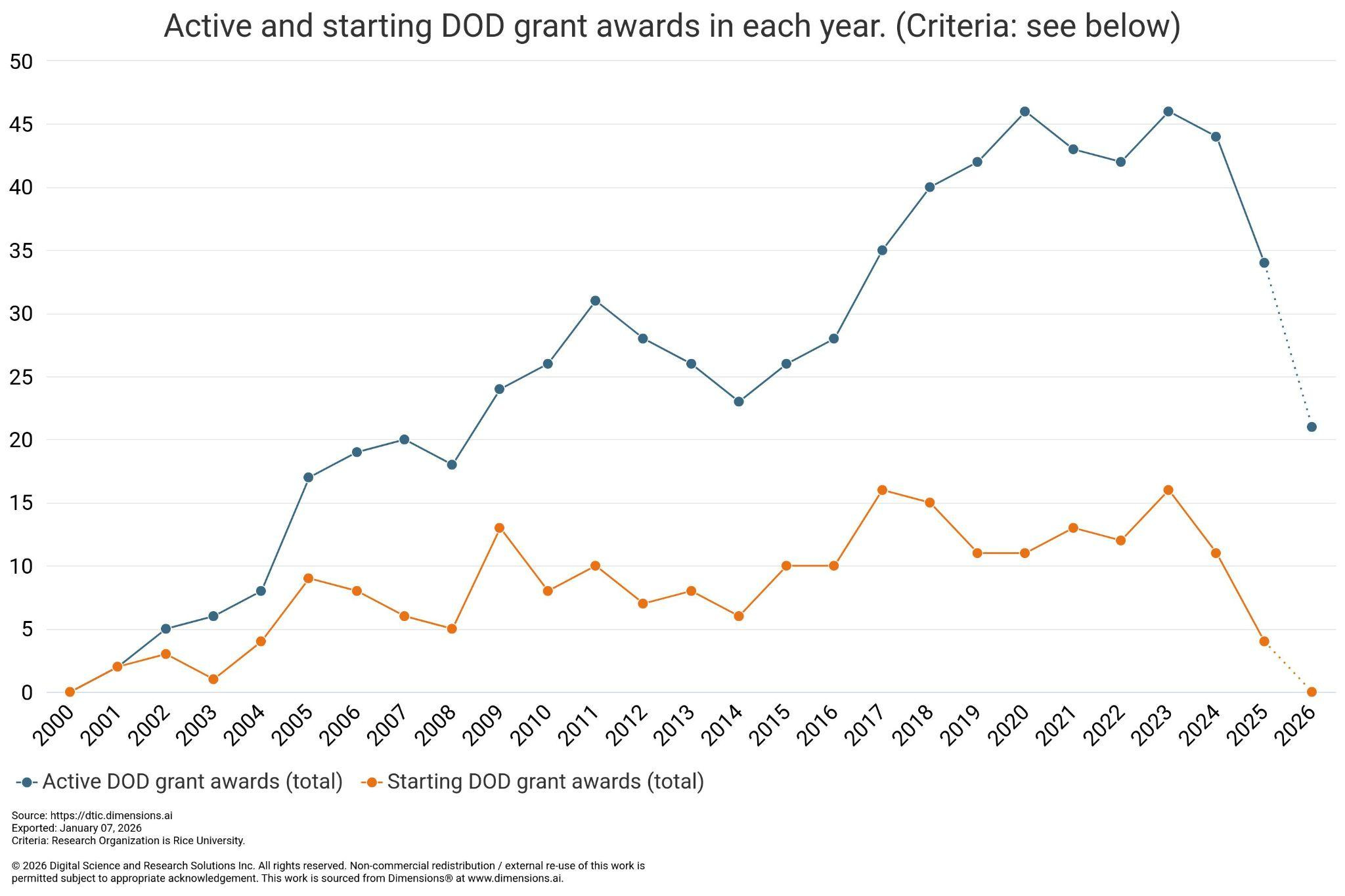
Source: Defense Technical Information Center, retrieved January 2026lii
Top Rice Recipients of Department of War funding, 2000-2025
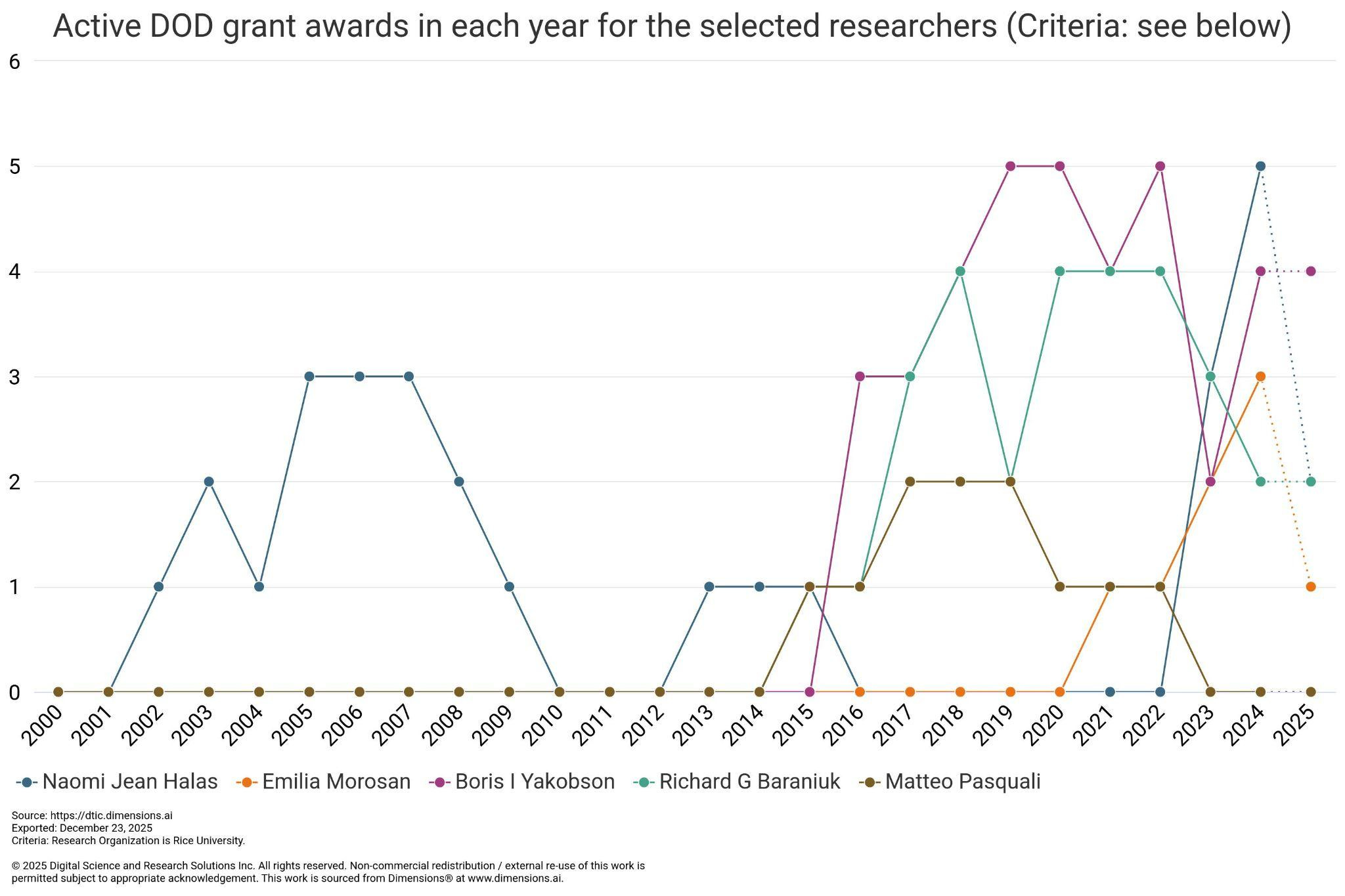
Source: Defense Technical Information Center (retrieved December 2025)liii
Examples of military technology projects at Rice
Semiconductor microsystems facility to develop military technologies
Rice researchers are a key partner in a $1.4 billion project to develop semiconductor microsystems facility for the Department of Defense. The large collaborative team, led by UT-Austin, was awarded $840 million from DARPA in 2024, combined with $552 million from the Texas Legislature for UT’s semiconductor consortium, the Texas Institute for Electronics. The grant will help establish a research, design, and prototyping facility to “enable DOD to create higher performance, lower power, lightweight and compact defense systems. Such technology could apply to radar, satellite imaging, unmanned aerial vehicles.” Rice research team leader Ramamoorthy Ramesh highlighted Rice’s computer and electrical engineering strengths and his company, Kepler Computing, is a part of the team. The broader research team includes 32 defense electronics and commercial semiconductor companies and 18 academic institutions.liv
Nonsurgical neurotechnology for warfighters and warfare
In 2020, (Defense Advanced Research Projects Agency) DARPA awarded $9.8 million to Rice researchers for the a project for the Next-Generation Nonsurgical Neurotechnology (N3) program to “connect the brains of warfighters to computers to enable fast, effective, and intuitive hands-free interaction with military systems.”lv The project is entitled Magnetic, Optical, and Acoustic Neural Access (MOANA) and the research team is based in Electrical and Computer Engineering, Bioengineering, and the Ken Kennedy Institute. The PI previously received a DARPA early career fellowship in 2014.lvi According to DARPA’s own website, “aims to develop high-performance, bi-directional brain-machine interfaces for able-bodied service members. Such interfaces would be enabling technology for diverse national security applications such as control of unmanned aerial vehicles and active cyber defense systems or teaming with computer systems to successfully multitask during complex military missions.”lvii
Military Wearables
Rice’s Smart Helmet Projects for the Navy
Rice’s Office of Innovation has a $1.3 million project sponsored by the Office of Naval Research for developing 3D-printable smart helmets. The helmet is intended to be “both protective equipment and a wearable technology platform that detects threats, monitors vital signs and provides situational awareness.”lviii The Navy funds enabled Rice researchers to purchase two industrial-grade 3D printers, and the Office of Innovation is constructing the Rice Nexus, “a dedicated space at the Ion where faculty and students can turn “proof-of-principle” ideas into viable prototypes that will be attractive to industry and investors.”lix
According to the project’s abstract on the DoD research repository, the project “developed a customizable, 3D-printed Head-Mounted Sensor System (HMSS) designed for hyper-enabled operators (HEOs) in mosaic warfare environments….equips warfighters to function as interconnected nodes within a larger tactical network, ensuring superior situational awareness and decision cycles in complex operational environments. The HMSS platform directly supports the military’s strategic goals of achieving cognitive overmatch and operational superiority through innovation and adaptability. This platform represents a transformative leap in wearable sensor technology, bridging critical gaps in existing systems and delivering unparalleled performance for warfighters in the complex, multi-domain battlefields of the future.”lx
Sleeping Cap project for the US Army Military Operational Medicine
Engineers from Rice’s NeuroEngineering Initiative are developing a “sleeping cap” to analyze the cleansing flow of louis that drains the brain of common metabolic waste during sleep. Rice’s team, in partnership with the Institute of Biosciences and Bioengineering and physicians at Houston Methodist Hospital and Baylor College of Medicine, received $2.8 million in 2021 as a first installment of a multiyear grant from the US Army.lxi
Multiagent Robotic Learning for Israel Ministry of Defense
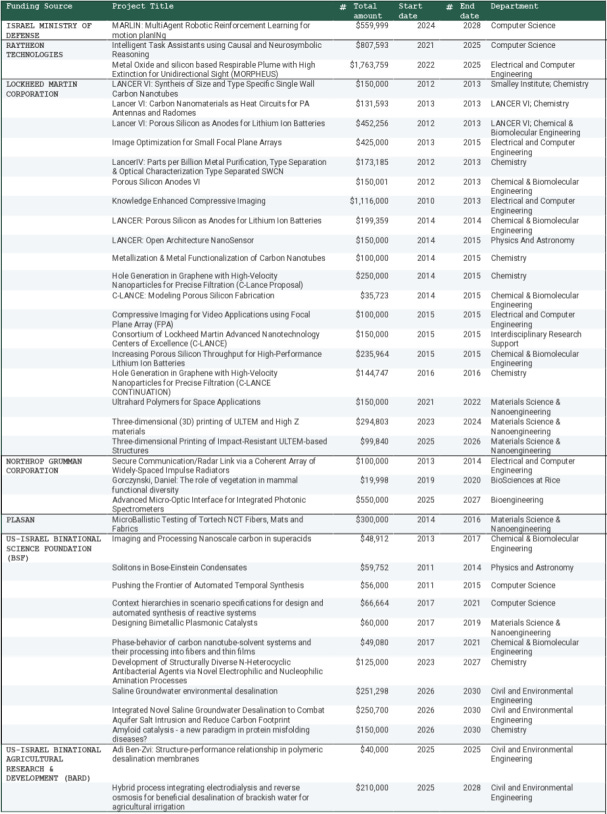
The Israel Ministry of Defense is funding a 2024-2028 faculty research project in the Department of Computer Science entitled “MultiAgent Robotic Reinforcement Learning for motion planINg.”lxii
Table: Examples of Faculty Research Projects (beyond DoD)
Known links and collaborations with private weapons and surveillance contractors
Rice’s “Research Security” AI tool (PRISM) expands surveillance systems and potential usage by the state of Texas on public university faculty
Rice University has a unique AI security tool that is a collaboration between the Office of Research Security and a Rice Computer Science faculty’s company, ThirdAI. The tool, called PRISM (Preventative RISk Monitoring), aims to quickly identify “research security risks” by combining background databases and network analysis. PRISM uses AI to “help with rapidly evolving federal regulations and protect against potential reputational and financial risks.” Possibly in response to a 2024 Texas Executive Order issued by Governor Greg Abbott, Rice was contacted about an AI program to run security checks on Texas public university faculty. PRISM may be currently implemented through the Texas Department of Public Safety as a third party reviewer.
Some departments at Rice have been informed that the Office of Research Security is using the AI on faculty and students as follows: if any federal grant application (i.e. DoD, DoE, NIH, NSF) is flagged for a conflict of interest or collaboration during the agency review process, the sponsoring university is asked to investigate and certify that the faculty or staff member is not collaborating with those foreign actors; or if so, will agree to cease to work with them. Additionally, the Office of Graduate and Postgraduate Studies is also using PRISM to screen graduate student applicants before they are officially admitted. So far these cases have largely concerned Russia, Iran, China, Macau, and Hong Kong, but with expanding and erratic travel bans and expansive definitions of anti-terrorism by the government, there is concern not only about the expanded list of countries, but about the potential for abuse given the national climate and how AI has been applied by third party actors to target international students and faculty for deportation due to speech and expression.
Lockheed Martin and Rice’s Smalley-Curl Institute
In 2008, Rice entered into a multi-year nanotechnology partnership with Lockheed Martin to develop six projects annually, including stealth technology. Rice established a Lockheed Martin Advanced Nanotechnology Center of Excellence (LANCER), based at the Richard E. Smalley Institute for Nanoscale Science and Technology (now called Smalley-Curl Institute). The center paired researchers from Lockheed Martin with Rice experts in carbon nanotechnology, photonics, plasmonics, and more. Between 2010 and 2016, Rice received at least $3.96 million in research funding, since 2023 Rice has two faculty projects that have been funded by Lockheed.
In many ways, the LANCER program seems to be a template for later Rice collaborative programs, growing “from the bottom-up,” where according to Wade Adams, Rice’s Director of the Smalley Institute, “The folks in the labs are the ones who came to us and said, ‘Make it easier for us to work together.’”lxiii In 2008, more than a quarter of the science and engineering faculty hired at Rice in the previous two decades were nanotechnology experts affiliated with the Smalley Institute.lxiv LANCER grew out of a series of technology exchange events between the Smalley Institute and Lockheed Martin scientists, led by Rice faculty and designed to keep Lockheed Martin researchers apprised of the latest nanotechnology discoveries.
Between 2005 and 2014, Professor James Tour (Chemistry; Materials Science and NanoEngineering) authored 32 of the 55 publications jointly funded by the DoD and Lockheed Martin, likely as part of this partnership. It is unclear the current status of the partnership.lxv Since 2021, Lockheed has funded three Rice faculty projects on ultra hard polymers for space applications and 3D printing of ULTEM and High Z materials. Rice also sends students to Lockheed’s annual “Ethics in Engineering” competition and advertises employment opportunities through its Center for Career Development.lxvi Lockheed is the largest U.S. arms supplier to Israel, providing F-16 and F-35 jets, Hellfire missiles, and CH-53K helicopters used in the bombardment of Gaza.
Raytheon Technologies (RTX)
Rice researchers work on battlefield obscurants on a team with Raytheon Technologies Research Center and the Palo Alto Research Center on DARPA-funded project entitled “Coded Visibility.” According to a 2022 article, the project aims to develop “tailorable, tunable, safe obscurants that provide warfighters with an asymmetric advantage.”lxvii Additionally, Raytheon Technologies funded another Rice research project on intelligent task assistants and causal and neurosymbolic reasoning in the Department of Computer Science. Rice has one professor of practice on faculty who is a technical fellow at Raytheon.lxviii Rice has also offered discounts to MBA students through Raytheon-affiliated programming. Raytheon supplies air-to-surface missiles, cluster bombs, and funds Israel’s Iron Dome. Its CEO publicly cited the war in Gaza as a future source of corporate revenue.lxix
Other military manufacturers: Northrop Grumman, Plasan
Plasan, a private military vehicle manufacturer for the Israeli military, funded a project on microballistic testing in the Department of Materials Sciences and NanoEngineering.lxx Northrop Grumman funds faculty research on micro-optic interfaces for photonic spectrometers in the Department of Bioengineering. Northrop Grumman is the world’s third-largest military company. It manufactures weapons used by the Israeli military against Palestinian civilians and surveillance technologies used by US immigration authorities to monitor the US-Mexico border.
US Critical Minerals and Energy Resilience Strategy partnership with Locksley Minerals
In August 2025, Rice began the process of entering into a strategic collaboration with Locksley Resources, a critical minerals company, focusing on securing antimony and rare earths for US national security goals. Locksley provided $550,000 for the project’s first year, and under the agreement, all of the project’s intellectual property will be jointly owned by Rice and Locksley. At Rice, the project would be related to the Department of Materials Science & Nanoengineering and the Rice Advanced Materials Institute (RAMI). Locksley develops American-made antinomy for defense applications; antimony is essential for producing ammunition, explosives, and propellants, along with components for armored vehicles, missile and electronic components, and flame retardant materials. The initiative “supports the Trump administration’s executive orders to secure domestic supply chains for critical minerals.”
Joint-funded DoW research with Lockheed Martin, ConocoPhillips, Boeing, RTX
According to the DoW research repository database, Rice-affilitated researchers and projects have resulted in 4,431 publications as of January 2026. Of these 4,431 publications, the major funders were: Air Force Office of Scientific Research (36%); the Air Force (30.6%); Welch Foundation (28.9%); Office of Naval Research (28.9); Army Research Office (23.9); Defense Advanced Research Projects Agency (14.8%). In regards to private funders of collaborative DoW projects, Rice researchers have published 55 papers with Lockheed Martin funding, 11 with ConocoPhillips Co, 7 with Boeing, and 6 with RTX. Rice researcher-collaborative publications with Lockheed Martin funding represents about 5% of Lockheed Martin’s publications produced in collaboration with the DoW.lxxi
Rice’s Distinguished Professors
University Professor
University Professor is Rice’s most distinguished rank of professor. Of the seven living University Professors, at least three have multi-million dollar projects funded by the Department of War/Defense:
Naomi Halas: Rice professor with the second most DoW funding ($13.24 million total) and author of 246 DoW publications and 17 DoW technical reports.lxxii The majority of Halas’ grants come from the Air Force, but also Congressionally Directed Medical Research Programs, the Army and Navy. Halas was the lead investigator for five projects funded by the Multidisciplinary University Research Initiative (MURI) at the Department of Defense, with the most recent being a $7.5 million project funded in 2024.lxxiii In 2009, Halas received the Department of War/Defense’s most prestigious single-investigator fellowship. Halas is also faculty of the Rice University National Security Research Accelerator (RUNSRA).lxxiv Halas’ research is known for showing that the nanoscale internal and external morphology of noble metal nanoparticles controls their optical properties. Halas’ projects focus on optics and photonics, design and fabrication of optically responsive nanostructures, nanophotonics, and plasmonics.
Lydia Kavraki - Kavraki was a researcher in a 2017 $250 million project on Advanced Robotics Manufacturing ($80 million from the Department of Defense). Kavraki has authored 18 DoW publications and 3 DoW technical reports.lxxv Kavraki is also faculty of the Rice University National Security Research Accelerator (RUNSRA).lxxvi Kavraki’s research focuses on physical AI, robotics, and computational biomedicine.
Moshe Vardi - Vardi was a researcher in a 2020 $7.5 million grant on AI from the Multidisciplinary University Research Initiative (MURI) at the Department of War.lxxvii Vardi also was a researcher in a 2017 $250 million project on Advanced Robotics Manufacturing ($80 million from the Department of War).lxxviii Vardi has authored 13 DoW publications and 8 technical reports.lxxix Vardi’s research focuses on automated reasoning, databases, computational complexity theory, design specification and verification.
Other notable recipients of DoW funding
Richard Baraniuk (Electrical and Computer Engineering): Rice’s top recipient of DoW funding. Baraniuk has authored 179 DoW publications, 18 DoW technical reports, and 9 DoW grant awards, totalling in $14.54 million since 2014.lxxx Almost 90% of the funds have come from the Navy, and Baraniuk has also received grants from the Air Force and Army. Baraniuk’s research focuses on multiscale, computational signal and image processing, data science, and neuroengineering.
Boris Yakobson (Materials Science and NanoEngineering): Yakobson has received $7.49 million in DoW funding through 11 grants, and authored 300 DoW publications and 2 DoW technical reports. The funding comes mainly from the Navy and Air Force, as well as the Army. Yakobson works on theory and modeling of structure, kinetics, and properties of materials derived from macroscopic and fundamental molecular interactions. His projects focus on the physical properties of nanotubes, in particular their electro-mechanics, and recently with graphene and graphane.
James Tour (Chemistry; Materials Science and NanoEngineering): Tour has authored the most DoW papers by far of any Rice researcher, totaling in 486 publications and 14 DoW technical reports. Tour has received $1.39 million in DoW grants.lxxxi Tour is listed as an author on 32 of the 55 Dow publications with joint funding from Lockheed Martin.lxxxii Tour’s research focuses on organic synthesis, chemical biology, spectroscopy and imaging, and nanomaterial synthesis.
Pulickel Ajayan (Materials Science and NanoEngineering; Chemical and Biomolecular Engineering; Chemistry): Ajayan has authored the second-most DoW publications at Rice, with 429 publications, 5 DoW technical reports, and 1 grant award ($60,000). Ajayan’s research focuses on carbon nanotubes.
Matteo Pasquali (Chemical and Biomolecular Engineering, Chemistry and Materials Science and NanoEngineering) has significant collaborations with Aramco and Technion-Israel Institute of Technology,lxxxiii which partners with Elbit Systems and Rafael Advanced Defense Systems, one of Israel’s largest government-sponsored weapons manufacturers. Pasquali has received $3.2 million for 2 DoW grants and authored 131 DoW publications and 1 DoW technical report.lxxxiv Pasquali is director of Rice’s Carbon Hub and Kennedy Institute.
Department of War fellowships, awards, and grants
Rice faculty have received various fellowships and awards from the military, most notably from the departments of Electrical and Computer Engineering, Computer Sciences, Bioengineering and Biosciences, Physics & Astronomy, Chemical and Biomolecular Engineering, Statistics, and also Psychology. Awards are not simply monetary in value, but also serve to normalize and valorize military funding in higher education. Notable individual faculty awards include:
Vannevar-Bush Faculty Fellowship
The Department of War/Defense’s most prestigious single-investigator fellowship with up to $3 million in funding. The fellowship commemorates Vannevar Bush, the director of the Office of Scientific Research and Development during World War II, who “played a central role in building up the science and technology enterprise that drove America’s rapid growth as a military and economic superpower….While pursuing individual research endeavors, the scientists will collaborate directly with defense laboratories, contribute their insights to DOD leadership, and engage with the broader national security community to enrich the collective knowledge base of the defense enterprise.”lxxxv Four Rice faculty have received this fellowship, including Naomi Halas (Electrical and Computer Engineering) in 2009; Richard Baraniuk (Electrical and Computer Engineering, Computer Science) in 2017; Jeffrey Tabor (Bioengineering and Biosciences) and Qimiao Si (Physics and Astronomy) in 2023; and Emilia Moroson (Physics and Astronomy) in 2024 for research on quantum materials with emergent properties.lxxxvi
Multidisciplinary University Research Initiative (MURI) fellowships
The Department of Defense’s Office of Naval Research MURI fellowships are aimed at solving military problems. Recent Rice recipients include Naomi Halas (Electrical and Computer Engineering) in 2024 and Caroline Ajo-Franklin (Biosciences) in 2022, with a $6.25 million grant, co-PIs Jonathan Silberg (Biosciences) and Rafael Verduzco (Chemical and Biomolecular Engineering).lxxxvii lxxxviii
Military Cybersecurity Research
A few examples from 2023: Edward Knightly (Electrical and Computer Engineering) received a $1.8 million grant from the US Army to counter 6G and Wifi risks, or “security against ‘metasurface-in-the-middle’ attacks.”lxxxix Rice Army Research Laboratory researchers won an award for a paper identifying AI-based threats to encrypted wireless network communications.xc A project in the Department of Electrical and Computer Engineering received a grant from Army Research Office “directorate of the U.S. Army Combat Capabilities Development Command Army Research Laboratory, to develop a machine learning framework that improves military communication networks’ decision-making processes.”xci
Other award examples include
Young Investigator Program of the US Air Force Office of Scientific Research: In 2024, Rice professor of materials science and nanoengineering received $450,000 for research on quantum explosive materials.xcii
Early Career Program Award from the Army Research Office, of the US Army Combat Capabilities Development Command Army Research Laboratory (DEVCOM ARL): The award aims to recruit faculty for Army-related research. One successful Rice faculty project aims to “equip the data-driven and network-centric Army of the future by enabling fast and autonomous extraction of actionable knowledge across all networked systems” to “rapidly and continuously integrate all domains of warfare in multi-domain operations” to deter and fight against “near-peer adversaries.”xciii
Army Research Office’s Young Investigator Award: Multiple statistics and engineering awardeesxciv
U.S. Army Wilks Award for contributions to Army statistical research and applicationxcv
Office of Naval Research Young Investigator Award: Multiple awardees in Physics & Astronomy and Mechanical Engineeringxcvi
Military Research in the Social Sciences
Rice’s Psychology Department has numerous connections with the Department of War, particularly the Army Research Institute, with multiple faculty serving as fellows and receiving research funding.xcvii Psychology faculty have had recent projects on military vision equipment and military aircraft operations.xcviii Between 2007 and 2025, Rice researchers have published psychology-related 47 research publications for the DoW, 7 DoW technical reports, and 1 grant.xcix Creative Venture Funds from Rice’s Office of Research have been additionally used to supplement Psychology projects funded by the Army Research Institute.c
In 2025, Rice professors published a study for the National Academies of Sciences, Engineering and Medicine to improve military education and training. One lead researcher and professor of psychology said that “The U.S. military is more than just the backbone of national security; it’s one of the nation’s largest hubs for education and training….With millions of active-duty personnel, reservists and civilian employees, the Department of Defense (DoD) is tasked with ensuring its workforce is prepared to successfully carry out land, sea, air, cyber and space missions.”ci
Concluding questions on research at Rice
Research independence:
Given that a greater percentage of Rice’s research funding will likely originate from the Department of War and private weapons and energy corporations in coming years, how might military and corporate interests increasingly shape scientific knowledge production and research agendas?
The Rice scientific community recently organized a “Stand up for science” demonstration to condemn the major recent cuts in federal scientific research funds, particularly at the National Science Foundation and National Institute of Health. How might the Rice scientific community continue to advocate for a healthy diversity of future funding sources, to counter overreliance on military and corporations that have conflicts of interest with ethical science?
Research funding transparency:
How can Rice be more explicit about its research funding and ownership? For example, in public materials on civilian and commercial applications of research, should funding sources be disclosed so the broader Rice community understands the stakes and directions of the research projects on campus?
Science for beneficial, benevolent, and ethical use:
More broadly, what should research and science be for? How can we foster independent spaces to discuss research ethics?
How can Rice faculty transition towards ethical investments and incentives for research?
Is the current research structure at odds with the goals of safeguarding the environment and promoting human freedom? How can Rice administration align research incentives with a recommitment to the university’s goals of centering student education and advancing responsible research for planetary and human wellbeing?
III.
NORMALIZING MILITARISM: RICE’S ENTANGLEMENTS WITH GENOCIDE & WAR
Chapter Summary
Beyond research, Rice is institutionally and financially connected with a range of entities involved in genocide, apartheid, and war industries. This report section outlines Rice’s financial and institutional entanglements through donors and student scholarships, institutional contracts, its lobbying firm, and connections with Israeli universities listed on the Palestinian boycott campaign for materially supporting illegal settlements and warfare.cii Rice’s entanglements normalize and materially supports militarism in the United States and in other contexts, such as the Israeli apartheid and genocide, through multiple modes of collaboration, financial relations, and institutional engagements, including:
Material entanglements with militarism through donations and partnerships with institutions that directly profit from global warfaring including:
Receiving donations from entities that actively profit and perpetuate war, such as Raytheon and other Department of War contractors, and fossil fuel energy companies such as Exxon Mobil and Chevron, which are both on the Palestinian boycott list in addition to being a major contributor of climate changeciii
Hiring a lobbying firm that represents a host of military weapons suppliers and contractors; contracting Canvas, whose parent company signed multi-million dollar contracts with the US and Israeli militaries
Partnering with corporations that advance global warfare and environmental destruction through Rice’s Presidential Partners program and others
Ideological and material support for Israel’s genocide and apartheid in Palestine
Hosting major events and trainings that normalize militaristic ideologies, including at Baker Institute for Public Policy
Institutional relations with Israeli universities with publicly-established links to apartheid and genocidal practices; hundreds of thousands of dollars of contracts with unknown Israeli entities
Rice Board of Trustees, which has members with direct connections and incentivized relationships to the military industry and fossil fuel industries
Established a business school scholarship that targets those who have served in the Israeli military during the documented period of genocide since 2023, funded by a donor who advocates for the active repression and punishment of pro-Palestine speech in Texas
No financial transparency, despite a 2025 democratic student body referendum requesting disclosure of Rice’s investments
This section concludes by turning towards the investment portfolios of Rice’s endowment which are administered by the Rice Management Company (RMC).civ In 2024, Rice’s undergraduate student body voted in favor of disclosing the investments managed by RMC.cv Rice refused and instead issued a “Divestment Statement”cvi claiming it would only prioritize “financial outcomes” and preclude “the use of endowment funds to support political or social positions.” However, as this report demonstrates, its existing investments, entanglements, and commitments are by no means politically neutral.
Material entanglements with militarism
Corporate donations
According to a recent August 2025 newsletter by the Office of Corporate and Foundation Relations, Rice received donations from corporate entities actively involved or complicit with genocide, apartheid, and war industries:
$100,000 from Advanced Micro Device, Inc (AMD), a computer processor company that has a large presence in Israelcvii and partners with Israel-based AI companies such as NeuReality whose CEO has since the beginning of the 2023 genocide posted about dismantling the UN agency for Palestinian refugees.cviii
$200,000 from Baker Botts LLP, which represents an Israel-based petroleum companycix; Houston Partner Bill Kroger who in 2020 received an award from the Anti-Defamation League, a well-known organization that has advocated for incarcerating critics of Israeli policiescx
$366,500 from Chevron, the primary producer of natural gas for Israel and owns and operates the largest Israeli oil fields in the Eastern Mediterranean.cxi Chevron produces one fifth of all Venezuelan oil, and, as the only US energy firm granted a waiver to operate in the country amid US sanctions, it stands to gain mightily from the Trump administration’s measures to effect regime change in Venezuela.cxii
$200,000 total from Raytheon Technologies. Raytheon (now RTX) is deeply involved with Israel’s occupation forces. It recently received a $1.25 billion contact to build missiles for Israelcxiii
$100,000 from Google, which continuously partners with Israeli occupation forces. Google accepted a $1.2 billion contract with the Israeli government, Project Nimbus. IN 2024, Google fired 28 employees who protested this contract.cxiv Google also accepted a $45 million contract with the Israeli government to spread Israeli propaganda in 2025cxv
$50,000 from Mitsubishi, the Israeli occupation forces use the Mitsubishi Outlander for IDF officerscxvi
$375,000 from Exxon Mobil, provides fuel for Israeli military jets and other operations, formalized through governmental contractscxvii
This is just a quick and small glimpse into Rice’s donor profiles. In 2025, Rice’s Office of Corporate and Foundation Relations (OCFR) newsletter highlighted the top 6 corporate donors to Rice: Aramco, Chevron, ConocoPhilips, ExxonMobil, Shell, and Woodside Energy.
The OCFR also lists “Presidential Partners” which are “most engaged corporate partners involved holistically across campus through investments, sponsored research, campus engagements, and recruiting.” These firms are: BP, Chevron, ConocoPhilips, ExxonMobil, Google, Microsoft, SaudiAramco|SABIC, Schlumberger, Shell, TotalEnergies. According to the OCFR, 1593 Rice alumni are employed at these corporations, and the oil & gas and aerospace sectors are among the top industries for Rice graduates.cxviii The George R. Brown School of Engineering and Computing boasts Boeing, Google, and Microsoft as its top employers of graduates.cxix Presidential Partners are deeply embedded in Rice’s education through research funding, employment, and advisory positions. Almost all of the top donors and “Presidential Partners” are oil companies, meaning that the oil industry has an outsized influence on Rice’s education, research, and knowledge production. Furthermore, Chevron, ExxonMobil, and Shell are all listed on the Palestinian boycott and divestment campaign for their involvements in Israeli occupation and genocide in Palestine.
Greenwashing Partnerships
In addition to openly soliciting and accepting donations from institutions that directly advance warfare, Rice also pursues partnerships that entangle the integrity of its education with these organizations that profit from ecological destruction. These include:
The Ken Kennedy Institute, with the subtitled description “Responsible AI and Computing for Global Impact,” boasts partnerships with BP, ExxonMobil, Shell, AWS, Intel and Microsoft.cxx The institute’s graduate fellowships partner with “industry partners,” all of which are oil companies.cxxi
Corporate partner Chevron: Headquartered in Houston, one of the most pervasive industry names at Rice is Chevron. In addition to be one of Rice’s top corporate donors, Rice hosts a number of partnerships funded by Chevron including: providing 10 graduate fellowships annuallycxxii and the annual Chevron Lecture on Energy.cxxiii Both of these partnerships are put forth under the banner of renewable energy. In fact, almost all of Rice’s institutions dedicated to the study of sustainability, renewable energy, and climate change are shaped directly by oil industry executives.
Rice’s Sustainability Institute, the main research center for sustainability considers the Chevron Graduate Fellows to be part of its affiliated scholars.
The Carbon Hub at Rice has the stated goal “to advance industrial decarbonization, electrification, and hydrogen production by transforming hydrocarbons into sustainable materials to house, move, clothe, power, and feed people.”cxxiv While words like “sustainability” adorn the Carbon Hub’s website, its stated mission clearly announces the expansion of fossil fuel extraction. Each one of its four advisory boards is staffed by executives from Shell, Saudi Aramco and SABIC.
The Baker Institute’s Energy Forum in the Center for Energy Studies has an advisory committee of almost entirely oil companies.cxxv
Partnering with military entities and contractors
Canvas: this course management platform’s parent company InStructure is partnered with OpenAI, which announced a $200 million contract in July 2025 with the Department of War to develop AI for military and surveillance purposes.cxxvi While OpenAI initially had policies against working with military and intelligence clients, these have recently changed and Microsoft has provided the Israeli military with large-scale access to OpenAI’s GPT-4 model.cxxvii
Lobbying firm Cornerstone Government Affairs advocates for Rice’s interests in Congress.cxxviii Cornerstone has links to Israel and war-related corporations.cxxix Among its clients are dozens of weapons manufacturers, oil companies, and military contractors like ExxonMobil, Palantir, and Boeing, amongst many others.cxxx As reported in the Rice Thresher in 2025, Cornerstone also has extensive connections lobbying for the fossil fuel industry.cxxxi On Rice’s behalf, Cornerstone lobbied in 2024 for two issues related to Create AI congressional bills and for two issues related to Senate Bill 4921, Department of Defense Appropriations Act, 2025.cxxxii
Space Studies at Rice: The Space Studies program lists two potential sources of student internships: NASA and the Air Force Research Laboratory. cxxxiii Rice Space Institute, David Alexander, is on the executive committee of the Texas Aerospace Research and Space Economy Consortium (TARSEC) which aims to strengthen military, civil, and commercial aerospace activity in Texas.cxxxiv The Professional Studies Masters’ Program in Space Studies lists various aerospace military contractors as “Partners.”cxxxv
HTX Labs (which has received investment from Rice University’s investment groups) was awarded a three-year, $90 million contract in 2023 to provide immersive training technology and content for both the Air Force and the Space Force.cxxxvi
Student design competitions: The Department of War and war-industry corporations like Lockheed Martin, Raytheon, and Textron Aviation hold student design competitions that Rice students participate in. For example, in 2022, Rice students participated in a drone engineering competition for the US Coast Guard.cxxxvii Rice students participated in the 2016 design competition sponsored by Textron Aviation, Raytheon Missile Systems, and the American Institute of Aeronautics and Astronautics in Wichita, Kansas.cxxxviii National Security Innovation Network (NSIN), which is a component of the Defense Innovation Unit, a Department of War program office, also runs “hackathon” events and competitions, such as the “Reality Bytes” competition which explicitly designed “to help enhance performance of Department of Defense personnel responsible for analyzing the health and vulnerabilities of networks.”
Conflicts of interest? Rice Boards and corporate power entanglements
Rice has a range of boards that serve as advisory entities that shape Rice’s future directions. According to a 2024 Student Association resolution, a vice president of Elbit Systems sits on Rice’s “data standards development board and security advisory board.”cxxxix Elbit develops 85% of land-based equipment used by the IDF and plays a central role in building the West Bank surveillance wall.cxl This is just one example, and further research is needed to consider a range of other advisory boards at Rice, which sometimes are difficult to investigate because the members are not public information. The following section considers Rice’s highest advisory entity, the board of trustees.
Rice Board of Trustees
The Rice Board of Trustees is the university’s highest governing body, whose goal is “ensuring that Rice fulfills its mission of becoming a premier teaching and research university.”cxli It has 26 members, including 25 appointed trustees and the university president, who have the power of oversight and strategic guidance on university matters. Numerous members of the Board of Trustees hold direct connections to the defense industry, Zionist entities, and fossil fuel industries. Some include:
Mark Durcan, former CEO of Micron Technologycxlii — Micron has a subsidiary in Israel and collaborates with the National Nuclear Security Agency (NNSA) and the Department of War’s Defense Advanced Research Projects Agency (DARPA)
Terrence Gee of Coca Cola Corporation Floridacxliii — Coca Cola is on the Boycott, Divestment and Sanctions listcxliv due to its usage of land and resources from illegally occupied settlements in the West Bank and Syrian Golan. The International Court of Justice affirmed in July 2024 that Israel’s entire occupation of Gaza and the West Bank, including East Jerusalem, is illegal, as are all Israeli settlements built on occupied land. As Israeli settlements – on occupied Palestinian and Syrian land – are considered war crimes under international law, Coke is complicit in a war crime.cxlv Gee was named the interim Chief Information Officer of Rice University in July 2025cxlvi
George Y. Gonzalez, partner at Haynes and Boonecxlvii — a law firm that has represented several Israeli firms, including defense firms. According to its own website: “Represented a leading Israeli defense electronics manufacturer before DDTC in several ITAR investigations concerning the proper maintenance of restricted facilities as well as allegations of improper disclosures of U.S. defense information to unauthorized Israeli persons”cxlviii
Patti Lipoma Kraft, the wife of Jonathan Kraft, who is CEO of The Kraft Groupcxlix — notorious for its Zionist and specifically pro-IDF advocacy. For example, “the Kraft Group boasts of its “Touchdown in Israel” program, where NFL players are given free, highly organized vacations to see “the holy land” and come back to spread the word about “the only democracy in the Middle East”cl
Robert T. Ladd, chair of Stellus Capital Managementcli — a private credit manager that provides financing to companies including those in the aerospace and defense sectors, including companies that are Department of War suppliersclii
Elle Moody, SVP of the Moody Foundationcliii — in 2024 the Moody Foundation gave a $250,000 grant to Friends of the Texas Holocaust, Genocide, and Antisemitism Advisory Commission (THGAAC).cliv The THGAAC was created by Greg Abbott in 2021 to surveil educational institutions and suppress support for Palestine under the guise of “combating and confronting antisemitism.”clv The donation was solicited by Jay Zeidman, a commissioner of THGAACclvi and Community Partner of the Jewish Studies program at Rice (see the next section for more on this)clvii
Jeremy Thigpen, is the Chairman of the Board of Directors and former president and CEO of Transocean Ltdclviii (famous for the 2010 deepwater horizon oil spillclix) — one of Transocean’s rigs, the Transocean Barents, was contracted in 2023 by TotalEnergies to drill in the Eastern Mediterranean, at the Lebanese-Israel borderclx
James Whitehurst, executive Chair of Unity Technologies — a gaming company that works on advanced simulations, human-machine interfaces, and training for the U.S. military including the Air Force’s Multi-Domain Operations (MDO) program.clxi Unity has offices in Tel Aviv and acquired Israeli ad-tech company IronSource in 2022.clxii Unity is a major contractor of an enterprise technology firm, CACI, that has multi-million dollar agreements with the US government on various defense initiatives, including assisting the US Army in areas such as aerial intelligence, surveillance, and reconnaissanceclxiii
Additionally, multiple board of trustees members have significant roles in the fossil fuels industry, including Michol Eckland, Holli Ladhani, Jennifer Kneale, Byron Pope, Cathryn Rodd Selman, Randa Duncan Williams. A previous Rice trustee, James Turley, who served from 2007-2015, also was on the Board of Directors for Northrup Grumman, a company that produces F-35 components and partners with Elbit Systems to arm the Israeli Air Force.clxiv
Ideological and material support for Israel’s genocide and apartheid in Palestine
MBA scholarship for IDF soldiers who served during genocide
Most recently, Rice’s Jones School of Business established a scholarship program with explicit preference for Israeli military veterans who have served during the documented period of genocide in Gaza since 2023.clxv The endowment’s initiator and donor, Jay Zeidman, is an active architect in suppressing pro-Palestine protests in Texas. In 2023, Zeidman was appointed to the Texas Holocaust, Genocide, and Antisemitism Advisory Commission (THGAAC), which works with city and state police to repress educational communities that express any critical views of Israel in Texas. The donation was solicited by Jay Zeidman, a commissioner of THGAACclxvi and Community Partner of the Jewish Studies program at Rice.clxvii In an interview with Mattias Henze, the Director of Rice’s Program in Jewish Studies, Zeidman boasted about violent repression in Texas public universities to “teach people that actions have consequences, and diplomas were withheld, funding was withheld from those who were allowing these encampments and protests that were defined as hate speech to occur. And it gave precedent for private universities, like Rice, to use this as grounding to prevent antisemitism events from happening on their campus.”clxviii
Though the scholarship is now routed through a formal endowment at Rice, its language remains steeped in Zionist militarism. In public materials from earlier iterations of the scholarship — shared by Bar Natan via LinkedIn in January — combat veterans were specifically emphasized, including those who had fought in the 2023 Gaza assault (termed the “Iron Swords War” by the IDF). Preference was granted to IDF soldiers who had participated directly in that conflict.clxix In a translated statement from the prior scholarship version, recipients were described as follows: “[The Gibborim scholarship] is in light of the increase in antisemitism cases on campuses in the U.S. against Jewish, Israeli students, and IDF graduates, and serves as a direct, crushing, and unequivocal response to any attempt to undermine their place on campus. You, graduates of service in the IDF, are heroes.”clxx According to Chris Stipes, executive director of news and media relations, the scholarship prioritizes individuals with “advanced knowledge of the mission and fundamental values” of the IDF.clxxi
Despite this overtly political framing, Dean Peter Rodriguez of the business school maintained that the scholarship is “not political in any sense,” framing it instead as a routine merit-based award.clxxii Yet, the language used in the scholarship’s promotional materials — and the broader context of its emergence — suggest otherwise. The awarding of the scholarship in Spring 2024 coincided with the university’s active suppression of student-led divestment efforts.
The Baker Institute
In 2022, the Baker Institute signed a memorandum of understanding with the US Army “for the institute to provide expertise to support the Army Civil Affairs Psychological Operations Command” (USAACAPOC).clxxiii Within USAACAPOC is the Psychological Operations (PSYOP) unit which is known for running counterinsurgency campaigns in Iraq and many other occupied locations.clxxiv This memorandum of understanding encapsulates the role that the Baker Institute under its current director, David Satterfield, has defined itself as a mouthpiece for US military aggression.
Satterfield has a long career in US-led war, serving as Deputy Chief of Mission in Baghdad and Senior Advisor to the Secretary of State Condoleezza Rice for Iraq during the US occupation of Iraq, during the years which saw the highest numbers of civilian deaths.clxxv Following the beginning of the genocide in Gaza, Satterfield served as the Special Envoy for Middle East Humanitarian Issues from October 2023 to April 2024. During this period, Satterfield advocated for the ethnic cleansing of Gaza by pushing for a direct population “transfer” into Egypt.clxxvi Satterfield used his position at Baker to host US and Israeli politicians and foreign policy leaders widely criticized for their involvement in war crimes including: Meir Dagan, former director of the Mossad,clxxvii Mike Pompeo in 2019,clxxviii Ehud Barak in 2023,clxxix Hillary Clinton and Henry Kissinger in 2023,clxxx Condoleezza Rice in 2024,clxxxi and David Petraeus in 2024.clxxxii Additionally, The Baker Institute hosted the Rice Chabad event featuring Omer Shem Tov, a former Israeli hostage and IDF soldier, who explicitly linked his story to Israeli military justifications for ongoing operations in Gaza.clxxxiii Satterfield also continually hosts the American Jewish Committee,clxxxiv a lobbying group specifically tasked with promoting Israel’s interests in US policy.clxxxv These events all served to drum up support for and normalization of the genocide in Palestine under the guise of diplomatic professionalism.clxxxvi
The Boniuk Institute
The Boniuk Institute is an interdisciplinary center that self-describes as researching “religious tolerance.” The Boniuk Institute conducted a survey in 2024 on religious tolerance, which contained a number of questions about the genocide in Gaza or the “Israel and Gaza crises” in the parlance of the survey, recasting genocide as “religious conflict.”clxxxvii The survey was sent multiple times to the entire student body.
Institutional contracts worth over $250k with unknown Israeli entities
By law, universities are required to disclose contracts and gifts over $250,000 (within a calendar year) from foreign entities. Rice has had at least four $750,000 contracts with entities from Israel since 2015. The nature of these contracts is unknown; further research is needed to see both the entities involved and the nature of these contracts.

Source: Federal Student Aid (government website)clxxxviii

Source: National Association of Scholars (NAS) foreign donor databaseclxxxix
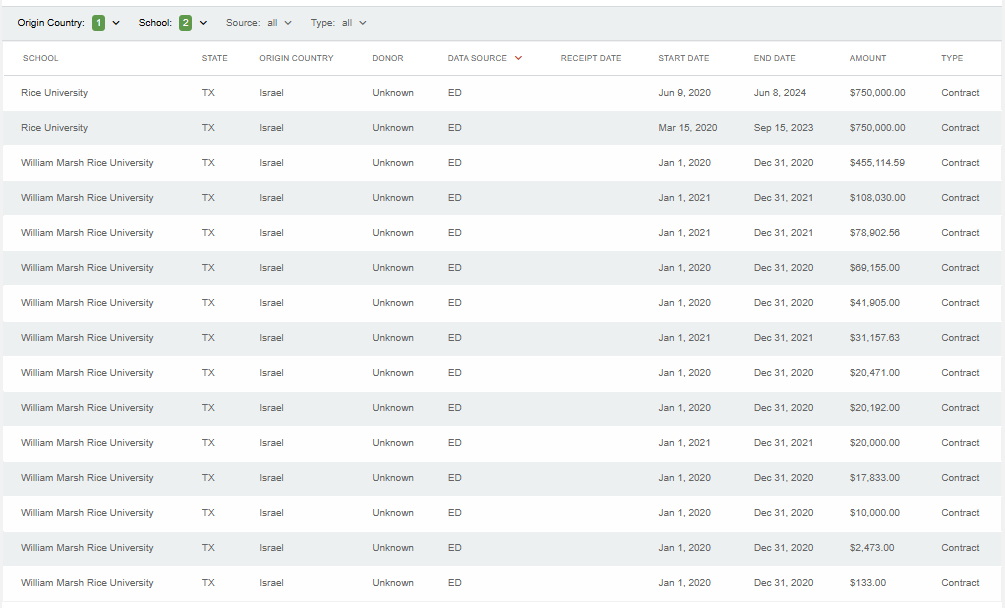
Rice contracts with entities in Israel, reported to the federal government
Institutional relations with Israeli universities that materially support to genocide and occupation
In 2025, Rice began its partnership with Venice International University, a global academic consortium of 23 universities which include Tel Aviv University. This arrangement includes sending faculty and students to the Venice campus. Tel Aviv University has research connections with Elbit Systems for projects such as autonomous drone navigation, trains soldiers and lawyers for the IDF, and directly shapes Israeli security policy. The former head of Tel Aviv University’s Institute for National Security Studies formally stated that the IDF has to win wars by “destroying houses and infrastructure and causing suffering for hundreds of thousands.”cxc
At an undergraduate level, Rice has a research scholarship that supports students to go to universities such as Technion-Israel Institute of Technology, which partners with Elbit Systems and Rafael Advanced Defense Systems, one of Israel’s largest government-sponsored weapons manufacturers.cxci One of the scholarship’s donors, Max Blankfield, was head of Texas Friends of the IDF (FIDF) in 2019, has attended and sponsored attendees for AIPAC conferences, and has publicly critiqued the United Nations Relief and Works Agency for Palestinian refugees.cxcii As outlined in the “Engineering Violence” faculty research section, Rice faculty also have numerous research collaborations with Technion researchers funded by the Department of War.
In the past, Rice has offered a Rice in Israel study abroad program with the Rothberg International School at The Hebrew University in Jerusalem, which is still listed on the Program in Jewish Studies website.cxciii Rice also has a Naval Reserves Officers’ Training Corps (ROTC) Unit, which was founded in 1941.cxciv Rice’s NROTC is part of the NROTC Houston Consortium which has graduated over 900 officers since World War II into the Navy and Marines. One program opportunity for NROTC graduates, as listed in their handbook, is the Anna Sobel Levy Foundation Scholarship.cxcv The stated goal of the fellowship scholarship is “to provide future officers an opportunity to learn first-hand about the unique relationship between the U.S. and Israel, to master regional politics, culture, and security affairs, and to study foreign languages at Hebrew University in Jerusalem.”cxcvi As has been well documented by scholars, Hebrew University is partially built on illegally expropriated land in East Jerusalem and materially supports the IDF by hosting a military base and providing logistical equipment.cxcvii
Rice Management Company’s Opaque Investment Portfolio
In response to student body pressure,cxcviii RMC issued a Divestment Statement attempting to ward off the rising tide of students demanding ethical behavior by their university endowments. This proves to be public-facing about-face for Rice, which, until the wave of divestment campaigns launched by the student movement in solidarity with Palestine following the beginning of the Gaza genocide, was publicly open to ethical investing through a commitment to becoming carbon-neutral by 2030.cxcix As part of this commitment, the RMC Board of Directors approved a sustainability statement in December 2021 and approved Rice and RMC’s signatory status on the United Nations Principles for Responsible Investment (PRI).cc
PRI promotes “environmental, social and governance factors” (ESG) as a part of institutional investment practice. One of the PRI principles is “appropriate disclosure on ESG issues.” Not only has RMC failed to disclose its progress towards its carbon neutrality goals and adherence to PRI, but the content of its portfolio is entirely opaque unless Rice is legally obligated to disclose. This extreme lack of transparency is at odds with the very status of a non-profit endowment let alone compatible with even the weakest commitments to ethical investment. This report section outlines [1] what we know about Rice Management Company and [2] the ethical investment agreement Rice signed in 2022 and how Rice has failed to uphold these commitments.
What We Know
Rice University, through the Rice Management Company (RMC), operates one of the wealthiest endowments per undergraduate student in the country. With an endowment exceeding $8 billion as of 2024, roughly $1.6 million per undergraduate student, Rice’s financial model is heavily reliant on investment returns, which comprise over 40% of the university’s annual operating budget.cci Rice University’s endowment is made up of a pool of managed assets currently valued at $7.48 billion USD.ccii This asset pool is managed by Rice Management Company (RMC).cciii Rice also has a directly managed real estate portfolio valued at about 590 million USD.cciv Rice’s investment strategy privileges high-return asset classes such as private equity, venture capital, and energy. These are the three sectors consistently linked to extractive industry, surveillance technologies, and militarized infrastructure nation-wide.
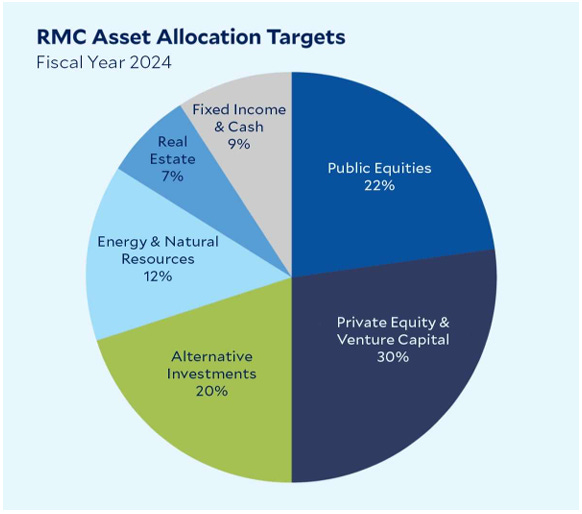
This pie chart is essentially the extent of RMC’s public communication on the structure of its endowment. Its annual reports are typically 4 pages long.ccv Due to this lack of transparency, only a sketchy understanding of Rice’s investment structure is available. Each of the sections indicated in this chart will be discussed with as much detail as possible. According to the FY24 endowment report, Rice actively profits from:ccvi
Venture Capital & Private Equity (30%): Now the endowment’s largest allocation at $2.3 billion, with a 10-year return of 16.3%. These assets are often held through opaque partnerships with limited disclosure and significant exposure to industries like AI weaponization, border surveillance, and fossil fuel tech. RMC’s 2024 annual report says, “Rice’s venture capital and private equity program has grown to $2.3 billion, the endowment’s largest allocation. Risk is managed by diversifying across 20 active external partners and investing in a range of industries around the globe”ccvii
Energy & Natural Resources (12%): In its fiscal year 2024 report,ccviii RMC indicated that the “energy portfolio” accounted for a significant amount of the total 9.7% return (excluding directly held real estate). This likely corresponds to the “Energy & Natural Resources” holdings in the September 2024 chart which account for 12% of the total holdings.ccix
Public Equities (22%): Some of the companies that most egregiously support the ongoing genocide in Gaza and are deeply integrated into systems of colonial war are publicly traded companies, likely to be found in standard Public Equity portfolios.ccx Public equities with links to war and genocide include weapons manufacturers such as Lockheed Martin, Northrop Grumman, and Raytheon—major suppliers of armaments used in the siege on Gaza and the broader U.S. military-industrial complex. These companies are not merely theoretical holdings; Rice actively collaborates with them through research, career pipelines, and advisory boards.
Alternative Investments (30%): A vague category that could include any investments that are not bonds, stocks or cash. Again, there is no further information provided by Rice as to what this sector is invested in.
Fixed Income & Cash (9%): There is also no information regarding the specific investments of this straightforward and easily reportable category.
Rice’s Violations as a Signatory of the UN Principles for Responsible Investment (PRI)
In 2022, Rice committed to becoming carbon-neutral by 2030 and became a signatory of the UN Principles for Responsible Investment (PRI).ccxi In doing so, Rice made a public declaration that it will integrate environmental, social, and corporate governance (ESG) factors into its investment decisions. This should thus preclude entanglement with corporations complicit in apartheid and genocide, the fossil fuels industry, and the international arms trade.
Violating the Principles, Point by Pointccxii
Rice’s portfolio and partnerships are in conflict with PRI principles it has pledged to uphold:
Principle 1: “We will incorporate ESG issues into investment analysis and decision-making processes.” This principle is violated by RMC’s apparent failure to screen investments for ESG harm; or if any screening is occurring, the failure to disclose precludes this from public knowledge
Principle 2: “We will be active owners and incorporate ESG issues into our ownership policies and practices.” This principle is violated by Rice’s passive ownership model. It does not engage companies on ethical concerns or publish shareholder voting records, which are standard practice at peer institutions like Stanford or Brown
Principle 3 “We will seek appropriate disclosure on ESG issues by the entities in which we invest.” is violated by Rice’s refusal to disclose ESG risks or seek reporting from companies it invests in. RMC’s holdings remain secret despite repeated calls from students, faculty, and alumni
Principle 4 “We will promote the acceptance and implementation of the Principles within the investment industry.” This principle is violated by Rice’s partnerships with corporations profiting from war. There is no evidence that Rice communicates PRI-aligned expectations to service providers or fund managers. In fact, RMC’s “Divestment Statement” actively broadcasts a denunciation of ethical investing
Principle 5 “We will work together to enhance our effectiveness in implementing the Principles.” This principle is violated by Rice’s lack of participation in PRI-aligned collaborative investor networks—particularly those working on divestment from military contractors or fossil fuel firms. It is also violated by Rice’s hostility towards student and faculty groups working towards divesting the endowment from genocide and ecological destruction. This is evidenced by Rice dismissing the outcome of the divestment vote and its draconian restrictions to student protestccxiii
Principle 6 “We will each report on our activities and progress towards implementing the Principles. This principle is violated by Rice’s total lack of public reporting on PRI implementation or ESG metrics
RMC’s limited elaboration of its investment strategy thus is incompatible with its signed commitments. The 2024 annual report champions returns over any consideration of ethics and the university’s place in global systems of exploitation and violence. The annual report says “Rice is in the forever business, meaning we are investing to support and maintain university operations and goals for generations of Owls.”ccxiv RMC’s strategy fails to distinguish between profitable investments and ethical ones. In its discussion of its risk strategy, Rice introduces the idea of “intergenerational equity,”ccxv or the ability of the endowment to constantly generate wealth for decades to come. This structure is not neutral and creates an architecture of sanctioned harm. With Rice’s investment portfolio being so obscured, there is a significant amount of further research to be done into Rice’s portfolio.
A refusal to normalize militarism: Concluding questions for the Rice community
As this section of the report demonstrates, the commitments to war and fossil fuel industries are advanced through words and ideas as much as they are advanced through the development of technology and weapons. Just as Rice has adopted an approach to research funding which prioritizes large grants and increasing collaborations with the Department of War, Rice also invests both through its endowments and its educational programming in militarism and ecological destruction.
How do these entanglements with war and fossil fuel industries shape, affect, and harm the educational environment at Rice? How can we better identify, understand and analyze these linkages across the many parts of the university?
If a student vote can be ignored by Rice’s administration, who gets to decide what values the university represents?
How can Rice faculty and staff strengthen their own democratic participation as members of the university and commit to tackling ethical questions of institutional complicity?
IV. STATE OF CAMPUS ACTIVISM & ANTI-WAR SPEECH
Summary
Since October 2023, Rice University has witnessed an unprecedented wave of student activism in response to Israel’s military campaign in Gaza. The campus community has organized vigils, teach-ins, demonstrations, and other educational events to express solidarity, raise awareness, and make demands to end to the genocide.ccxvi Drawing inspiration from national campus movements and in solidarity with the Palestinian campaign of Boycott, Divestment, and Sanctions, Rice students mobilized to call for institutional divestment from companies complicit in genocide and occupation. These activist activities have been met with a combination of administrative suppression, policy changes, intimidation tactics, and sanctions. Students, faculty, and staff have been physically and verbally harassed for these activities.
Rice’s administrative and institutional response to anti-genocide activism and also right-wing anti-DEI policies can be characterized as [1] displaying anticipatory overcompliance; [2] defaulting on existing flawed bureaucratic procedures which have been easily weaponized to harass students, faculty, and staff; and [3] exemplifying the “Palestine exception”ccxvii whereby otherwise permissible and encouraged freedom of expression and academic inquiry is uniquely harshly and formally suppressed. For example, in Spring 2024, Rice’s Office for Access, Equity and Equal Opportunity (AEEO, now Equal Opportunity Services) shut down a student association vote on divestment in Spring 2024, prompting the Muslim Legal Fund of America to file a Title IV complaint against Rice for discrimination.ccxviii More recently, a Fall 2025 student resolution about divesting from violence in Sudan was also undemocratically blocked. Additionally, Rice implemented a new set of extremely restrictive demonstration policies in Fall 2024, following the wave of repressive protest policies implemented at universities nation-wide in direct response to pro-Palestine student demonstrations in Spring 2024.ccxix
This report section briefly summarizes Rice’s student activism, administrative responses, and how the institution has formally generated a hostile campus climate for activism. Notably:
Multiple blocking student votes on disclosure and divestment resolutions related to Palestine and Sudan
Weaponization of federal anti-discrimination laws to harass and intimidate anti-genocide activism, filed through Rice’s Office of Equal Opportunity Services
Proactively enacting repressive demonstration policies in 2024
Publicly claiming “institutional neutrality” while enabling a climate of harassment of faculty, staff, and students
Active hostility against anti-war speech
Suppressing & ignoring Student Association decisions
In Spring 2024, the Student Association Senate introduced Senate Resolution No. 2, which explicitly called for Rice University to boycott and divest from companies complicit in the genocide in Gaza.ccxx These included corporations such as Lockheed Martin, Elbit Systems, Chevron, Raytheon, and Intel, named for their material ties to the Israeli military operations.
Following the resolution’s introduction, Student Association representatives were threatened, through anonymous phone calls to their parents. One Student Association representative experienced stalking and threats through anonymous phone calls and a physical note left on their car on campus.ccxxi Rice’s AEEO Office forced the Student Association to table it while it conducted an investigation of a complaint lodged by a student.ccxxii In response, concerned faculty submitted a letter of protest, and faculty members met directly with administrators. Despite this, the administration refused to reverse its decision, continuing a pattern of institutional suppression of Palestinian advocacy also condemned in a Senate Resolution (No. 14) that supported an anti-genocide faculty-led public letter in 2023.ccxxiii
In the Spring of 2024, Rice graduate students attempted to introduce a statement condemning the genocide and the suppression of student activism to the Graduate Student Association (GSA). Following the introduction of this initiative, Rice administrators met with GSA members and suggested that pursuing a statement could lead to lost employment opportunity and legal persecution specifically for international students.
By Summer 2024, the Muslim Legal Fund of America filed a Title VI complaint against Rice with the Office of Civil Rights, asserting that the university had violated federal anti-discrimination laws by suppressing the student divestment vote.ccxxiv The summer also saw a sudden update to Rice’s protest and speech policies, which gave administrators broad authority to penalize dissent on campus, outlined in further detail a later section below.
Harassment of anti-genocide activism and affirmations of Palestinian humanity
Members of the Rice community who have expressed dissent against Israel’s genocide in Gaza since 2023 have been harassed physically, financially, and online. A few examples include: while one student was peacefully protesting at an event, a professor physically manhandled the student, grabbing them by the arm and dragged them out. In advance of the October 2025 event bringing a pro-genocide speaker onto campus, some Rice students were preemptively denied entry to an event they had registered for months prior and were threatened with disciplinary action for planning a silent walkout.ccxxv As students were tabling to raise awareness about the genocide in Palestine, a Rice employee approached them, shouted, and threatened that they would use their experience and connections with the IDF to surveil and harm them.
Faculty members who wore keffiyehs experienced harassment by members of the Rice community, including: being physically approached and being shouted at; having their photos taken to be sent to the University president with the intent of punishment; a distinguished Rice professor posting their photos on social media and asking tens of thousands of followers to identify one on the internet; a dean calling faculty and threatening that there would be new future policies in place to limit what faculty can wear at university events. The same distinguished Rice professor listed above who posted photos of colleagues has also repeatedly publicly written names of members of the Rice community they deemed to be pro-Palestinian, alongside posting threatening photos of knives (that they claim Israelis on campus regularly wield due to “self-defense” concerns).
Weaponizing Anti-Semitism and civil rights law through the Equity Office
In addition to the AEEO blocking the Spring 2024 Student Association vote, the AEEO’s complaint process has been actively used to harass and shut down campus speech and activism. Student activists who organized events commemorating the beginning of the genocide in Gaza were subject to discrimination (on the basis of nationality) complaints filed through the Office of Access, Equity, and Equal Opportunity (later renamed Office of Equal Opportunity Services to comply with federal anti-DEI policies), subjecting them to long-term mental and financial stress to find legal representation in defense.
Faculty members have also been unduly subject to the weaponization of discrimination complaints filed through the Office of Equal Opportunity Services, mirroring an extensive national pattern of the weaponization of anti-Semitism to repress dissent against Israel’s genocide in Gaza since 2023. As noted in The Guardian, “the Trump administration has turned civil rights legislation into a cudgel to root out progressive politics on US campuses, with billions of dollars in federal funding on the line, pro-Palestinian professors have increasingly been caught in the crossfire.”ccxxvi This phenomenon is extensively documented in a 2025 report “Discriminating against Dissent: The Weaponization of Civil Rights Law to Repress Campus Speech on Palestine” written by the American Association of University Professors.ccxxvii
Anticipatory Overcompliance and Hiding Behind “Institutional Neutrality”
New Highly Restrictive Protest Policies
In tandem with its suppression of disclosure and divestment efforts, Rice University introduced repressive protest policies during Summer 2024 - Policies 820 and 856ccxxviii - without any meaningful student or faculty consultation.ccxxix Policy 820 grants the administration expansive authority to define, permit, or revoke demonstrations and to classify gatherings as policy violations. Policy 856 empowers any university employee to remove flyers and posters based on vague criteria of appropriateness, effectively enabling ideological censorship. These new demonstration policies significantly increase administrative and police surveillance, including provisions to limit demonstrations to only four locations on campus, new time restrictions, and defining a demonstration as any expressive acts by one or more persons on campus, including even vigils or religious services.ccxxx
Following a wave of repressive demonstration policies across the country, these policies were introduced amidst mounting student dissent and appear directly designed to chill protest, suppress political expression, and quash mobilization around Palestine. While there is no lip service towards supporting students’ rights, the new policies ironically claim that it is not “intended to diminish Rice’s commitment to the academic freedom of its faculty….for where people hesitate to speak their mind, critical thinking has no purchase and the university cannot even begin to carry out its mission.”ccxxxi And yet, the policy undoubtedly has the opposite effect. In response, Senate Resolution No. 5 condemned the changes and demanded the formation of a student-inclusive committee to rewrite the policies. That demand has gone unmet.
Rice dropped 70 spots in the Foundation for Individual Rights and Expression’s 2026 rankings and received an “F,” citing overbroad harassment policies and vague demonstration restrictions. Even student survey data shows deep disillusionment with open dialogue at Rice.ccxxxii
In January 2025, a group of UN Special Rapporteurs on Human Rights sent letters to five universities highlighting human rights violations against international student activists that had been involved in Palestine solidarity work. These universities–Columbia, Cornell, Georgetown, Minnesota State, and Tufts–all saw student deportations and abductions by immigration enforcement as a result of their activism. The letter, however, highlights administrative overreach that occurred across the country, including at Rice. The Special Rapporteurs write, “The restrictive measures at Columbia University reflect nationwide structural changes at universities to suppress Palestine solidarity movements. This has been recorded in a report by the UN Special Rapporteur on the rights to freedom of peaceful assembly and of association.” The letter indicates the toll that repression has taken on international students in particular, “Students report self-censoring political expression, and particularly international students are withdrawing from activism due to deportation fears.”ccxxxiii
Administrative Messaging and “Institutional Neutrality”
Over the course of the 2023–2025 academic years, Rice University administration has released a series of official statements addressing the ongoing genocide in Gaza and the political mobilization on campus. While these messages claim to express concern for “all members of the community” and champion a so-called “culture of care,” a deeper reading reveals a pattern of institutional gaslighting: erasure of Palestinian suffering, asymmetric empathy, and strategic ambiguity designed to protect Rice’s assumed political neutrality and financial relationships at the expense of moral clarity. Nowhere in the dozens of university-wide emails do university senior leaders name Israel’s sustained assault on Gaza named as a genocide,ccxxxiv despite the fact that an email from April 29, 2024 acknowledges the enormous toll on Palestinian life.ccxxxv This failure continues even as major international organizations, scholars, and nations have condemned the genocide in Gaza.ccxxxvi In multiple emails, administrative voices focus heavily on grief within the “Jewish and Israeli communities” while only vaguely referencing Palestinians.ccxxxvii The administration has never acknowledged the threats, doxxing, and physical intimidation faced by Palestinian, Muslim, and allied students on campus — including being dragged from events, stalked, and harassed. Nor has it condemned the external attacks on students by far-right blogs and lobbying groups. This rhetorical asymmetry functions to decontextualize violence, protect institutional stakeholders, and neutralize student dissent. It is a form of political sanitization, one that reflects and reinforces Rice’s investment entanglements with weapons manufacturers, fossil fuel firms, and defense contractors.
Examples of Misdefining anti-Semitism and DEI: Institutional Training and Orientation Speaker
In Fall 2024, dozens of Rice administrators and staff attended a four-hour workshop by the Academic Engagement Network (AEN), an organization funded by the Israel on Campus Coalition. According to AEN’s own materials, it “mobilizes networks of university faculty and administrators to counter antisemitism, oppose the denigration of Jewish and Zionist identities, promote academic freedom, and advance education about Israel.” The arc of the training has two major points: 1.) critiques of Israel (anti-Zionism) are the most recent stage of ancient anti-Semitism, and 2.) associating Jewish people with power is an anti-Semitic trope, thus critiques of Israel that suggest Jewish people have power is anti-Semitic. The training materials include a document co-written by AEN and Hillel that are a set of should/shouldn’t guidelines for faculty and students.ccxxxviii Furthermore, the AEN board consists of many high-ranking university administrators who have openly targeted student organizers including figures from Texas A&M and Smith College.
In Fall 2025, Rice required all incoming students to attend a mandatory “Diversity and Community at Rice” orientation program, featuring speaker Suzanne Nossel, then–former CEO of PEN America. Nossel has been widely criticized for her pro-Israel stance and her organization’s failure to support Palestinian voices. She resigned from PEN in October 2024 amidst backlash, though she denied that the resignation was related to PEN’s position on the genocide.ccxxxix Nossel was invited to speak by the Vice Provost for the Office of Access and Institutional Excellence, despite prior warnings from student leaders and Community Facilitators (CFs) about her troubling record. Several Community Facilitators, students in charge of upholding inclusionary practices during orientation, walked off stage during the talk in protest.ccxl
The above event occurred amid broader restructuring of diversity education at Rice, with CFs required to revise their training slides to remove terms like “microaggressions” and instead use legally palatable phrases like “everyday slights.” Like universities across the country, Rice renamed its Diversity, Equity, and Inclusion office to the “Office of Access and Institutional Excellence” in 2025, following the inauguration of Donald Trump.ccxli The Vice Provost for the Office of Access and Institutional Excellence confirmed that these revisions were made under guidance from university legal counsel.ccxlii
Pro-Palestine activism in a repressive state
Rice exists in a notably repressive state for Palestine solidarity activism. The Texas State Governor’s office contacted Rice during Rice Student for Justice in Palestine’s 2024 encampment demanding that student protestors be arrested. Texas materially invests in the state of Israel; most recently in late 2023, Texas state purchased $45 million Israeli bonds.ccxliii In 2025, Abbott threatened to defund the city of San Marcos which was considering a ceasefire resolution.ccxliv Rice is located in Houston, Texas, which is home to the single most significant port in the United States for the transshipment of F-35 fighter jet manufacturing for Lockheed Martin Corporation. F-35 fighter jets are the “crown jewel” of Israel’s military and play a key role in its genocidal airstrikes of Gaza. As the community organization coalition Houston Arms Embargo has extensively researched, the Port of Houston received over 400 shipments of F-35 parts, with over 40% of shipments coming directly from Israel, for transport by rail and assemblage in Fort Worth, Texas.ccxlv The Port of Houston is a public entity and contracts with Maersk, the shipping company profiting from transport of Lockheed Martin, and a major target of the Palestinian boycott movement.ccxlvi
Texas law prohibits public institutions—including universities—from contracting with or investing in businesses that boycott Israel, effectively criminalizing financial support for BDS (the Boycott, Divestment, Sanctions movement). The legislation, first enacted in 2017 and revised in 2019, mandates certification from government contractors that they do not and will not participate in pro-Palestinian boycotts; it applies to contracts with companies employing at least 10 people and valuing more than $100,000.ccxlvii This legal framework has had an immediate chilling effect on student divestment movements across Texas campuses. For instance, University of Houston students, who passed a “Divest from Death” resolution demanding divestment from weapon manufacturers supplying the Israeli military, were rebuffed by university officials citing incompatibility with state law.ccxlviii Courts have upheld the law’s constitutionality, with Attorney General Paxton emphasizing it underscores Texas’s unwavering “commitment to stand with Israel.”ccxlix
The Texas Holocaust, Genocide, and Antisemitism Advisory Commission (THGAAC) was created by Greg Abbott in 2021 to surveil educational institutions and suppress support for Palestine under the guise of “combating and confronting antisemitism.”ccl Influential Rice donor Jay Zeidman is a commissioner of THGAAC.ccli THGAAC works with city and state police to repress educational communities that express any critical views of Israel in Texas, advocating for the restrictive International Holocaust Remembrance Alliance (IHRA) definition of anti-semitism. Texas lawmakers are pushing to embed the IHRA “working definition” of anti-semitism into school and university disciplinary codes. Senate Bill 326 would require public K‑12 districts and higher ed institutions to use this expansive definition when evaluating student conduct, effectively expanding the legal basis for disciplining speech deemed antisemitic.cclii The IHRA definition, while non‑legally binding, is widely critiqued for its deliberate ambiguity, especially the inclusion of criticism of Israel as a potential marker of antisemitism. This ambiguity allows institutions to label legitimate pro‑Palestinian expressions as discriminatory or hateful.ccliii Civil liberties advocates and academic scholars warn that such definitions are being used to suppress political critique rigorously, undermining free speech and academic freedom on campus.ccliv
Chapter conclusion: A healthy campus for activism & expression
In a financialized university model where tuition, research funding, and prestige flow through the same extractive pipelines, students are often told to accept complicity as the price of education. But the students at Rice have made clear that silence is no longer tolerable. In the past, Rice’s Board of Governors refused to divest from apartheid South Africa in a timely fashion. Now, the same rhetorical evasions are being used to defend entanglements in an apartheid regime in Palestine. By linking divestment to human dignity, students at Rice are continuing a long legacy of campus resistance from Vietnam to South Africa to Gaza.
Taken as a whole, Rice’s response reflects a broader national strategy that aims to suppress pro-Palestinian dissent through administrative procedure, misdefine dissent against genocidal systems as hate, and obscure complicity with the language of neutrality. What is occurring is the protection of institutional interests at the expense of the free speech and democratic expression of the heart of the university’s community - its students, faculty, and staff. How can faculty and students mobilize to promote, rather than suppress, free speech on campus?
V. TOWARDS AN ANTI-WAR UNIVERSITY: CONCLUSION & QUESTIONS
The title of this report, Engineering Violence, draws inspiration from a conference entitled “Engineering Destruction: Militarization and the War Economy,” held in July 2025 at Birzeit University in the West Bank in Palestine. In the words of economist Taher Al-Labadi at the conference, Israel’s economy is not simply affected by war, but constituted by war. As Palestinians scholars, activists, and citizens have regularly emphasized, the current genocide has been long in the making, manufactured by a vast military-industrial apartheid system that includes the Israeli state and military, but also materially and ideologically supported and enabled by a wide set of global institutions and actors. These include the United States government and military, weapons manufacturers, surveillance technology firms, construction companies, media companies, financial institutions such as banks and insurers, and universities.cclv
Indeed, this report began as an attempt to examine Rice’s connections with the Israeli military and institutions that uphold Israel’s genocidal apartheid state in the aftermath of October 7, 2023. As the research for the report unfolded, however, it became increasingly clear to the report writers that Rice is deeply entangled with many militaristic entities and the larger war industry. As outlined in this report, Rice has research collaborations, scholarships, and other entanglements with multiple militaries and weapons manufacturers such as Lockheed Martin and Raytheon, fossil fuel giants like Chevron and Exxon, and Israeli academic institutions that directly contribute technical, military, and material support of apartheid, genocide, and repressive political conditions both abroad and, increasingly, in the United States.
Without ethical regulations and considerations, academics must accept the fact that research is often weaponized, making them contributors to war-making and authoritarian governance globally. We urge Rice to recommit to being a university oriented towards collective, planetary well-being by considering:
Financial transparency and disclosing Rice’s financial interests in war-related and energy industries, including donations, investments, and research funding
Upholding ethical investment commitments by divesting and disentangling from entities that profit from war and planetary destructioncclvi
Opening conversations across the university about what it means for the majority of future university research funds to come from military and private entities
This report is thus an attempt to open a conversation about challenging existing dynamics at Rice, and we return to the questions at the beginning of the report: What might an ethical, anti-war university look like? What kind of research and science do we want to do? Are there ways to measure scientific research prestige that do not equate it entirely with funding size? What other measures of research excellence might Rice adopt? And how might the university support researchers who are reluctant to seek DoW or private funding on ethical grounds? More generally, what do we want the university to be for? And for whom do we want to do our work?
Although these are big questions, social change occurs through many small, concrete, and incremental actions of members of a community. We hope these questions are taken up by concerned Rice community members, whether in colleges, departments and centers, in student, faculty, and staff groups, the Faculty Senate, and any other Rice community spaces.
VI. ACKNOWLEDGMENTS & ENDNOTES
Acknowledgments
This report was authored by a group of Rice community members. The research began in May 2025 and concluded in January 2026. The Anti-War Initiative offered important research tools (https://antiwar.io/research-tools) to access DoD funding data and university tax and audit documents, which are publicly accessible (to date, January 2026) but took significant time to locate, compile, and analyze.
Finally, this report comes after two years of genocide in Gaza, led by the Israeli government and materially made possible by the United States and the global military industry. The genocide has killed hundreds of thousands of people so far, through both direct bombardment and disease, famine, and other deadly consequences of the mass displacement of 99% of Gazans.cclvii According to the Israeli military’s own estimates in 2025, at least 83% of Palestinians they killed in Gaza since 2023 were civilians; nearly half have been children.cclviii The unacceptability of this tragedy was the initial impetus for writing this report and remains at the heart of an unfolding broader anti-war anti-authoritarian movement.
i Endnotes
I. Introduction
Source: Defense Technical Information Center. For relative comparison with other universities: Duke has received $576.77 million; Emory $149.91 million; Johns Hopkins $827.45 million; Stanford $1.1 billion, MIT $1.24 billion. https://dtic.dimensions.ai/discover/grant?or_facet_research_org=grid.21940.3e
ii https://dtic.dimensions.ai/discover/grant?or_facet_research_org=grid.21940.3e
iii https://dra.rice.edu/rising-center
iv https://news.rice.edu/news/2025/rice-establishes-center-membrane-excellence-advance-separation-technologies-energy-and
v For more on how the US-Israel Binational Science Foundation and US-Israel Binational Agricultural Research & Development funding agencies actively participate in and uphold illegal settlements and apartheid in Palestine, see: https://apnews.com/article/science-israel-west-bank-international-law-jerusalem-0fd5bd1b2fadd80c8486c16c14a22427
vi https://nta.org/2020/12/01/darpa-awards-9-8m-to-rice-university-for-next-gen-nonsurgical-neurotechnology-program/
vii https/investigate.afsc.org/company/northropgrumman
viii For example, in the late 1990s and early 2000s, Rice heavily invested in becoming a national leader in “nano-bio-info-enviro” fields. By 2008, more than a quarter of the science and engineering faculty hired at Rice in the previous two decades were nanotechnology experts affiliated with the Smalley Institute. This became a leading pitch for Rice’s utility in establishing a partnership with Lockheed Martin Corporation. https://news2.rice.edu/2008/04/22/smalley-institute-partners-with-lockheed-martin/
ix https://momentous.rice.edu/ai
x https://dra.rice.edu/rising-center
xi https://news.rice.edu/news/2024/rice-hosts-assistant-secretary-defense-science-and-technology
xii Emails can be sent to: antiwar.rice@proton.me
xiii https://qmro.qmul.ac.uk/xmlui/handle/123456789/94585
xiv https://www.un.org/unispal/document/a-hrc-59-23-from-economy-of-occupation-to-economy-of-genocide-report-special-rapporteur-francesca-albanese-palestine-2025/
II. ENGINEERING VIOLENCE
xv In a recent 2024 speech while founding new Texas space initiatives, right-wing Governor Greg Abbott referenced Rice’s long history in space exploration, invoking JFK’s famous announcement of putting a man on the moon, which was delivered at Rice. https://news.rice.edu/news/2024/rices-david-alexander-serve-texas-aerospace-research-and-space-economy-consortium
xvi For relative comparison with other universities: Duke has received $576.77 million; Emory $149.91 million; Johns Hopkins $827.45 million; Stanford $1.1 billion, MIT $1.24 billion. Source: Defense Technical Information Center at https://dtic.dimensions.ai/discover/grant?or_facet_research_org=grid.21940.3e.
xvii https://dtic.dimensions.ai/discover/grant?or_facet_research_org=grid.21940.3e
xviii May 2, 2025 update: https://research.rice.edu/opd/executive-orders-and-funding
xix https://www.science.org/content/article/congress-set-reject-trump-s-major-budget-cuts-nsf-nasa-and-energy-science
xx https://www.defense.gov/News/News-Stories/Article/article/4227847/senior-officials-outline-presidents-proposed-fy26-defense-budget/
xxi https://news.rice.edu/news/2022/rice-baker-institute-sign-mou-us-army
xxii https://news.rice.edu/news/2024/rice-led-study-uncovers-breakthrough-magnetism-could-transform-quantum-computing-and; https://bdsmovement.net/news/palestinian-academic-unions-commend-global-universities-for-ending-ties-with-complicit-israeli; https://www.weizmann.ac.il/wsos/sites/feinberg/files/uploads/fgs_update_04dec2023_-_update_and_adjustments_for_students_following_the_iron_swords_war.pdf
xxiii https://bdsmovement.net/news/appeal-action-end-cornell-university-collaboration-technion
xxiv https://nta.org/2020/12/01/darpa-awards-9-8m-to-rice-university-for-next-gen-nonsurgical-neurotechnology-program/
xxv https://www.wired.com/2015/03/woman-controls-fighter-jet-sim-using-mind/
xxvi https://www.defenseone.com/technology/2018/09/its-now-possible-telepathically-communicate-drone-swarm/151068/?oref=d-channeltop
xxvii https://dtic.dimensions.ai/analytics/grant/funder/aggregated?or_facet_research_org=grid.21940.3e
xxviii https://dra.rice.edu/
xxix https://dra.rice.edu/
xxx https://news.rice.edu/news/2024/rice-hosts-assistant-secretary-defense-science-and-technology
xxxi https://news.rice.edu/news/2023/rice-university-welcomes-us-navy-research-official-campus-visit
xxxii Ericsson emphasized the DOD’s commitment to engaging with diverse innovators from nontraditional spaces to tackle critical challenges. https://news.rice.edu/news/2024/rice-hosts-assistant-secretary-defense-science-and-technology
xxxiii https://news.rice.edu/news/2024/rice-hosts-assistant-secretary-defense-science-and-technology
xxxiv https://news.rice.edu/news/2024/rice-hosts-assistant-secretary-defense-science-and-technology
xxxv DARPA is a Department of Defense initiative that was founded in 1957 in response to the launch of Sputnik, https://www.darpa.mil/about#history
xxxvi https://runsra.rice.edu/
xxxvii https://runsra.rice.edu/about-runsra
xxxviii https://kenkennedy.rice.edu/news/rice-tapped-army-cutting-edge-communications-research
xxxix https://runsra.rice.edu/about-runsra
xl https://projects.propublica.org/nonprofits/display_audit/2024-06-GSAFAC-0000344857
xli https://runsra.rice.edu/people; https://runsra.rice.edu/connect
In 2025, RUNSRA Advisory Committee consisted of: Pulickel Ajayan, Paul Cherukuri, Tam Dao, Naomi Halas, Lydia Kavraki, Thomas Killian, Lane Martin, Luay Nakhleh, Doug Natelson, Ramamoorthy Ramesh, Ashutosh Sabharwal, Jeffrey Tabor, James Tour. RUNSRA personnel included: Vinod Veedu (Assistant Vice President), Pulickel Ajayan (Benjamin M. and Mary Greenwood Anderson Professor of Engineering), Robert Vajtai (Research Professor), Ashutosh Sabharwal (Ernest Dell Butcher Professor of Engineering, Electrical and Computer Engineering), Boris Yakobson (Karl F. Hasselmann Professor, Materials Science and NanoEngineering Member, Ken Kennedy Institute), Aditya Mohite, Edward W. Knightly, Santiago Segarra, Michael S. Wong, László Kürti, James Tour, Caroline Ajo-Franklin, David Alexander, Zachary T. Ball, Gang Bao, Reginald DesRoches, Naomi J. Halas, Lydia E. Kavraki, Carolyn Nichol, Peter J. A. Norlander, Qimiao Si, Jonathan Silberg, Ramamoorthy Ramesh, Paul Cherkuri, Yousif Shamoo.
xlii The CHIPS and Science Act of 2022 is a milestone in bolstering the U.S. semiconductor industry with $280 billion allocated to stimulate growth and innovation.
https://news.rice.edu/news/2024/department-defenses-dev-shenoy-addresses-rice-community-microelectronics-advancements-and
xliii https://nsin.mil/
xliv https://research.rice.edu/qa/national-security-innovation-network; https://nsin.mil/
xlv Other NSIN programs include NSIN Experts, X-Force, and Tech Squad, that link university faculty, students, and STEM professionals directly with DoD officials through laboratory technology and real-world problem solving opportunities. To engage students, the NSIN offers a Technology and National Security Fellowship, which “matches doctoral and master’s candidates in STEM fields with policy makers and national laboratory-level DoD researchers to provide technical expertise on an emerging national security problem.” https://www.nsin.mil/experts/ ; https://research.rice.edu/qa/national-security-innovation-network
xlvi https://www.afrl.af.mil/News/Article-Display/Article/3827834/afrl-opens-international-center-at-rice-university/
xlvii https://dra.rice.edu/rising-center
xlviii https://news.rice.edu/news/2022/rice-baker-institute-sign-mou-us-army
xlix https://cloud.google.com/blog/topics/public-sector/rice-university-and-google-public-sector-partner-to-build-an-innovation-hub-in-texas/
l https://www.un.org/unispal/document/a-hrc-59-23-from-economy-of-occupation-to-economy-of-genocide-report-special-rapporteur-francesca-albanese-palestine-2025/
li https://dtic.dimensions.ai/analytics/grant/overview/timeline?order=date&or_facet_research_org=grid.21940.3e&local:indicator-y1=timeline-source-funding-amount&year_from=2000&year_to=2026
lii https://dtic.dimensions.ai/analytics/grant/overview/timeline?order=date&or_facet_research_org=grid.21940.3e&local:indicator-y1=timeline-source-funding-amount&year_from=2000&year_to=2026
liii https://dtic.dimensions.ai/analytics/grant/researcher/timeline?or_facet_research_org=grid.21940.3e&local:entities=ur.0617370330.48&local:entities=ur.015007171437.02&local:entities=ur.01100253604.04&local:entities=ur.01147031604.79&local:entities=ur.0651324536.88&year_from=2000&year_to=2025
liv The Rice research team includes Ramamoorthy Ramesh, Lane Martin (director of the Rice Advanced Materials Institute), Ashok Veeraraghavan (chair of electrical and computer engineering, Pulickel Ajayan (founding chair of the material science and nanoengineering department), Kaiyuan Yang (electrical and computer engineering), and Guha Balakrishnan (electrical and computer engineering).
https://news.rice.edu/news/2024/rice-researchers-advancing-microelectronics-manufacturing-darpa-funded-team-0
lv https://nta.org/2020/12/01/darpa-awards-9-8m-to-rice-university-for-next-gen-nonsurgical-neurotechnology-program/
lvi Rice’s researcher has described the project through medical terms, while DARPA N3 has much more militaristic presentation of the project’s aims. For example: “Most immediately, we’re thinking about ways we can help patients who are blind. In individuals who have lost the ability to see, scientists have shown that stimulating parts of the brain associated with vision can give those patients a sense of vision, even though their eyes no longer work.” Meanwhile, the N3 program manager notes that “The nice thing is that [N3] will also allow us to start exploring neurotechnology for the able-bodied soldier, if, for example, I’m operating a computer network or operating drones. As more artificial intelligence starts to propagate into our military environment, the way that we interact with these AI systems is going to change.”
https://eceweb.rice.edu/news/brain-brain-communication-demo-receives-darpa-funding; https://news.rice.edu/news/2019/feds-fund-creation-headset-high-speed-brain-link; https://www.afcea.org/signal-media/cyber-edge/mind-control-machines-isnt-brain-surgery-any-more
lvii https://www.darpa.mil/research/programs/next-generation-nonsurgical-neurotechnology
lviii Team collaborators: Pulickel Ajayan (Material Sciences), Reginald DesRoches (Civil and Environmental Engineering), Marcia O’Malley (Mechanical Engineering), James Tour (Chemistry). https://news.rice.edu/news/2021/rice-tapped-develop-3d-printed-smart-helmets-military
https://news.rice.edu/news/2023/rices-office-innovation-partners-carbon-and-tyrex-group
lix https://www.tyrexmfg.com/news/rices-office-of-innovation-partners-with-carbon-and-tyrex-group/
lx Grant title: “Sixth Sense: Head Mounted Sensor System for the Hyper-Enabled Operator.” Funder: US Department of the Navy. Grant number: N000142512247. Investigators: Paul Cherukuri.
https://dtic.dimensions.ai/details/grant/grant.14882467?order=date&or_facet_research_org=grid.21940.3e
lxi Paul Cherukuri, collaborating with Taiyun Chi and Ashok Veeraraghavan (Electrical and Computer Engineering). https://news.rice.edu/news/2021/us-army-backs-sleeping-cap-help-brains-take-out-trash
lxii See Table at the end of this section.
lxiii https://investors.lockheedmartin.com/news-releases/news-release-details/lockheed-martin-and-rice-partner-nanotech-research
lxiv https://news2.rice.edu/2008/04/22/smalley-institute-partners-with-lockheed-martin/
lxv https://dtic.dimensions.ai/discover/publication?order=date&or_facet_research_org=grid.21940.3e&or_facet_funder=grid.419474.b
lxvi https://news.rice.edu/news/2024/rice-team-brings-home-top-prize-2024-ethics-engineering-case-competition
lxvii https://www.defenseadvancement.com/news/darpa-selects-teams-to-produce-next-generation-battlefield-obscurants/
lxviii https://engineering.rice.edu/news/thanh-tran-named-technical-fellow-raytheon
lxix https://www.businessinsider.com/raytheon-ceo-benefit-dod-budget-increases-war-israel-2023-10
lxx https://afsc.org/gaza-genocide-campaign
lxxi https://dtic.dimensions.ai/discover/publication?order=funding
lxxii https://dtic.dimensions.ai/discover/grant?order=funding&or_facet_research_org=grid.21940.3e&and_facet_researcher=ur.015007171437.02
lxxiii https://news.rice.edu/news/2024/75m-dod-grant-backs-revolutionary-multi-university-research
lxxiv https://runsra.rice.edu/people
lxxv https://dtic.dimensions.ai/discover/publication?order=funding&and_facet_researcher=ur.01305760674.47
lxxvi https://runsra.rice.edu/people
lxxvii https://news.rice.edu/news/2020/researchers-set-sights-theory-deep-learning
lxxviii https://news2.rice.edu/2017/01/13/rice-has-role-in-new-250m-robotics-manufacturing-institute
lxxix https://dtic.dimensions.ai/discover/publication?order=funding&or_facet_researcher=ur.011743631465.56
lxxx https://dtic.dimensions.ai/discover/technical_report?order=funding&or_facet_research_org=grid.21940.3e&and_facet_researcher=ur.0617370330.48
lxxxi https://dtic.dimensions.ai/discover/grant?order=funding&or_facet_researcher=ur.01275626274.52
lxxxii https://dtic.dimensions.ai/discover/publication?order=date&or_facet_research_org=grid.21940.3e&or_facet_funder=grid.419474.b&and_facet_researcher=ur.01275626274.52
lxxxiii https://dtic.dimensions.ai/analytics/publication/author/aggregated?and_facet_researcher=ur.0651324536.88&or_facet_research_org=grid.6451.6&and_facet_research_org=grid.21940.3e&viz-st:aggr=mean
lxxxiv https://dtic.dimensions.ai/discover/grant?or_facet_researcher=ur.0651324536.88&and_facet_research_org=grid.21940.3e
lxxxv https://www.defense.gov/News/Releases/Release/Article/3463726/department-of-defense-selects-2023-vannevar-bush-faculty-fellows-to-pursue-vita/
lxxxvi https://news.rice.edu/news/2024/rices-emilia-morosan-awarded-prestigious-vannevar-bush-faculty-fellowship; https://news.rice.edu/news/2023/rice-researchers-earn-prestigious-defense-department-grants; https://www.war.gov/News/Releases/Release/Article/3463726/department-of-defense-selects-2023-vannevar-bush-faculty-fellows-to-pursue-vita/
lxxxvii https://www.defense.gov/News/Releases/Release/Article/2953234/department-of-defense-announces-university-research-funding-awards/
https://news.rice.edu/news/2024/75m-dod-grant-backs-revolutionary-multi-university-research
lxxxviii Other recipients include Randall Hulet (Physics and Astronomy) and Leonardo Dueñas-Osorio (Engineering) whose projects brought $1.6 million to Rice in 2013. https://news2.rice.edu/2013/07/02/rice-faculty-win-two-muri-awards/
lxxxix https://www.ece.rice.edu/news/knightly-awarded-us-army-grant-counter-6g-wi-fi-risks
xc https://eceweb.rice.edu/news/rice-university-ece-and-army-research-lab-scientists-win-ieee-icc-best-paper-award
xci https://news.rice.edu/news/2023/grant-backs-research-teaching-networks-make-better-decisions
xcii https://engineering.rice.edu/news/zhu-named-us-air-force-young-investigator-program
xciii https://eceweb.rice.edu/news/santiago-segarra-awarded-army-early-career-program-ecp-award
xciv For example, Dan Kowal (Statistics) in 2020; Philip Ernst (Statistics) in 2018; Lane Martin (Materials Science and NanoEngineering, Chemistry, and Physics and Astronomy, Director of the Rice Advanced Materials Institute) in 2010. An example of an award: Ernst’s project received a three-year, $235,617 grant. Ernst’s research proposal, “Next-generation quickest detection,” proposes development of geometric probabilistic optimization techniques to address the dangers posed by space weather threats (cosmic rays, solar flames, solar particles) to Army defense systems. https://statistics.rice.edu/news/ernst-receives-armys-young-investigator-award; https://statistics.rice.edu/news/kowal-receives-isbas-inaugural-blackwell-rosenbluth-award
https://profiles.rice.edu/faculty/lane-martin
xcv David Scott; https://statistics.rice.edu/about/faculty-awards
xcvi For example, Guido Pagano (Physics and Astronomy) in 2022; Pedram Hassanzadeh (Mechanical Engineering) in 2020; Jeffrey Tabor in 2014; Farinaz Koushanfar in 2009; https://www.onr.navy.mil/education-outreach/sponsored-research/yip
xcvii See faculty CVs and pages for their linkages: Fred Oswald, Margaret Beier, Eduardo Salas
xcviiihttps://profiles.rice.edu/sites/g/files/bxs3881/files/2022-02/DeLucia%2C%20Pat%20CV%20JAN%202022%20%282%29.pdf
xcixhttps://dtic.dimensions.ai/discover/publication?or_facet_research_org=grid.21940.3e&and_facet_for=80023&order=date
c Rice Creative Venture Funds provided $37.500 for a 2019-2020 workshop (Computational psychometrics: Measurement, modeling and meaning in the AI era) that supplemented Army Research Institute funds. https://profiles.rice.edu/sites/g/files/bxs3881/files/2022-02/Oswald%2C%20Fred%20CV%20Jan%202022.pdf
ci https://news.rice.edu/news/2025/beier-leads-national-academies-study-future-military-education-and-training
III. NORMALIZING MILITARISM
For more information, see the Palestinian Campaign for the Academic and Cultural Boycott of Israel: https://www.bdsmovement.net/pacbi
ciii https://bdsmovement.net/news/energy-embargo-now-end-genocide
civ https://investments.rice.edu/
cvhttps://www.houstonchronicle.com/news/houston-texas/education/article/majority-rice-student-voters-support-divestment-19964119.php
cvi https://investments.rice.edu/
The statement was added between December 10, 2024 and January 25, 2025 according to wayback machine data.
cvii https://www.clrn.org/does-amd-support-israel/
cviii https://www.linkedin.com/posts/moshe-tanach-9274a03_the-palestinians-are-not-incapable-people-activity-7169984077377343488-GWaN
The firm also signed this: https://www.bakerbotts.com/news/2023/11/baker-botts-joins-letter-condemning-anti-semitism
cix https://www.bakerbotts.com/experience/n/naphtha-israel-petroleum-corporation--ac
cx https://southwest.adl.org/packed-house-joins-adl-in-honoring-bill-kroger-with-the-karen-h-susman-jurisprudence-award/; https://truthout.org/articles/jewish-organizations-are-fighting-back-against-khalil-deportation/
cxi https://www.bdsmovement.net/chevron
cxii https://subscriber.politicopro.com/article/eenews/2026/01/07/chevrons-venezuela-gamble-could-soon-pay-off-00712625; https://www.ttnews.com/articles/chevron-extend-venezuela-oil
cxiii https://www.rtx.com/news/news-center/2025/11/21/r2s-receives-1-25-billion-tamir-production-contract-for-facility-in-camden-arka
cxiv https://tech.co/news/what-is-project-nimbus-google
cxv https://www.middleeastmonitor.com/20250904-google-under-fire-for-45m-deal-with-netanyahus-office-to-spread-gaza-genocide-propaganda/
cxvi https://www.haaretz.com/israel-news/2025-11-02/ty-article/.premium/idf-drops-chinese-cars-switches-to-japans-mitsubishi-fleet/0000019a-45ac-d21b-a7db-edfe90400000
cxvii https://palestinecampaign.org/psc-company/exxon-mobil-corp/
cxviii https://ccd.rice.edu/about/annual-report
cxix https://engineering.rice.edu/about/facts-rankings
cxx https://kenkennedy.rice.edu/we-build-partnerships
cxxi https://kenkennedy.rice.edu/current-collaborations
cxxii https://si.rice.edu/chevron-fellows-call-applications-fy26
cxxiii https://chbe.rice.edu/news-events/chevron-lecture-energy
cxxiv https://carbonhub.rice.edu/
cxxv https://www.bakerinstitute.org/energy-forum
cxxvi https://www.cnbc.com/2025/06/16/openai-wins-200-million-us-defense-contract.html
cxxvii https://www.theguardian.com/world/2025/jan/23/israeli-military-gaza-war-microsoft
cxxviii https://www.opensecrets.org/federal-lobbying/clients/hired-firms?cycle=2025&id=D000037089
cxxix https://cgagroup.com/trade-missions/#:~:text=In%20addition%20to%20our%20work,make%20those%20goals%20a%20reality.
cxxx For example, it represents nanotech company Advanced Medical Devices (see page X for more), defense investor Advent International, military electronics supplier Ampere Computing, military communications company Analog Devices Inc, electronics contractor Anduril Industries, weapons developer Applied Research Associates, BlackRock which invests significantly in companies actively complicit in violence in Gaza (i.e. Palantir, Caterpillar, Lockheed Martin), defense contractor Boeing, AI military contractor Camgian Corporation, military operations contractor Chenega Corporation, DoD cybersecurity contractor CrowdStrike, military tech company Epirus Inc, ExxonMobil, military drone contractor Firestorm Labs, military cybersecurity contractor Fortress Information Security, military contractor Galileo Inc, defense supplier Garmin, military supplier GE Aerospace, major military supply contractor General Dynamics, military software supplier HBM nCode, military tech contractor Hidden Level, military electronics supplier Hyperion Technology Group, military satellite contractor Iridium Communications, military contractor KBR Inc., defense aerospace contractor Kratos Defense & Security Solutions, military medical tech contractor Lumen Bioscience, military cybersecurity contractor Merlin International, military medical tech contractor Moberg Analytics, military hypersonic collaborator NineTwelve Institute, military medical tech contractor Nirsense LLC, military tech contractor Palantir, military tech contractor Parraid LLC, military analytics contractor Prescient Edge, military AI contractor Primordial Labs, military quantum computing contractor PSIQuantum, military tech contractor Quantum Technology Services, military AI contractor r4 Technologies, military contractor Rajant Corporation, military contractor RTX (Raytheon), military AI contractor Rune Technologies, military weapons contractor Saab AB, military AI contractor Scale AI, military vehicles contractor Seasatellites Inc, association of military contractors Semiconductor Industry Association, military operations contractor Shift5 Inc, military communications contractor Sigma Defense Systems, military IT contractor Smartronix Inc, military aircraft contractor Starfighters Space, military engineering contractor Thunderbold Solutions, military supplier Transdigm Group, military hardware and software contractor True Anomaly, military electronics contractor TSS Solutions, and military cybersecurity contractor ZeroFOX.
https://www.opensecrets.org/federal-lobbying/firms/summary?cycle=2025&id=D000021939
cxxxi https://www.ricethresher.org/article/report-reveals-rices-lobbying-firms-ties-to-fossil-fuel-interests-20250122
cxxxii https://www.opensecrets.org/orgs/rice-university/lobbying?id=D000037089
cxxxiii https://profms.rice.edu/programs/space-studies/applications
cxxxiv Other members of this committee include representatives from space and defense tech companies and military contractors Aegis Aerospace, Intuitive Machines, CesiumAstro Inc. and Firefly Aerospace. https://news.rice.edu/news/2024/rices-david-alexander-serve-texas-aerospace-research-and-space-economy-consortium
cxxxv https://profms.rice.edu/programs/space-studies/info
cxxxvi https://houston.innovationmap.com/htx-labs-vr-military-contract-2665232783.html#:~:text=HTX%20Labs%20wins%20$90M,virtual%20reality%20(VR)%20headsets.
cxxxvii https://news.rice.edu/news/2022/rice-u-students-reverse-engineer-drug-smuggling-drone-us-coast-guard
cxxxviii https://aiaa.org/wp-content/uploads/2024/12/2016-dbf-top-reports35c1e6260e28477681353b8c4c4a195b.pdf
cxxxix https://www.ricethresher.org/article/2024/03/senate-debates-resolution-to-boycott-divest-sa-funds-from-israel-aligned-companies
cxl https://bdsmovement.net/news/elbit-systems-war-criminals-and-genocidaires-face-financial-woes
cxli https://ofs.rice.edu/communications/featured-stories/board-trustees-guides-rices-future
cxlii https://news.rice.edu/news/2020/rice-welcomes-5-new-trustees
cxliii https://news.rice.edu/news/2025/terrence-gee-named-interim-chief-information-officer-rice
cxliv https://bdsmovement.net/news/coca-cola-quenching-israel%E2%80%99s-genocidal-soldiers%E2%80%99-thirst
cxlv https://www.ohchr.org/en/press-releases/2024/07/experts-hail-icj-declaration-illegality-israels-presence-occupied
cxlvi https://news.rice.edu/news/2025/terrence-gee-named-interim-chief-information-officer-rice
cxlvii https://profiles.rice.edu/board-trustees/george-y-gonzalez-90
cxlviii https://www.haynesboone.com/experience/practices-and-industries/international/israel
cxlix https://www.thekraftgroup.com/jonathan-kraft/
cl https://www.thenation.com/article/society/robert-kraft-super-bowl-commercial/
cli https://business.rice.edu/person/robert-t-ladd
clii https://www.stelluscapital.com/portfolio/
cliii https://moodyf.org/elizabeth-moody/
cliv https://jhvonline.com/friends-of-the-texas-holocaust-genocide-and-antisemitism-advisory-commiss-p33153-90.htm
clv https://thgaac.texas.gov/assets/uploads/docs/THGAAC-One-Pager.pdf
clvi https://thgaac.texas.gov/about/our-commissioners
clvii https://jewishstudies.rice.edu/branches/winter-2024/community-partner-spotlight-jay-zeidman
clviii https://www.deepwater.com/jeremy-d-thigpen
clix https://www.epa.gov/enforcement/deepwater-horizon-bp-gulf-america-oil-spill
clx https://www.reuters.com/business/energy/drilling-rig-arrives-lebanons-block-9-begin-exploration-minister-2023-08-16/
clxi A 2025 purchase order from the US Air Force: “The U.S. Air Force awarded a $19.8K purchase order to Unity Technologies SF for SOFPREP L2-Unity licenses on September 30, 2025, with a completion date of September 29, 2026. The contract represents a firm fixed price acquisition without set-aside designation, with performance occurring in Tampa, Florida. Unity Technologies SF, a subsidiary of Unity Software Inc., is a child entity that specializes in real-time 3D content creation and operation platforms serving industries including gaming, architecture, and filmmaking. This award builds upon Unity’s established relationship with the Department of Defense, particularly the Air Force, where the company has previously delivered modeling, simulation, prototyping, and software capabilities in support of multi-domain command and control systems integration initiatives. Unity holds a position on a $900M Air Force Life Cycle Management Center multiple award indefinite delivery indefinite quantity contract for developing innovative approaches to capability development and synthetic environment development for multi-domain systems. The current purchase order for software licenses supports the Air Force’s continued investment in advanced simulation and modeling capabilities, leveraging Unity’s proven platform to enhance operational planning and training environments.”
https://govtribe.com/award/federal-contract-award/purchase-order-h9241525pe022
clxii https://www.calcalistech.com/ctechnews/article/rji7ze9kjg
clxiii https://observer.com/2022/08/unity-a-video-game-platform-will-help-the-u-s-military-design-war-simulations/; https://www.gamedeveloper.com/business/unity-signs-multi-million-dollar-contract-to-help-u-s-government-with-defense; https://www.vice.com/en/article/unity-workers-question-company-ethics-as-it-expands-from-video-games-to-war/
clxiv https://business.rice.edu/person/james-s-turley; https://investor.northropgrumman.com/news-releases/news-release-details/northrop-grumman-elects-james-s-turley-its-board-directors
clxv https://www.ricethresher.org/article/2025/03/mba-endowment-supports-non-u-s-veterans-with-fundamental-values-of-idf1
clxvi https://thgaac.texas.gov/about/our-commissioners
clxvii https://jewishstudies.rice.edu/branches/winter-2024/community-partner-spotlight-jay-zeidman
clxviii https://jewishstudies.rice.edu/branches/winter-2024/community-partner-spotlight-jay-zeidman
clxix https://www.linkedin.com/posts/asaf-bar-natan_gibborim-hero-scholarshippdf-activity-7276735296187060224-caTf?utm_source=share&utm_medium=member_desktop&rcm=ACoAAFw60W4BPHq8S4E_O2LNsRssOYBG8DbQtsY
https://aringo.co.il/wp-content/uploads/2024/12/Gibborim-Scholarship.pdf
clxx https://aringo.co.il/wp-content/uploads/2024/12/Gibborim-Scholarship.pdf
clxxi https://www.ricethresher.org/article/mba-endowment-supports-non-u-s-veterans-with-fundamental-values-of-idf1-20250327
clxxii https://www.ricethresher.org/article/mba-endowment-supports-non-u-s-veterans-with-fundamental-values-of-idf1-20250327
clxxiii https://news.rice.edu/news/2022/rice-baker-institute-sign-mou-us-army
clxxiv https://www.apa.org/monitor/jun03/operation
clxxv https://2001-2009.state.gov/r/pa/prs/ps/2006/66520.htm; https://www.iraqbodycount.org/database/
clxxvi https://www.huffpost.com/entry/gaza-conditions-worsen-united-states-aid_n_654e9179e4b0373d70b22072
clxxvii https://ricethresher.org/article/former-israeli-hostage-visits-rice-pro-palestine-demonstraters-denied-entry-20251105
clxxviii In November 2019, Baker invited Mike Pompeo, then-Secretary of State under President Donald Trump, to campus. Pompeo has been involved in numerous civilian deaths abroad, particularly through drone strikes and support for Saudi operations in Yemen.
clxxix https://www.houstonchronicle.com/news/houston-texas/education/article/diplomats-gather-rice-mark-75-years-israel-s-17923242.php
Israel at 75 was funded by the American Jewish Committee, the Hebrew Free Loan Association of Houston, Houston Hillel, the Jewish Federation of Greater Houston, Rice University’s Jewish Studies Program, Congregation Beth Yeshurun, the Anti-Defamation League, Congregation Emanu El, Evelyn Rubenstein JCC, Seven Acres Jewish Senior Care Services and Congregation Beth Israel.
clxxx In October 2023, Baker held its 30th Anniversary Gala, featuring former Secretary of State Hillary Clinton, who helped wage large-scale attacks on Libya, Afghanistan, and Syria, James Baker, and a prerecorded message from Henry Kissinger, the late Secretary of State who orchestrated U.S. coups and massacres from Chile to Cambodia. Student organizers held an Anti-War Teach In and protest of the event. https://www.axios.com/local/houston/2023/10/26/kissinger-clinton-baker-rice-university-gala
clxxxi In February 2024, the Baker Institute awarded Condolezza Rice, architect of the Iraq War and the Bush-era torture program, its “Excellence in Leadership” prize during a Shell-sponsored lecture. Condolezza Rice justified Israel’s siege on Gaza from the stage and was met with student protests inside and outside the venue. David Satterfield, Baker Director and U.S. Special Envoy for Middle East Humanitarian Issues, moderated the discussion without critical pushback. Student organizers executed a banner drop and protest to oppose the legacy of war crimes lauded at this event. https://ricethresher.org/article/condoleezza-rice-visits-rice-university-20240221
clxxxii In September 2024, the Baker Institute hosted former U.S. Army General David Petraeus who led U.S. occupation forces in Iraq and Afghanistan. During this lecture, Satterfield and Petraeus openly endorsed a complete U.S.-Israeli occupation of Gaza and an Israeli ground invasion of Lebanon. https://www.bakerinstitute.org/event/global-challenges-and-us-interests-conversation-gen-david-petraeus
clxxxiii https://ricethresher.org/article/former-israeli-hostage-visits-rice-pro-palestine-demonstraters-denied-entry-20251105
clxxxiv https://jhvonline.com/ajc-baker-institute-host-program-on-american-politics-and-antisemitism-p33985-89.htm.
https://www.bakerinstitute.org/event/us-policy-middle-east-conversation-ted-deutc.
clxxxv https://www.ajc.org/
clxxxvi See details of these events and student responses in the next report section.
clxxxvii https://news.rice.edu/news/2024/study-shows-rices-religious-and-cultural-diversity-fosters-inclusive-environment-0
clxxxviii https://fsapartners.ed.gov/knowledge-center/topics/section-117-foreign-gift-and-contract-reporting/section-117-foreign-gift-and-contract-data
clxxxix https://www.nas.org/foreign-donor-database
cxc https://bdsmovement.net/news/academia-weapons-and-occupation-how-tel-aviv-university-serves-interests-israeli-military-and
cxci https://jewishstudies.rice.edu/branches/winter-2024/summer-research-technion; https://bdsmovement.net/news/appeal-action-end-cornell-university-collaboration-technion
cxcii https://www.israelnationalnews.com/news/257291; https://texashistory.unt.edu/ark:/67531/metapth544192/m1/14/
cxciii https://jewishstudies.rice.edu/study-abroad
cxciv https://nrotc.rice.edu/about/rice-unit-history
cxcv https://nrotc.rice.edu/sites/g/files/bxs3356/files/2020-02/GUIDEBOOK_0.pdf
cxcvi The Anna Sobel Levy Foundation offers other scholarship programs and its website states that “future military officers from ROTC programs have been the backbone of the program” and that they also accept “civilian students who are committed to careers in the Foreign Service or the various intelligence agencies.” https://www.annasobollevyfoundation.org/#:~:text=Historically%2C%20future%20U.S.%20military%20officers,up%20to%20%2416%2C000%20per%20year) Example of another Anna Sobol Levy program brochure: https://www.runi.ac.il/media/q0tpi43h/asl-brochure-2023.pdf
cxcvii https://bdsmovement.net/news/palestinian-academic-unions-commend-global-universities-for-ending-ties-with-complicit-israeli
cxcviii https://www.houstonchronicle.com/news/houston-texas/education/article/majority-rice-student-voters-support-divestment-19964119.php
cxcix https://news.rice.edu/news/2022/rice-announces-plans-be-carbon-neutral-2030
cc https://www.unpri.org/about-PRI/what-principles-for-responsible-investment
cci https://investments.rice.edu/
ccii https://investments.rice.edu/sites/g/files/bxs2926/files/inline-files/FY24-Endowment-Update.pdf
RMC describes its “strategy is to achieve a highly diversified long-term portfolio return while maintaining acceptable levels of risk exposure.”
cciii https://investments.rice.edu/
cciv https://realestate.rice.edu/;
https://investments.rice.edu/sites/g/files/bxs2926/files/inline-files/FY24-Endowment-Update.pdf
ccv https://investments.rice.edu/sites/g/files/bxs2926/files/inline-files/FY24-Endowment-Update.pdf
ccvi https://investments.rice.edu/sites/g/files/bxs2926/files/inline-files/FY24-Endowment-Update.pdf
ccvii https://investments.rice.edu/sites/g/files/bxs2926/files/inline-files/FY24-Endowment-Update.pdf
ccviii https://investments.rice.edu/sites/g/files/bxs2926/files/inline-files/FY24-Endowment-Update.pdf
ccix While further details are not published by RMC about what constitutes the “energy portfolio,” it is extremely likely that Chevron is a significant investment of the portfolio. Not only is it one of the largest U.S. energy companies, it is based in Houston and has deep institutional ties to the university that are explored in other areas of this report. Chevron is a primary divestment target because it is the main company facilitating oil extraction in the Eastern Mediterranean claimed by the State of Israel. Energy companies–dominated by oil and gas in the US with heavy presence in Houston–should be scrutinized by any responsible investment manager–particularly a signatory of PRI. Energy companies are deeply embedded in global systems of war and are, of course, driving ecological collapse. The exploitation of our global ecology in the tangle of corporate profit is inextricable from the colonial systems that produce war and genocide.
ccx https://investigate.info/divest
ccxi https://news.rice.edu/news/2022/rice-announces-plans-be-carbon-neutral-2030
ccxii https://www.unpri.org/about-PRI/what-principles-for-responsible-investment
ccxiii https://ricethresher.org/article/rice-issues-restrictions-on-campus-protests-poster-displays-20240911
ccxiv https://investments.rice.edu/sites/g/files/bxs2926/files/inline-files/FY24-Endowment-Update.pdf
ccxv Whether or not this “intergenerational equity” comes about via the entrenching of systems of militarization and fossil extraction that erode the communities Rice claims to serve, is apparently not the concern of Rice. Rice claims that its investment strategy is governed by its “most important risk tool”: understanding the drivers of return. But nowhere in its documentation or publications does it account for the reputational, political, or human costs of investing in corporations that violate international law, contribute to genocide, or extract wealth from Indigenous land. Instead, the endowment is managed through a technocratic lens that sees asset performance in isolation from social consequence. The RMC’s integration with university leadership—while framed as a benefit—only reinforces the inability to critique the university’s financial model from within. The CIO of RMC is also Rice’s Treasurer. RMC board members serve on the university’s finance committee. https://investments.rice.edu/risk-management
IV. STATE OF CAMPUS ACTIVISM
ccxvi The genocide in Palestine has profoundly impacted Rice’s campus community, in addition to Israel’s bombing and destruction of civilian housing and infrastructure in Lebanon, Iran, and Syria. Since the genocide began in 2023, Palestinian, Lebanese, Arab American, and Muslim Rice community members have experienced harassment and distress. For some in the Rice community, the genocide and other military campaigns have resulted in devastating personal losses.
https://www.ricethresher.org/article/2024/04/after-discrimination-complaint-rice-orders-sa-to-table-resolution-divesting-from-israel-aligned-companies; https://www.ricethresher.org/article/2024/04/student-activism-is-working-and-fear-mongering-cannot-hold-us-back
https://ricethresher.org/article/rice-students-for-justice-in-palestine-declares-liberated-zone-on-campus-20240424
ccxvii https://palestinelegal.org/the-palestine-exception
ccxviii https://shift.press/articles/rice-university-is-violating-pro-palestine-students-civil-rights/
ccxix https://aaup-utaustin.org/2024/09/13/statement-on-campus-time-place-and-manner-policies-and-the-jerusalem-declaration/
ccxx https://sa.rice.edu/resolution-tracker
ccxxi https://www.thenation.com/article/activism/gaza-solidarity-encampments-campus-crackdown-palestine/
ccxxii https://www.ricethresher.org/article/809293ef-cc62-4630-8661-19aaf5617baa
ccxxiii https://ricethresher.org/article/student-association-passes-senate-resolution-14-20240110
ccxxiv https://ricethresher.org/article/mlfa-files-title-vi-complaint-against-rice-20240822
ccxxv https://www.ricethresher.org/article/2ce230e7-e02c-4f4e-9af8-b9eba9406b61
ccxxvi https://www.theguardian.com/us-news/2025/sep/11/campus-investigations-professors-gaza-antisemitism
ccxxvii https://www.aaup.org/sites/default/files/2025-11/Discriminating-Against-Dissent_0.pdf
ccxxviii https://ricethresher.org/article/rice-issues-restrictions-on-campus-protests-poster-displays-20240911
ccxxix https://www.ricethresher.org/article/new-demonstration-and-poster-policies-seem-targeted-lack-student-input-20240911
ccxxx https://policy.rice.edu/820; https://policy.rice.edu/856
ccxxxi https://policy.rice.edu/820
ccxxxii https://www.ricethresher.org/article/3fe9cb02-db19-4bbc-b705-db824313ac96
ccxxxiii https://theintercept.com/2025/12/16/un-human-rights-universities-columbia-gaza-protests/
ccxxxiv https://president.rice.edu/communications
ccxxxv https://president.rice.edu/communications/end-semester-message-and-well-wishes
ccxxxvi For example, the word “genocide” only appears in the President’s emails in reference to “how I would deal with a call for the genocide of members of the Jewish community. My resolute response was that Rice unequivocally considers calls for violence or genocide against Jewish students or any other group to be evil, wrong and immoral.” DesRoches issued this statement following the congressional hearings on campus antisemitism in late 2023. https://president.rice.edu/communications/message-ongoing-safety-and-support-rice-community; https://www.npr.org/2023/12/05/1217459477/harvard-penn-mit-antisemitism-congress-hearing
ccxxxvii https://president.rice.edu/communications/message-support-rice-community
https://president.rice.edu/communications/message-ongoing-safety-and-support-rice-community
ccxxxviii For faculty, these include: “Refraining from Political Indoctrination in the Classroom” and similar language to the policies discussed last meeting: “Faculty should not subject students to their particular views and opinions concerning matters extraneous to the course of instruction itself, or to significantly insert material unrelated to the course” and encouragements to teach ‘diversity’ of viewpoints. There is also a section on statements that says: “Academic units, including departments, can speak in an official capacity only when the university leadership authorizes them to do so.”
ccxxxix https://writersagainstthewarongaza.com/statements/pen-america-boycott-lifted
ccxl https://www.ricethresher.org/article/0bfdc3ca-a783-470e-927c-6302c842d9cc
ccxli https://ricethresher.org/article/rice-rebrands-dei-office-amid-federal-scrutiny-20250305
ccxlii https://writersagainstthewarongaza.com/boycott-pen-america; https://writersagainstthewarongaza.com/statements/down-with-pen-america
ccxliii https://www.kxan.com/news/texas/texas-comptroller-announces-45m-israel-bonds-purchase/
ccxliv https://spectrumlocalnews.com/tx/south-texas-el-paso/politics/2025/04/30/gov--greg-abbott-says-san-marcos-faces-defunding-over--antisemitic--israel-ceasefire-resolution-#:~:text=Abbott%20says%20in%20his%20letter,participate%20in%2C%20boycotts%20of%20Israel.
ccxlv https://actionnetwork.org/petitions/houston-arms-embargo/
ccxlvi https://bdsmovement.net/MaskOfMaersk
ccxlvii https://www.cobbjohns.com/blog/2022/04/is-texas-pro-israel-boycott-ban-unconstitutional-2m4et
ccxlviii https://www.axios.com/local/houston/2024/05/15/israel-divestment-university-houston-texas-law
ccxlix https://www.texasattorneygeneral.gov/news/releases/paxton-wins-major-case-defending-texass-anti-boycott-israel-law
ccl https://thgaac.texas.gov/assets/uploads/docs/THGAAC-One-Pager.pdf
ccli https://thgaac.texas.gov/about/our-commissioners
cclii https://www.texaspolicyresearch.com/bills/89th-legislature-sb-326/
ccliii https://en.wikipedia.org/wiki/IHRA_definition_of_antisemitism
ccliv https://criticalzionismstudies.org/noihratoolkit/
V. CONCLUSION
cclv For more on this, see 2025 report by UN Special Rapporteur Francesca Albanese, From an economy of occupation to an economy of genocide.
cclvi The demand to divest from Israel’s apartheid regime, occupation of Palestinian territories, and genocide in Gaza is grounded in adherence to international law and commitment to human rights. It does not represent a minority political opinion or one side of a political debate. Rather, it reflects a powerful consensus among international human rights organizations and a significant body of international jurisprudence, which concludes that the state of Israel is committing crimes against humanity, including the crimes of apartheid and genocide. In previous decades, despite the popular global social movement and student activist demands, Rice refused to divest from South African apartheid in a timely fashion, only doing so after the tides had turned.
VI. ACKNOWLEDGMENTS & ENDNOTES
cclvii https://www.nature.com/articles/d41586-025-02009-8; https://euromedmonitor.org/en/article/6897/No-one-fully-survived:-Shocking-statistics-expose-the-devastating-scope-of-Israel%E2%80%99s-genocide-in-Gaza; https://www.thelancet.com/journals/lancet/article/PIIS0140-6736(24)01169-3/fulltext
cclviii https://www.972mag.com/israeli-intelligence-database-83-percent-civilians-militants/